

74
3 Mechanical Aspects of Biosystems
3.11 Stress Energy
Materials under elastic stress necessarily store energy. Some of that energy can
be subsequently released as work. Springs and elastic bands are famous for this
property.
From the definition of work done on a body as the sum of the forces acting on
the body times the resultant displacement in the direction of the force, the energy
stored in the volume of an elastic solid due to the material of the solid being under
stress can be shown to be
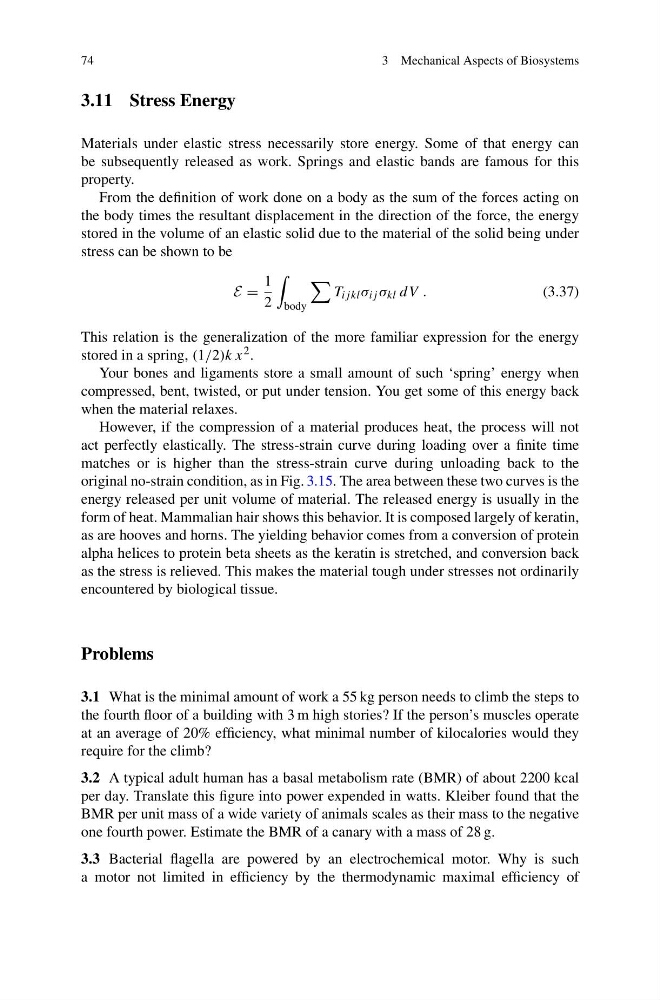
E =
1
2
body
T ij kl σ ij σ kl dV .
(3.37)
This relation is the generalization of the more familiar expression for the energy
stored in a spring, (1/2)k x 2 .
Your bones and ligaments store a small amount of such ‘spring’ energy when
compressed, bent, twisted, or put under tension. You get some of this energy back
when the material relaxes.
However, if the compression of a material produces heat, the process will not
act perfectly elastically. The stress-strain curve during loading over a finite time
matches or is higher than the stress-strain curve during unloading back to the
original no-strain condition, as in Fig. 3.15. The area between these two curves is the
energy released per unit volume of material. The released energy is usually in the
form of heat. Mammalian hair shows this behavior. It is composed largely of keratin,
as are hooves and horns. The yielding behavior comes from a conversion of protein
alpha helices to protein beta sheets as the keratin is stretched, and conversion back
as the stress is relieved. This makes the material tough under stresses not ordinarily
encountered by biological tissue.
Problems
3.1 What is the minimal amount of work a 55 kg person needs to climb the steps to
the fourth floor of a building with 3 m high stories? If the person’s muscles operate
at an average of 20% efficiency, what minimal number of kilocalories would they
require for the climb?
3.2 A typical adult human has a basal metabolism rate (BMR) of about 2200 kcal
per day. Translate this figure into power expended in watts. Kleiber found that the
BMR per unit mass of a wide variety of animals scales as their mass to the negative
one fourth power. Estimate the BMR of a canary with a mass of 28 g.
3.3 Bacterial flagella are powered by an electrochemical motor. Why is such
a motor not limited in efficiency by the thermodynamic maximal efficiency of
3 Mechanical Aspects of Biosystems
3.11 Stress Energy
Materials under elastic stress necessarily store energy. Some of that energy can
be subsequently released as work. Springs and elastic bands are famous for this
property.
From the definition of work done on a body as the sum of the forces acting on
the body times the resultant displacement in the direction of the force, the energy
stored in the volume of an elastic solid due to the material of the solid being under
stress can be shown to be
E =
1
2
body
T ij kl σ ij σ kl dV .
(3.37)
This relation is the generalization of the more familiar expression for the energy
stored in a spring, (1/2)k x 2 .
Your bones and ligaments store a small amount of such ‘spring’ energy when
compressed, bent, twisted, or put under tension. You get some of this energy back
when the material relaxes.
However, if the compression of a material produces heat, the process will not
act perfectly elastically. The stress-strain curve during loading over a finite time
matches or is higher than the stress-strain curve during unloading back to the
original no-strain condition, as in Fig. 3.15. The area between these two curves is the
energy released per unit volume of material. The released energy is usually in the
form of heat. Mammalian hair shows this behavior. It is composed largely of keratin,
as are hooves and horns. The yielding behavior comes from a conversion of protein
alpha helices to protein beta sheets as the keratin is stretched, and conversion back
as the stress is relieved. This makes the material tough under stresses not ordinarily
encountered by biological tissue.
Problems
3.1 What is the minimal amount of work a 55 kg person needs to climb the steps to
the fourth floor of a building with 3 m high stories? If the person’s muscles operate
at an average of 20% efficiency, what minimal number of kilocalories would they
require for the climb?
3.2 A typical adult human has a basal metabolism rate (BMR) of about 2200 kcal
per day. Translate this figure into power expended in watts. Kleiber found that the
BMR per unit mass of a wide variety of animals scales as their mass to the negative
one fourth power. Estimate the BMR of a canary with a mass of 28 g.
3.3 Bacterial flagella are powered by an electrochemical motor. Why is such
a motor not limited in efficiency by the thermodynamic maximal efficiency of