

3.7 Connection Between Stress and Strain
61
where l, w, h are the length, width, and height of a block of the material.
The constant Y is called ‘Young’s modulus’. The relative transverse contraction,
n P , is called the ‘Poisson ratio’. For an isotropic material, one can show that the
Poisson ratio must be less than 1/2, and that T xyxy = Y/(1 + n P ) and T xxyy =
Y n P /[(1 − 2n P )(1 + n P )]. The other components follow from symmetry.
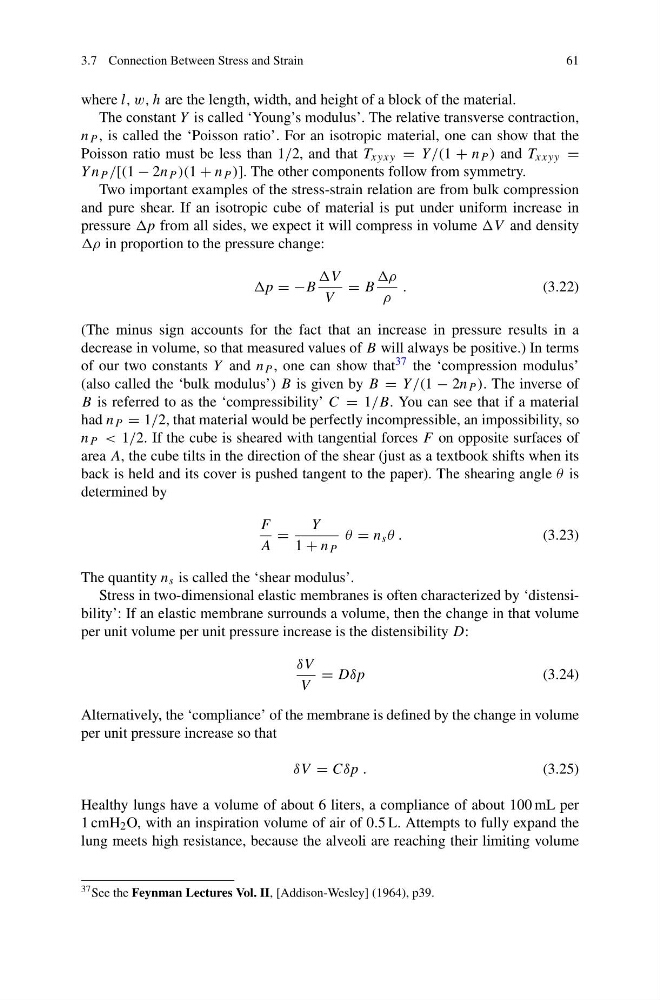
Two important examples of the stress-strain relation are from bulk compression
and pure shear. If an isotropic cube of material is put under uniform increase in
pressure p from all sides, we expect it will compress in volume V and density
ρ in proportion to the pressure change:
p = −B
V
V
= B
ρ
ρ
.
(3.22)
(The minus sign accounts for the fact that an increase in pressure results in a
decrease in volume, so that measured values of B will always be positive.) In terms
of our two constants Y and n P , one can show that 37 the ‘compression modulus’
(also called the ‘bulk modulus’) B is given by B = Y/(1 − 2n P ). The inverse of
B is referred to as the ‘compressibility’ C = 1/B. You can see that if a material
had n P = 1/2, that material would be perfectly incompressible, an impossibility, so
n P < 1/2. If the cube is sheared with tangential forces F on opposite surfaces of
area A, the cube tilts in the direction of the shear (just as a textbook shifts when its
back is held and its cover is pushed tangent to the paper). The shearing angle θ is
determined by
F
A
=
Y
1 + n P
θ = n s θ .
(3.23)
The quantity n s is called the ‘shear modulus’.
Stress in two-dimensional elastic membranes is often characterized by ‘distensibility’: If an elastic membrane surrounds a volume, then the change in that volume
per unit volume per unit pressure increase is the distensibility D:
δV
V
= Dδp
(3.24)
Alternatively, the ‘compliance’ of the membrane is defined by the change in volume
per unit pressure increase so that
δV = Cδp .
(3.25)
Healthy lungs have a volume of about 6 liters, a compliance of about 100 mL per
1 cmH 2 O, with an inspiration volume of air of 0.5 L. Attempts to fully expand the
lung meets high resistance, because the alveoli are reaching their limiting volume
37 See the Feynman Lectures Vol. II, [Addison-Wesley] (1964), p39.
61
where l, w, h are the length, width, and height of a block of the material.
The constant Y is called ‘Young’s modulus’. The relative transverse contraction,
n P , is called the ‘Poisson ratio’. For an isotropic material, one can show that the
Poisson ratio must be less than 1/2, and that T xyxy = Y/(1 + n P ) and T xxyy =
Y n P /[(1 − 2n P )(1 + n P )]. The other components follow from symmetry.
Two important examples of the stress-strain relation are from bulk compression
and pure shear. If an isotropic cube of material is put under uniform increase in
pressure p from all sides, we expect it will compress in volume V and density
ρ in proportion to the pressure change:
p = −B
V
V
= B
ρ
ρ
.
(3.22)
(The minus sign accounts for the fact that an increase in pressure results in a
decrease in volume, so that measured values of B will always be positive.) In terms
of our two constants Y and n P , one can show that 37 the ‘compression modulus’
(also called the ‘bulk modulus’) B is given by B = Y/(1 − 2n P ). The inverse of
B is referred to as the ‘compressibility’ C = 1/B. You can see that if a material
had n P = 1/2, that material would be perfectly incompressible, an impossibility, so
n P < 1/2. If the cube is sheared with tangential forces F on opposite surfaces of
area A, the cube tilts in the direction of the shear (just as a textbook shifts when its
back is held and its cover is pushed tangent to the paper). The shearing angle θ is
determined by
F
A
=
Y
1 + n P
θ = n s θ .
(3.23)
The quantity n s is called the ‘shear modulus’.
Stress in two-dimensional elastic membranes is often characterized by ‘distensibility’: If an elastic membrane surrounds a volume, then the change in that volume
per unit volume per unit pressure increase is the distensibility D:
δV
V
= Dδp
(3.24)
Alternatively, the ‘compliance’ of the membrane is defined by the change in volume
per unit pressure increase so that
δV = Cδp .
(3.25)
Healthy lungs have a volume of about 6 liters, a compliance of about 100 mL per
1 cmH 2 O, with an inspiration volume of air of 0.5 L. Attempts to fully expand the
lung meets high resistance, because the alveoli are reaching their limiting volume
37 See the Feynman Lectures Vol. II, [Addison-Wesley] (1964), p39.