

3.5 Response of Materials to Stress
57
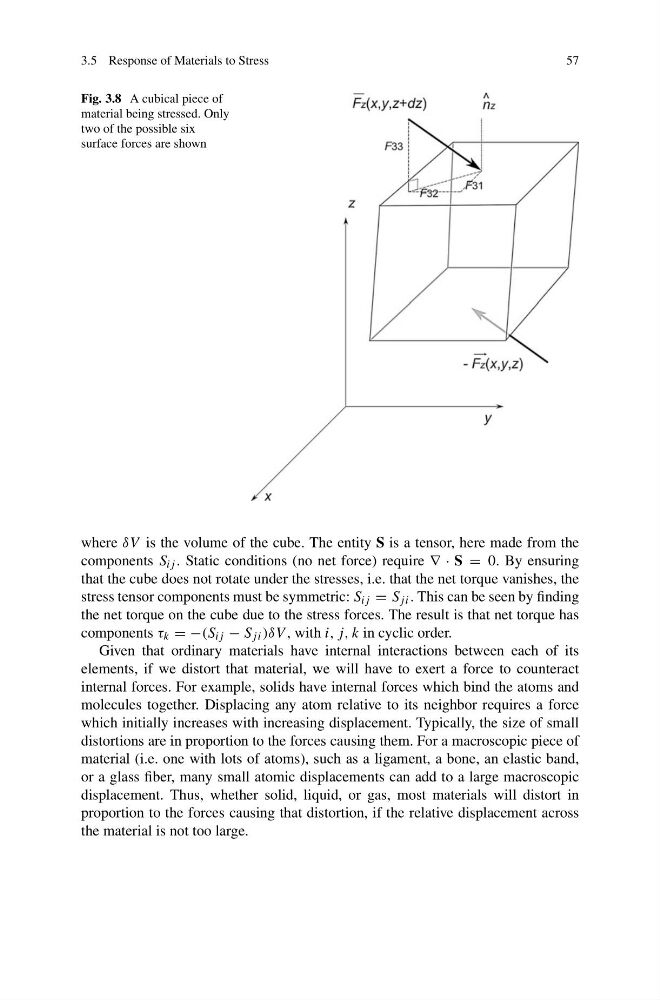
Fig. 3.8 A cubical piece of
material being stressed. Only
two of the possible six
surface forces are shown
where δV is the volume of the cube. The entity S is a tensor, here made from the
components S ij . Static conditions (no net force) require ∇ · S = 0. By ensuring
that the cube does not rotate under the stresses, i.e. that the net torque vanishes, the
stress tensor components must be symmetric: S ij = S ji . This can be seen by finding
the net torque on the cube due to the stress forces. The result is that net torque has
components τ k = −(S ij − S ji )δV , with i, j, k in cyclic order.
Given that ordinary materials have internal interactions between each of its
elements, if we distort that material, we will have to exert a force to counteract
internal forces. For example, solids have internal forces which bind the atoms and
molecules together. Displacing any atom relative to its neighbor requires a force
which initially increases with increasing displacement. Typically, the size of small
distortions are in proportion to the forces causing them. For a macroscopic piece of
material (i.e. one with lots of atoms), such as a ligament, a bone, an elastic band,
or a glass fiber, many small atomic displacements can add to a large macroscopic
displacement. Thus, whether solid, liquid, or gas, most materials will distort in
proportion to the forces causing that distortion, if the relative displacement across
the material is not too large.
57
Fig. 3.8 A cubical piece of
material being stressed. Only
two of the possible six
surface forces are shown
where δV is the volume of the cube. The entity S is a tensor, here made from the
components S ij . Static conditions (no net force) require ∇ · S = 0. By ensuring
that the cube does not rotate under the stresses, i.e. that the net torque vanishes, the
stress tensor components must be symmetric: S ij = S ji . This can be seen by finding
the net torque on the cube due to the stress forces. The result is that net torque has
components τ k = −(S ij − S ji )δV , with i, j, k in cyclic order.
Given that ordinary materials have internal interactions between each of its
elements, if we distort that material, we will have to exert a force to counteract
internal forces. For example, solids have internal forces which bind the atoms and
molecules together. Displacing any atom relative to its neighbor requires a force
which initially increases with increasing displacement. Typically, the size of small
distortions are in proportion to the forces causing them. For a macroscopic piece of
material (i.e. one with lots of atoms), such as a ligament, a bone, an elastic band,
or a glass fiber, many small atomic displacements can add to a large macroscopic
displacement. Thus, whether solid, liquid, or gas, most materials will distort in
proportion to the forces causing that distortion, if the relative displacement across
the material is not too large.