

E DNA Splitting by Radiation
651
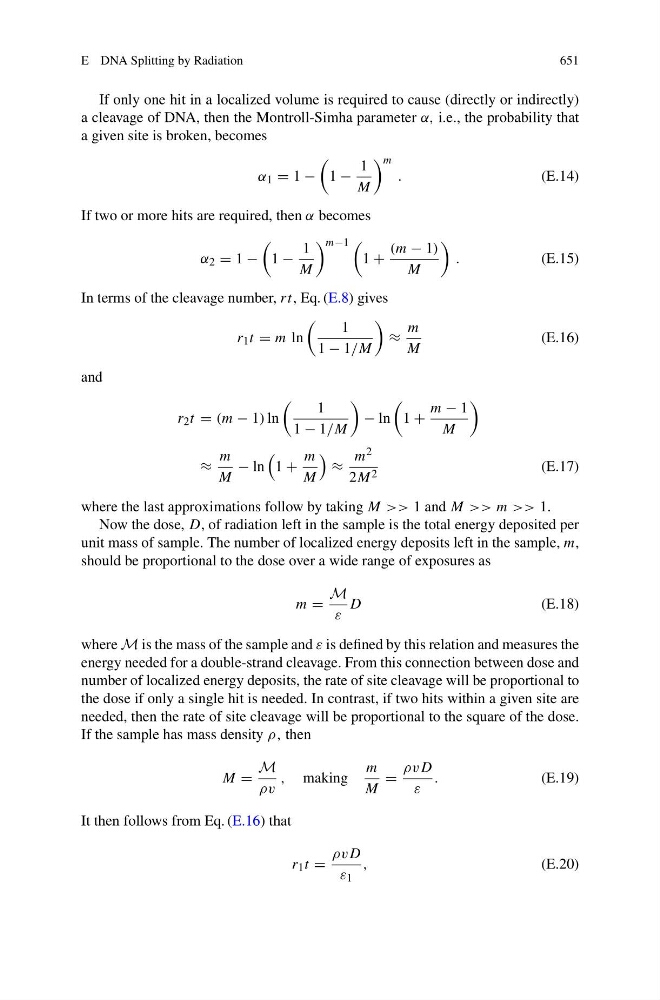
If only one hit in a localized volume is required to cause (directly or indirectly)
a cleavage of DNA, then the Montroll-Simha parameter α, i.e., the probability that
a given site is broken, becomes
α 1 = 1 −
1 −
1
M
m
.
(E.14)
If two or more hits are required, then α becomes
α 2 = 1 −
1 −
1
M
m−1
1 +
(m − 1)
M
.
(E.15)
In terms of the cleavage number, rt, Eq. (E.8) gives
r 1 t = m ln
1
1 − 1/M
≈
m
M
(E.16)
and
r 2 t = (m − 1) ln
1
1 − 1/M
− ln
1 +
m − 1
M
≈
m
M
− ln
1 +
m
M
≈
m 2
2M 2
(E.17)
where the last approximations follow by taking M >> 1 and M >> m >> 1.
Now the dose, D, of radiation left in the sample is the total energy deposited per
unit mass of sample. The number of localized energy deposits left in the sample, m,
should be proportional to the dose over a wide range of exposures as
m =
M
ε
D
(E.18)
where M is the mass of the sample and ε is defined by this relation and measures the
energy needed for a double-strand cleavage. From this connection between dose and
number of localized energy deposits, the rate of site cleavage will be proportional to
the dose if only a single hit is needed. In contrast, if two hits within a given site are
needed, then the rate of site cleavage will be proportional to the square of the dose.
If the sample has mass density ρ, then
M =
M
ρv
, making
m
M
=
ρvD
ε
.
(E.19)
It then follows from Eq. (E.16) that
r 1 t =
ρvD
ε 1
,
(E.20)