

642
D Bubbles
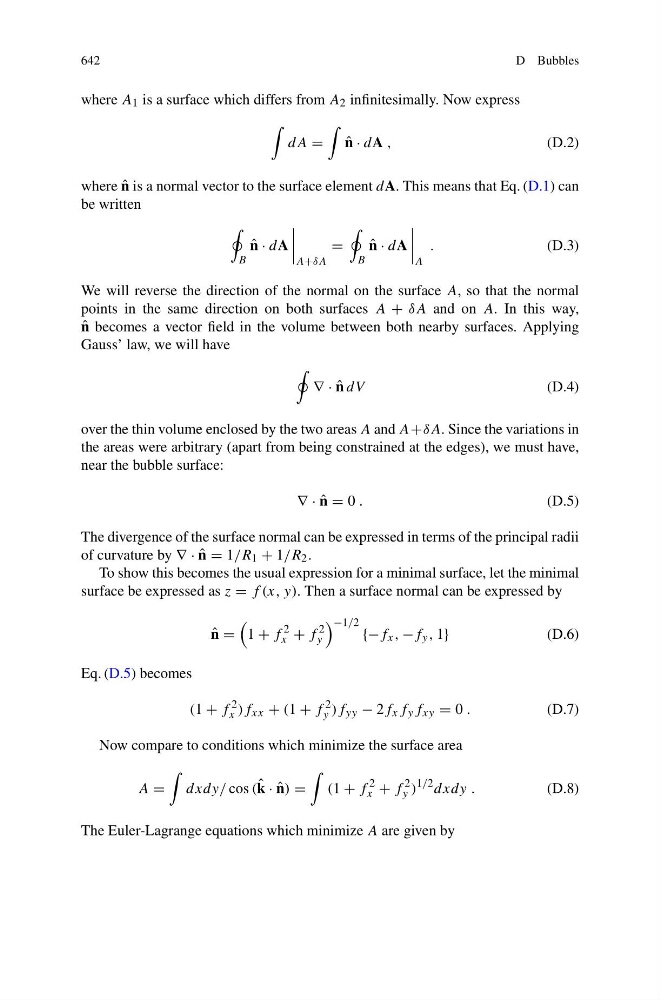
where A 1 is a surface which differs from A 2 infinitesimally. Now express
dA =
ˆ
n · dA ,
(D.2)
where ˆ
n is a normal vector to the surface element dA. This means that Eq. (D.1) can
be written
B
ˆ
n · dA
A+δA
=
B
ˆ
n · dA
A
.
(D.3)
We will reverse the direction of the normal on the surface A, so that the normal
points in the same direction on both surfaces A + δA and on A. In this way,
ˆ
n becomes a vector field in the volume between both nearby surfaces. Applying
Gauss’ law, we will have
∇ · ˆ
n dV
(D.4)
over the thin volume enclosed by the two areas A and A+δA. Since the variations in
the areas were arbitrary (apart from being constrained at the edges), we must have,
near the bubble surface:
∇ · ˆ
n = 0 .
(D.5)
The divergence of the surface normal can be expressed in terms of the principal radii
of curvature by ∇ · ˆ
n = 1/R 1 + 1/R 2 .
To show this becomes the usual expression for a minimal surface, let the minimal
surface be expressed as z = f (x, y). Then a surface normal can be expressed by
ˆ
n =
1 + f
2
x + f
2
y
−1/2 {−f x , −f y , 1}
(D.6)
Eq. (D.5) becomes
(1 + f
2
x )f xx + (1 + f
2
y )f yy − 2f x f y f xy = 0 .
(D.7)
Now compare to conditions which minimize the surface area
A =
dxdy/ cos ( ˆ
k · ˆ
n) =
(1 + f
2
x + f
2
y )
1/2 dxdy .
(D.8)
The Euler-Lagrange equations which minimize A are given by