

636
C Holography
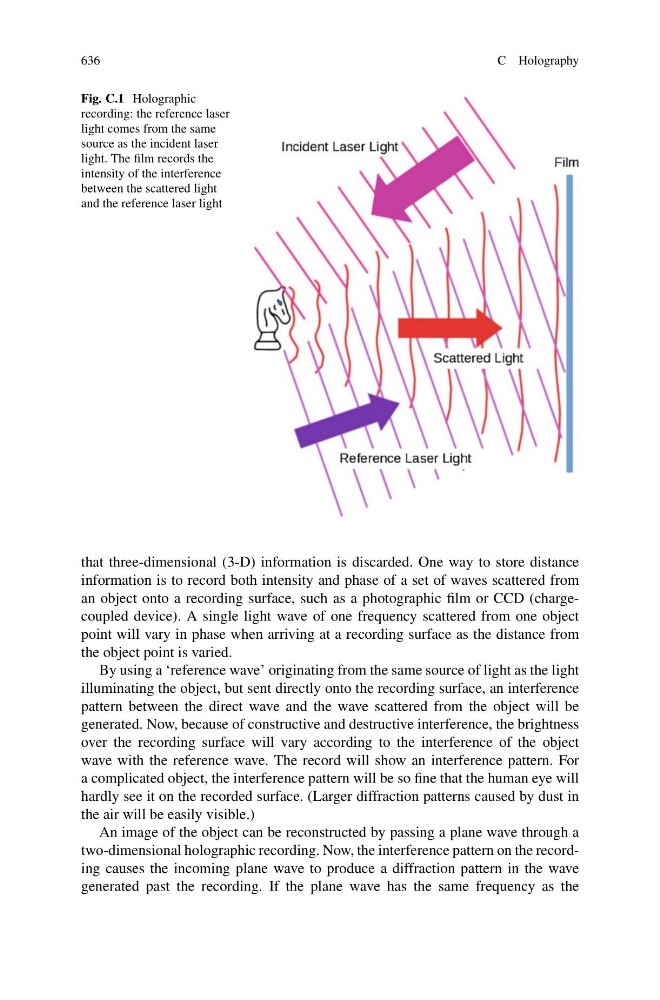
Fig. C.1 Holographic
recording: the reference laser
light comes from the same
source as the incident laser
light. The film records the
intensity of the interference
between the scattered light
and the reference laser light
that three-dimensional (3-D) information is discarded. One way to store distance
information is to record both intensity and phase of a set of waves scattered from
an object onto a recording surface, such as a photographic film or CCD (chargecoupled device). A single light wave of one frequency scattered from one object
point will vary in phase when arriving at a recording surface as the distance from
the object point is varied.
By using a ‘reference wave’ originating from the same source of light as the light
illuminating the object, but sent directly onto the recording surface, an interference
pattern between the direct wave and the wave scattered from the object will be
generated. Now, because of constructive and destructive interference, the brightness
over the recording surface will vary according to the interference of the object
wave with the reference wave. The record will show an interference pattern. For
a complicated object, the interference pattern will be so fine that the human eye will
hardly see it on the recorded surface. (Larger diffraction patterns caused by dust in
the air will be easily visible.)
An image of the object can be reconstructed by passing a plane wave through a
two-dimensional holographic recording. Now, the interference pattern on the recording causes the incoming plane wave to produce a diffraction pattern in the wave
generated past the recording. If the plane wave has the same frequency as the