

17.3 Self-stabilizing Life Systems
617
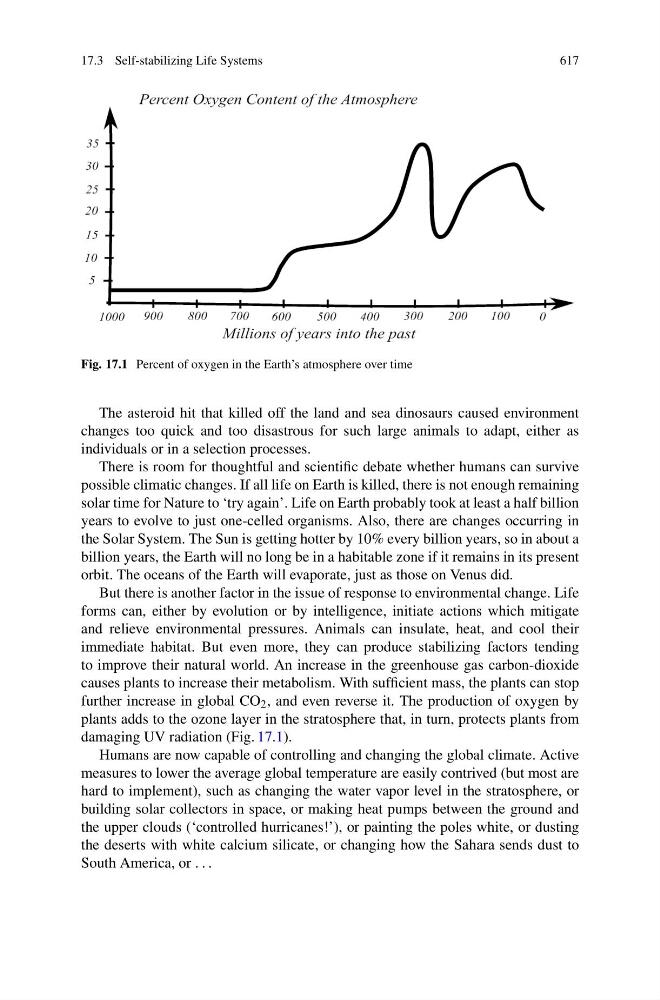
Fig. 17.1 Percent of oxygen in the Earth’s atmosphere over time
The asteroid hit that killed off the land and sea dinosaurs caused environment
changes too quick and too disastrous for such large animals to adapt, either as
individuals or in a selection processes.
There is room for thoughtful and scientific debate whether humans can survive
possible climatic changes. If all life on Earth is killed, there is not enough remaining
solar time for Nature to ‘try again’. Life on Earth probably took at least a half billion
years to evolve to just one-celled organisms. Also, there are changes occurring in
the Solar System. The Sun is getting hotter by 10% every billion years, so in about a
billion years, the Earth will no long be in a habitable zone if it remains in its present
orbit. The oceans of the Earth will evaporate, just as those on Venus did.
But there is another factor in the issue of response to environmental change. Life
forms can, either by evolution or by intelligence, initiate actions which mitigate
and relieve environmental pressures. Animals can insulate, heat, and cool their
immediate habitat. But even more, they can produce stabilizing factors tending
to improve their natural world. An increase in the greenhouse gas carbon-dioxide
causes plants to increase their metabolism. With sufficient mass, the plants can stop
further increase in global CO 2 , and even reverse it. The production of oxygen by
plants adds to the ozone layer in the stratosphere that, in turn, protects plants from
damaging UV radiation (Fig. 17.1).
Humans are now capable of controlling and changing the global climate. Active
measures to lower the average global temperature are easily contrived (but most are
hard to implement), such as changing the water vapor level in the stratosphere, or
building solar collectors in space, or making heat pumps between the ground and
the upper clouds (‘controlled hurricanes!’), or painting the poles white, or dusting
the deserts with white calcium silicate, or changing how the Sahara sends dust to
South America, or . . .