

604
15 Ordering Theory
Amplitude
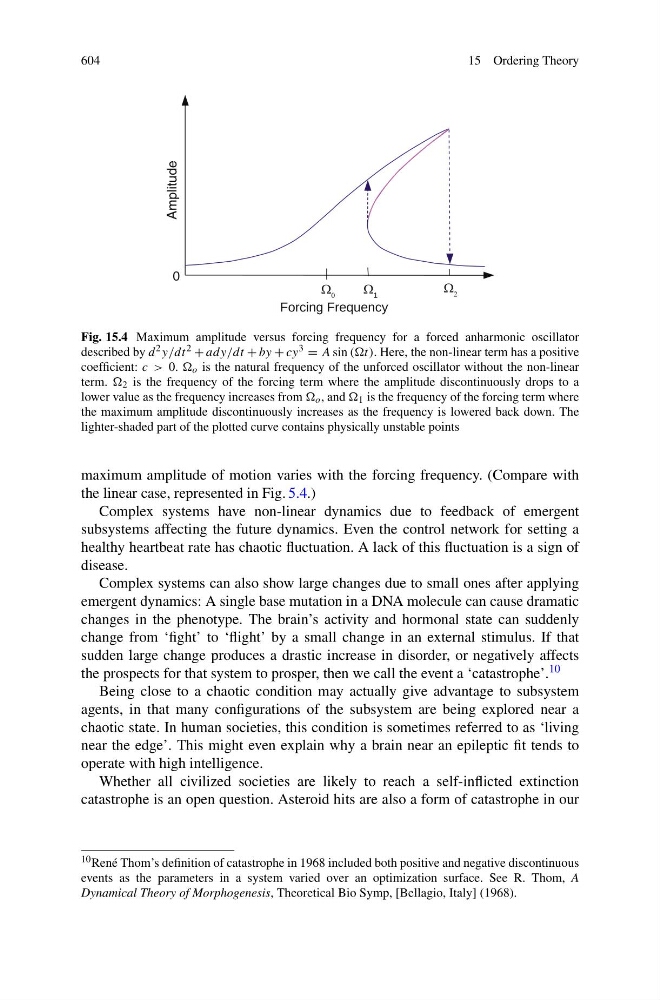
Fig. 15.4 Maximum amplitude versus forcing frequency for a forced anharmonic oscillator
described by d 2 y/dt 2 + ady/dt + by + cy 3 = A sin ((t). Here, the non-linear term has a positive
coefficient: c > 0. o is the natural frequency of the unforced oscillator without the non-linear
term. 2 is the frequency of the forcing term where the amplitude discontinuously drops to a
lower value as the frequency increases from o , and 1 is the frequency of the forcing term where
the maximum amplitude discontinuously increases as the frequency is lowered back down. The
lighter-shaded part of the plotted curve contains physically unstable points
maximum amplitude of motion varies with the forcing frequency. (Compare with
the linear case, represented in Fig. 5.4.)
Complex systems have non-linear dynamics due to feedback of emergent
subsystems affecting the future dynamics. Even the control network for setting a
healthy heartbeat rate has chaotic fluctuation. A lack of this fluctuation is a sign of
disease.
Complex systems can also show large changes due to small ones after applying
emergent dynamics: A single base mutation in a DNA molecule can cause dramatic
changes in the phenotype. The brain’s activity and hormonal state can suddenly
change from ‘fight’ to ‘flight’ by a small change in an external stimulus. If that
sudden large change produces a drastic increase in disorder, or negatively affects
the prospects for that system to prosper, then we call the event a ‘catastrophe’. 10
Being close to a chaotic condition may actually give advantage to subsystem
agents, in that many configurations of the subsystem are being explored near a
chaotic state. In human societies, this condition is sometimes referred to as ‘living
near the edge’. This might even explain why a brain near an epileptic fit tends to
operate with high intelligence.
Whether all civilized societies are likely to reach a self-inflicted extinction
catastrophe is an open question. Asteroid hits are also a form of catastrophe in our
10 René Thom’s definition of catastrophe in 1968 included both positive and negative discontinuous
events as the parameters in a system varied over an optimization surface. See R. Thom, A
Dynamical Theory of Morphogenesis, Theoretical Bio Symp, [Bellagio, Italy] (1968).