

3.3 Accelerated Motion and Life
45
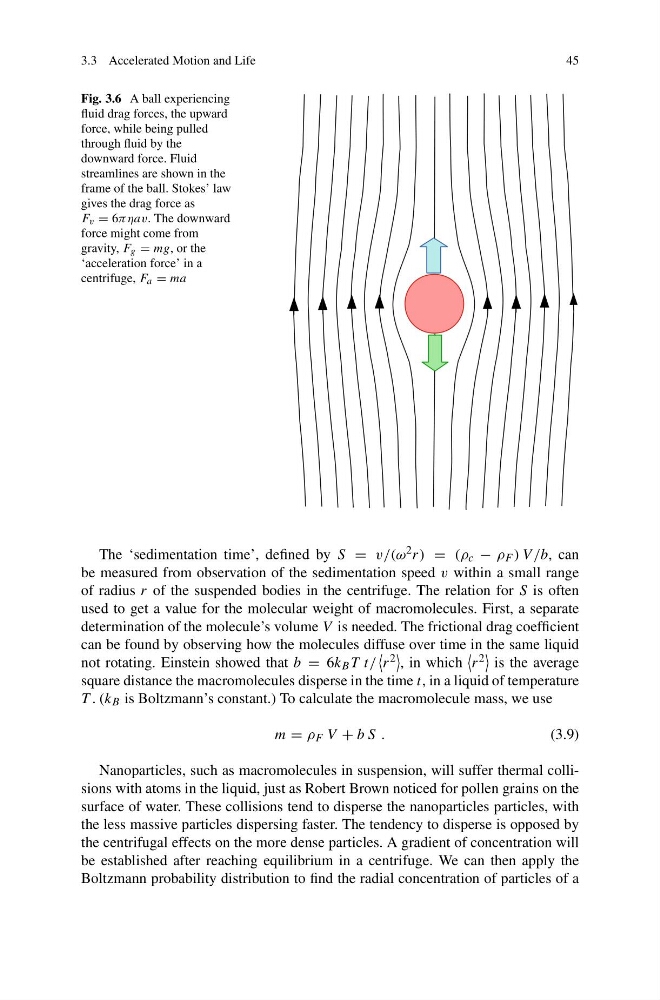
Fig. 3.6 A ball experiencing
fluid drag forces, the upward
force, while being pulled
through fluid by the
downward force. Fluid
streamlines are shown in the
frame of the ball. Stokes’ law
gives the drag force as
F v = 6πηav. The downward
force might come from
gravity, F g = mg, or the
‘acceleration force’ in a
centrifuge, F a = ma
The ‘sedimentation time’, defined by S = v/(ω 2 r) = (ρ c − ρ F ) V /b, can
be measured from observation of the sedimentation speed v within a small range
of radius r of the suspended bodies in the centrifuge. The relation for S is often
used to get a value for the molecular weight of macromolecules. First, a separate
determination of the molecule’s volume V is needed. The frictional drag coefficient
can be found by observing how the molecules diffuse over time in the same liquid
not rotating. Einstein showed that b = 6k B T t/
r 2
, in which
r 2
is the average
square distance the macromolecules disperse in the time t, in a liquid of temperature
T . (k B is Boltzmann’s constant.) To calculate the macromolecule mass, we use
m = ρ F V + b S .
(3.9)
Nanoparticles, such as macromolecules in suspension, will suffer thermal collisions with atoms in the liquid, just as Robert Brown noticed for pollen grains on the
surface of water. These collisions tend to disperse the nanoparticles particles, with
the less massive particles dispersing faster. The tendency to disperse is opposed by
the centrifugal effects on the more dense particles. A gradient of concentration will
be established after reaching equilibrium in a centrifuge. We can then apply the
Boltzmann probability distribution to find the radial concentration of particles of a
45
Fig. 3.6 A ball experiencing
fluid drag forces, the upward
force, while being pulled
through fluid by the
downward force. Fluid
streamlines are shown in the
frame of the ball. Stokes’ law
gives the drag force as
F v = 6πηav. The downward
force might come from
gravity, F g = mg, or the
‘acceleration force’ in a
centrifuge, F a = ma
The ‘sedimentation time’, defined by S = v/(ω 2 r) = (ρ c − ρ F ) V /b, can
be measured from observation of the sedimentation speed v within a small range
of radius r of the suspended bodies in the centrifuge. The relation for S is often
used to get a value for the molecular weight of macromolecules. First, a separate
determination of the molecule’s volume V is needed. The frictional drag coefficient
can be found by observing how the molecules diffuse over time in the same liquid
not rotating. Einstein showed that b = 6k B T t/
r 2
, in which
r 2
is the average
square distance the macromolecules disperse in the time t, in a liquid of temperature
T . (k B is Boltzmann’s constant.) To calculate the macromolecule mass, we use
m = ρ F V + b S .
(3.9)
Nanoparticles, such as macromolecules in suspension, will suffer thermal collisions with atoms in the liquid, just as Robert Brown noticed for pollen grains on the
surface of water. These collisions tend to disperse the nanoparticles particles, with
the less massive particles dispersing faster. The tendency to disperse is opposed by
the centrifugal effects on the more dense particles. A gradient of concentration will
be established after reaching equilibrium in a centrifuge. We can then apply the
Boltzmann probability distribution to find the radial concentration of particles of a