

Problems
575
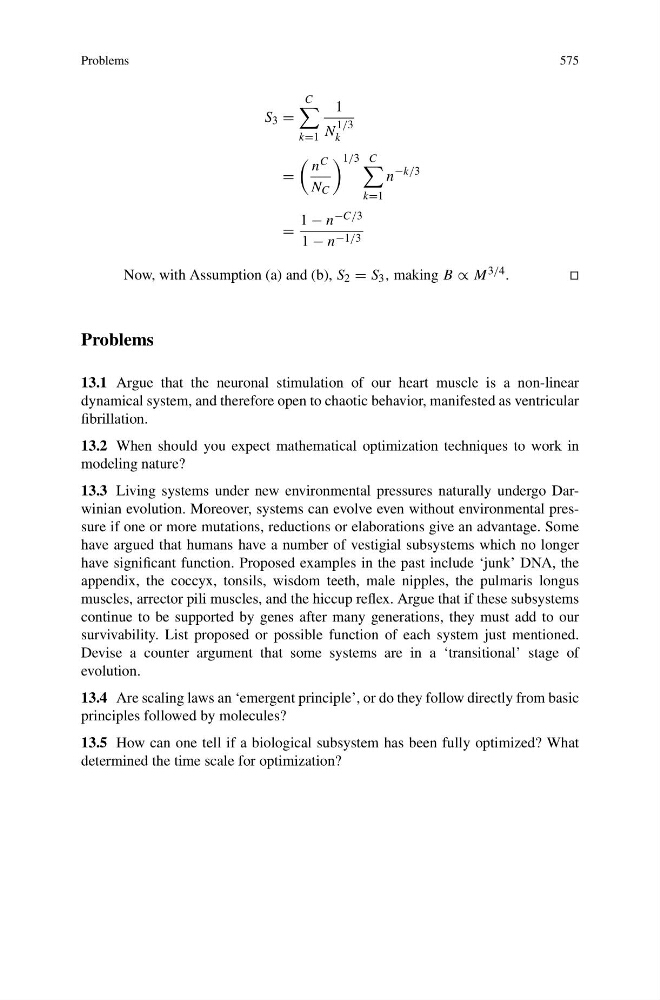
S 3 =
C
k=1
1
N
1/3
k
=
n C
N C
1/3 C
k=1
n
−k/3
=
1 − n −C/3
1 − n −1/3
Now, with Assumption (a) and (b), S 2 = S 3 , making B ∝ M 3/4 .
Problems
13.1 Argue that the neuronal stimulation of our heart muscle is a non-linear
dynamical system, and therefore open to chaotic behavior, manifested as ventricular
fibrillation.
13.2 When should you expect mathematical optimization techniques to work in
modeling nature?
13.3 Living systems under new environmental pressures naturally undergo Darwinian evolution. Moreover, systems can evolve even without environmental pressure if one or more mutations, reductions or elaborations give an advantage. Some
have argued that humans have a number of vestigial subsystems which no longer
have significant function. Proposed examples in the past include ‘junk’ DNA, the
appendix, the coccyx, tonsils, wisdom teeth, male nipples, the pulmaris longus
muscles, arrector pili muscles, and the hiccup reflex. Argue that if these subsystems
continue to be supported by genes after many generations, they must add to our
survivability. List proposed or possible function of each system just mentioned.
Devise a counter argument that some systems are in a ‘transitional’ stage of
evolution.
13.4 Are scaling laws an ‘emergent principle’, or do they follow directly from basic
principles followed by molecules?
13.5 How can one tell if a biological subsystem has been fully optimized? What
determined the time scale for optimization?