

42
3 Mechanical Aspects of Biosystems
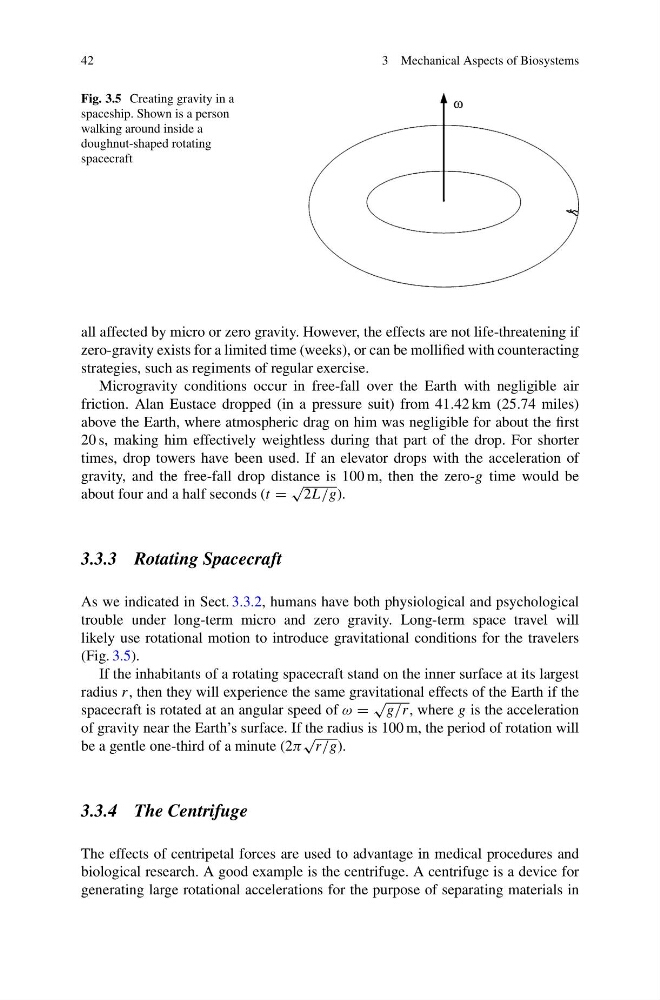
Fig. 3.5 Creating gravity in a
spaceship. Shown is a person
walking around inside a
doughnut-shaped rotating
spacecraft
all affected by micro or zero gravity. However, the effects are not life-threatening if
zero-gravity exists for a limited time (weeks), or can be mollified with counteracting
strategies, such as regiments of regular exercise.
Microgravity conditions occur in free-fall over the Earth with negligible air
friction. Alan Eustace dropped (in a pressure suit) from 41.42 km (25.74 miles)
above the Earth, where atmospheric drag on him was negligible for about the first
20 s, making him effectively weightless during that part of the drop. For shorter
times, drop towers have been used. If an elevator drops with the acceleration of
gravity, and the free-fall drop distance is 100 m, then the zero-g time would be
about four and a half seconds (t =
√
2L/g).
3.3.3 Rotating Spacecraft
As we indicated in Sect. 3.3.2, humans have both physiological and psychological
trouble under long-term micro and zero gravity. Long-term space travel will
likely use rotational motion to introduce gravitational conditions for the travelers
(Fig. 3.5).
If the inhabitants of a rotating spacecraft stand on the inner surface at its largest
radius r, then they will experience the same gravitational effects of the Earth if the
spacecraft is rotated at an angular speed of ω =
√
g/r, where g is the acceleration
of gravity near the Earth’s surface. If the radius is 100 m, the period of rotation will
be a gentle one-third of a minute (2π
√
r/g).
3.3.4 The Centrifuge
The effects of centripetal forces are used to advantage in medical procedures and
biological research. A good example is the centrifuge. A centrifuge is a device for
generating large rotational accelerations for the purpose of separating materials in
3 Mechanical Aspects of Biosystems
Fig. 3.5 Creating gravity in a
spaceship. Shown is a person
walking around inside a
doughnut-shaped rotating
spacecraft
all affected by micro or zero gravity. However, the effects are not life-threatening if
zero-gravity exists for a limited time (weeks), or can be mollified with counteracting
strategies, such as regiments of regular exercise.
Microgravity conditions occur in free-fall over the Earth with negligible air
friction. Alan Eustace dropped (in a pressure suit) from 41.42 km (25.74 miles)
above the Earth, where atmospheric drag on him was negligible for about the first
20 s, making him effectively weightless during that part of the drop. For shorter
times, drop towers have been used. If an elevator drops with the acceleration of
gravity, and the free-fall drop distance is 100 m, then the zero-g time would be
about four and a half seconds (t =
√
2L/g).
3.3.3 Rotating Spacecraft
As we indicated in Sect. 3.3.2, humans have both physiological and psychological
trouble under long-term micro and zero gravity. Long-term space travel will
likely use rotational motion to introduce gravitational conditions for the travelers
(Fig. 3.5).
If the inhabitants of a rotating spacecraft stand on the inner surface at its largest
radius r, then they will experience the same gravitational effects of the Earth if the
spacecraft is rotated at an angular speed of ω =
√
g/r, where g is the acceleration
of gravity near the Earth’s surface. If the radius is 100 m, the period of rotation will
be a gentle one-third of a minute (2π
√
r/g).
3.3.4 The Centrifuge
The effects of centripetal forces are used to advantage in medical procedures and
biological research. A good example is the centrifuge. A centrifuge is a device for
generating large rotational accelerations for the purpose of separating materials in