

13.2 Growth in a Population and Chaos Theory
559
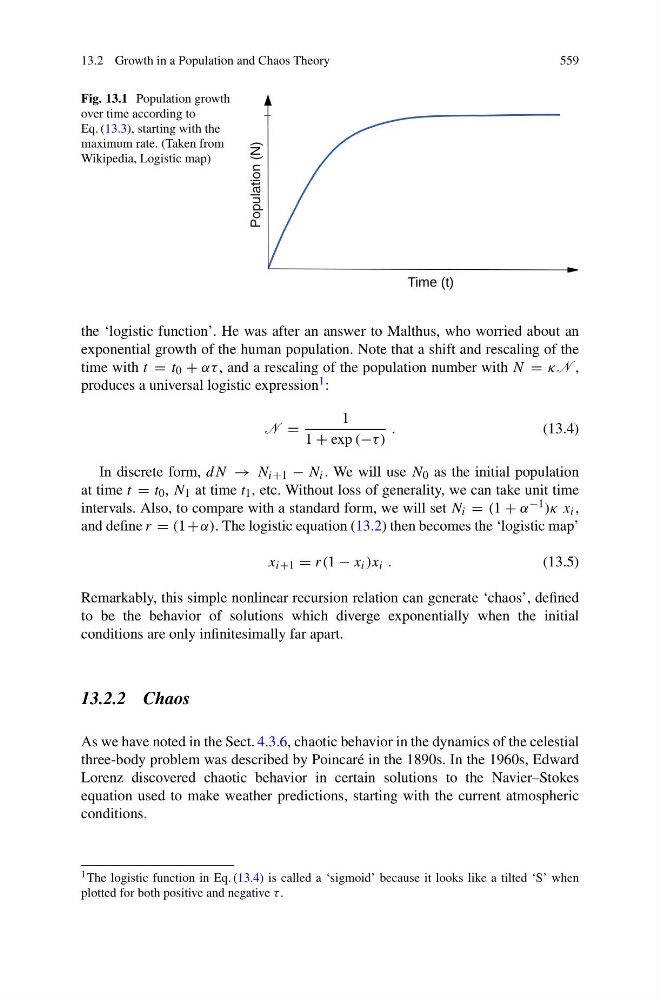
Fig. 13.1 Population growth
over time according to
Eq. (13.3), starting with the
maximum rate. (Taken from
Wikipedia, Logistic map)
Population (N)
the ‘logistic function’. He was after an answer to Malthus, who worried about an
exponential growth of the human population. Note that a shift and rescaling of the
time with t = t 0 + ατ , and a rescaling of the population number with N = κN ,
produces a universal logistic expression 1 :
N =
1
1 + exp (−τ )
.
(13.4)
In discrete form, dN → N i+1 − N i . We will use N 0 as the initial population
at time t = t 0 , N 1 at time t 1 , etc. Without loss of generality, we can take unit time
intervals. Also, to compare with a standard form, we will set N i = (1 + α −1 )κ x i ,
and define r = (1+α). The logistic equation (13.2) then becomes the ‘logistic map’
x i+1 = r(1 − x i )x i .
(13.5)
Remarkably, this simple nonlinear recursion relation can generate ‘chaos’, defined
to be the behavior of solutions which diverge exponentially when the initial
conditions are only infinitesimally far apart.
13.2.2 Chaos
As we have noted in the Sect. 4.3.6, chaotic behavior in the dynamics of the celestial
three-body problem was described by Poincaré in the 1890s. In the 1960s, Edward
Lorenz discovered chaotic behavior in certain solutions to the Navier–Stokes
equation used to make weather predictions, starting with the current atmospheric
conditions.
1 The logistic function in Eq. (13.4) is called a ‘sigmoid’ because it looks like a tilted ‘S’ when
plotted for both positive and negative τ .