

526
11 Biomolecular Structure and Interactions
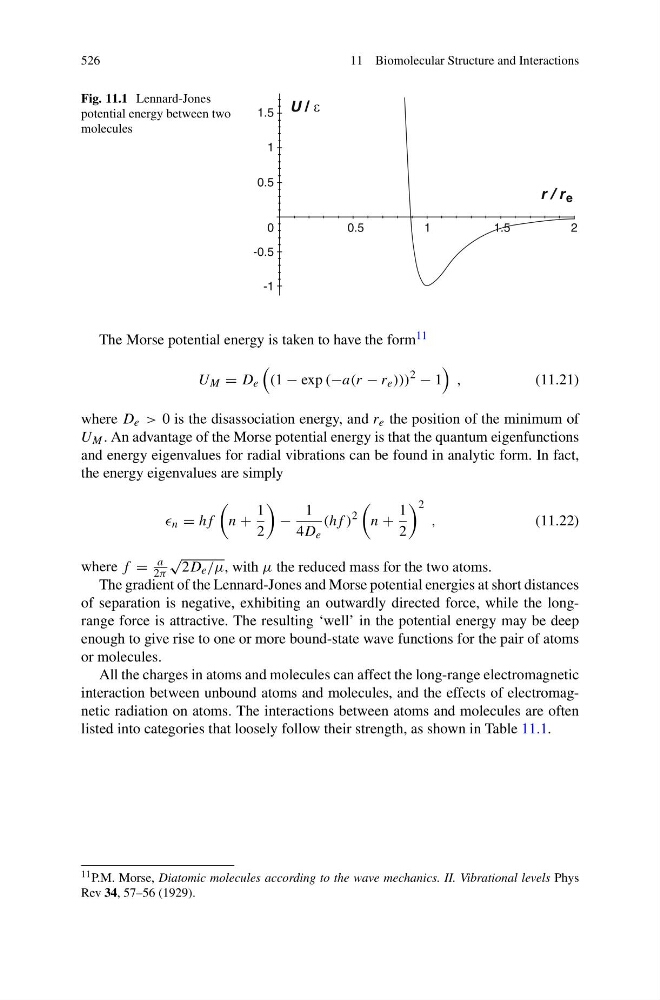
Fig. 11.1 Lennard-Jones
potential energy between two
molecules
1.5
0.5
-0.5
-1
0
0.5
1
1.5
2
r / r e
U / ε
1
The Morse potential energy is taken to have the form 11
U M = D e
(1 − exp (−a(r − r e )))
2
− 1
,
(11.21)
where D e > 0 is the disassociation energy, and r e the position of the minimum of
U M . An advantage of the Morse potential energy is that the quantum eigenfunctions
and energy eigenvalues for radial vibrations can be found in analytic form. In fact,
the energy eigenvalues are simply
n = hf
n +
1
2
−
1
4D e
(hf )
2
n +
1
2
2
,
(11.22)
where f =
a
2π
√
2D e /μ, with μ the reduced mass for the two atoms.
The gradient of the Lennard-Jones and Morse potential energies at short distances
of separation is negative, exhibiting an outwardly directed force, while the longrange force is attractive. The resulting ‘well’ in the potential energy may be deep
enough to give rise to one or more bound-state wave functions for the pair of atoms
or molecules.
All the charges in atoms and molecules can affect the long-range electromagnetic
interaction between unbound atoms and molecules, and the effects of electromagnetic radiation on atoms. The interactions between atoms and molecules are often
listed into categories that loosely follow their strength, as shown in Table 11.1.
11 P.M. Morse, Diatomic molecules according to the wave mechanics. II. Vibrational levels Phys
Rev 34, 57–56 (1929).