

502
10 The Statistical Basis of Bioenergetics
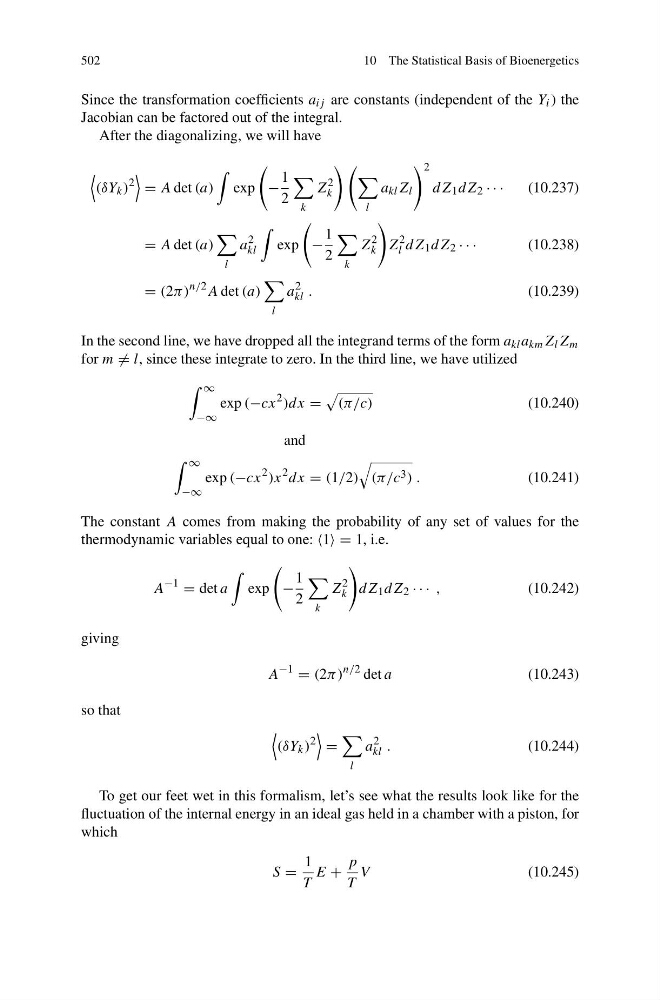
Since the transformation coefficients a ij are constants (independent of the Y i ) the
Jacobian can be factored out of the integral.
After the diagonalizing, we will have
(δY k )
2
= A det (a)
exp
−
1
2
k
Z
2
k
l
a kl Z l
2
dZ 1 dZ 2 · · ·
(10.237)
= A det (a)
l
a
2
kl
exp
−
1
2
k
Z
2
k
Z
2
l dZ 1 dZ 2 · · ·
(10.238)
= (2π)
n/2 A det (a)
l
a
2
kl .
(10.239)
In the second line, we have dropped all the integrand terms of the form a kl a km Z l Z m
for m = l, since these integrate to zero. In the third line, we have utilized
∞
−∞
exp (−cx
2 )dx =
(π/c)
(10.240)
and
∞
−∞
exp (−cx
2 )x
2 dx = (1/2)
(π/c 3 ) .
(10.241)
The constant A comes from making the probability of any set of values for the
thermodynamic variables equal to one: 1 = 1, i.e.
A
−1
= det a
exp
−
1
2
k
Z
2
k
dZ 1 dZ 2 · · · ,
(10.242)
giving
A
−1
= (2π)
n/2 det a
(10.243)
so that
(δY k )
2
=
l
a
2
kl .
(10.244)
To get our feet wet in this formalism, let’s see what the results look like for the
fluctuation of the internal energy in an ideal gas held in a chamber with a piston, for
which
S =
1
T
E +
p
T
V
(10.245)
10 The Statistical Basis of Bioenergetics
Since the transformation coefficients a ij are constants (independent of the Y i ) the
Jacobian can be factored out of the integral.
After the diagonalizing, we will have
(δY k )
2
= A det (a)
exp
−
1
2
k
Z
2
k
l
a kl Z l
2
dZ 1 dZ 2 · · ·
(10.237)
= A det (a)
l
a
2
kl
exp
−
1
2
k
Z
2
k
Z
2
l dZ 1 dZ 2 · · ·
(10.238)
= (2π)
n/2 A det (a)
l
a
2
kl .
(10.239)
In the second line, we have dropped all the integrand terms of the form a kl a km Z l Z m
for m = l, since these integrate to zero. In the third line, we have utilized
∞
−∞
exp (−cx
2 )dx =
(π/c)
(10.240)
and
∞
−∞
exp (−cx
2 )x
2 dx = (1/2)
(π/c 3 ) .
(10.241)
The constant A comes from making the probability of any set of values for the
thermodynamic variables equal to one: 1 = 1, i.e.
A
−1
= det a
exp
−
1
2
k
Z
2
k
dZ 1 dZ 2 · · · ,
(10.242)
giving
A
−1
= (2π)
n/2 det a
(10.243)
so that
(δY k )
2
=
l
a
2
kl .
(10.244)
To get our feet wet in this formalism, let’s see what the results look like for the
fluctuation of the internal energy in an ideal gas held in a chamber with a piston, for
which
S =
1
T
E +
p
T
V
(10.245)