

458
10 The Statistical Basis of Bioenergetics
E ≡ E = Tr [ ˆ
H ˆ
ρ ] ,
(10.84)
where ˆ
H is the Hamiltonian operator for the system. 35 The ‘Tr’ performs a trace,
i.e., the sum of the diagonal elements of the matrix on which Tr acts.
From Eq. (10.82),
Tr[ρ ] =
k
P k = 1 .
(10.85)
The quantum expression for the entropy of a system as a member of an ensemble
is given by 36
S = −k B Tr[ ˆ
ρ ln ˆ
ρ ] = −k B
P k ln P k
(10.86)
the latter being of the same form as the expression Eq. (10.81). However, Eq. (10.81)
gives the entropy of N occurrences of the independent particles in a system, while
Eq. (10.86) applies to any system whose possible microstates are known, and the
probabilities for each microstate have been discovered.
Underlying Assumption Made by Gibbs
Gibbs argued that for most systems at or near equilibrium, averages of system
variables over the ensemble well-approximates averages for a single system if taken
over sufficiently long times. This is a form of the ergodic hypothesis.
Choices for Ensemble Conditions
Various conditions can be imposed on a Gibbs ensemble, with the choice depending
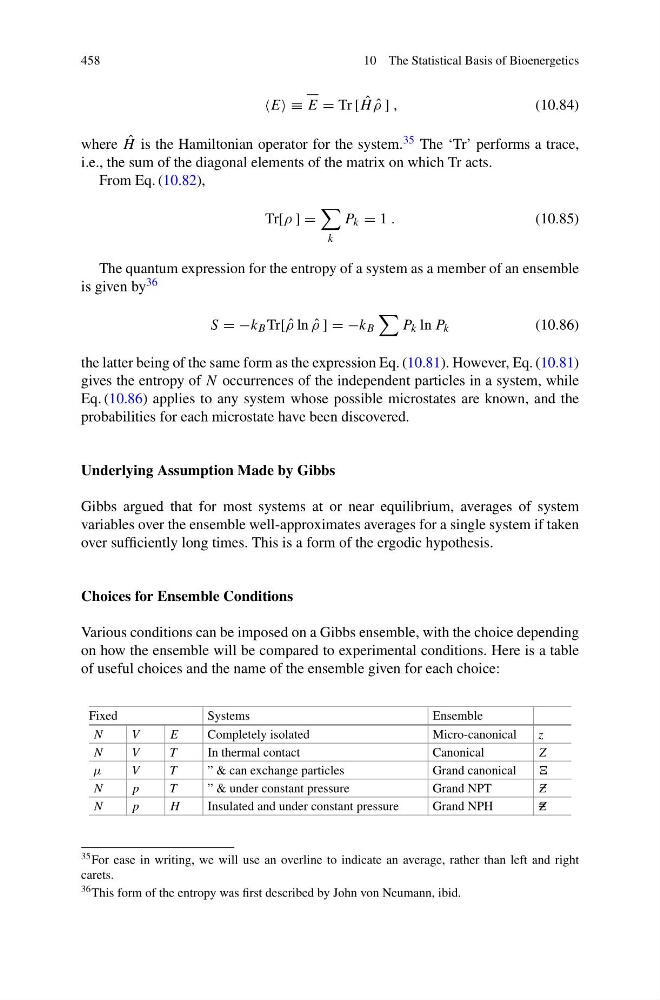
on how the ensemble will be compared to experimental conditions. Here is a table
of useful choices and the name of the ensemble given for each choice:
Fixed
Systems
Ensemble
N
V
E
Completely isolated
Micro-canonical
z
N
V
T
In thermal contact
Canonical
Z
μ
V
T
” & can exchange particles
Grand canonical
N
p
T
” & under constant pressure
Grand NPT
Z –
N
p
H
Insulated and under constant pressure
Grand NPH
Z =
35 For ease in writing, we will use an overline to indicate an average, rather than left and right
carets.
36 This form of the entropy was first described by John von Neumann, ibid.
10 The Statistical Basis of Bioenergetics
E ≡ E = Tr [ ˆ
H ˆ
ρ ] ,
(10.84)
where ˆ
H is the Hamiltonian operator for the system. 35 The ‘Tr’ performs a trace,
i.e., the sum of the diagonal elements of the matrix on which Tr acts.
From Eq. (10.82),
Tr[ρ ] =
k
P k = 1 .
(10.85)
The quantum expression for the entropy of a system as a member of an ensemble
is given by 36
S = −k B Tr[ ˆ
ρ ln ˆ
ρ ] = −k B
P k ln P k
(10.86)
the latter being of the same form as the expression Eq. (10.81). However, Eq. (10.81)
gives the entropy of N occurrences of the independent particles in a system, while
Eq. (10.86) applies to any system whose possible microstates are known, and the
probabilities for each microstate have been discovered.
Underlying Assumption Made by Gibbs
Gibbs argued that for most systems at or near equilibrium, averages of system
variables over the ensemble well-approximates averages for a single system if taken
over sufficiently long times. This is a form of the ergodic hypothesis.
Choices for Ensemble Conditions
Various conditions can be imposed on a Gibbs ensemble, with the choice depending
on how the ensemble will be compared to experimental conditions. Here is a table
of useful choices and the name of the ensemble given for each choice:
Fixed
Systems
Ensemble
N
V
E
Completely isolated
Micro-canonical
z
N
V
T
In thermal contact
Canonical
Z
μ
V
T
” & can exchange particles
Grand canonical
N
p
T
” & under constant pressure
Grand NPT
Z –
N
p
H
Insulated and under constant pressure
Grand NPH
Z =
35 For ease in writing, we will use an overline to indicate an average, rather than left and right
carets.
36 This form of the entropy was first described by John von Neumann, ibid.