

452
10 The Statistical Basis of Bioenergetics
z rot = (1 + 5)
L even
(2L + 1)e
−bL(L+1)
+ 3
L odd
(2L + 1)e
−bL(L+1) ,
(10.69)
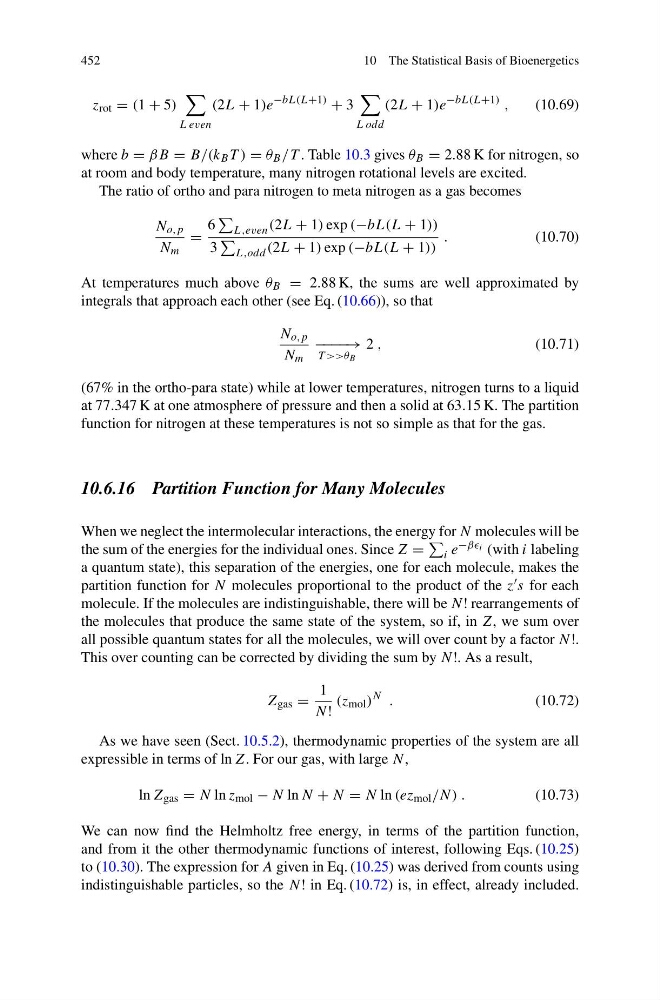
where b = βB = B/(k B T ) = θ B /T . Table 10.3 gives θ B = 2.88 K for nitrogen, so
at room and body temperature, many nitrogen rotational levels are excited.
The ratio of ortho and para nitrogen to meta nitrogen as a gas becomes
N o,p
N m
=
6
L,even (2L + 1) exp (−bL(L + 1))
3
L,odd (2L + 1) exp (−bL(L + 1))
.
(10.70)
At temperatures much above θ B = 2.88 K, the sums are well approximated by
integrals that approach each other (see Eq. (10.66)), so that
N o,p
N m
− −−−→
T >>θ B
2 ,
(10.71)
(67% in the ortho-para state) while at lower temperatures, nitrogen turns to a liquid
at 77.347 K at one atmosphere of pressure and then a solid at 63.15 K. The partition
function for nitrogen at these temperatures is not so simple as that for the gas.
10.6.16 Partition Function for Many Molecules
When we neglect the intermolecular interactions, the energy for N molecules will be
the sum of the energies for the individual ones. Since Z =
i e −ββ i (with i labeling
a quantum state), this separation of the energies, one for each molecule, makes the
partition function for N molecules proportional to the product of the z s for each
molecule. If the molecules are indistinguishable, there will be N ! rearrangements of
the molecules that produce the same state of the system, so if, in Z, we sum over
all possible quantum states for all the molecules, we will over count by a factor N !.
This over counting can be corrected by dividing the sum by N !. As a result,
Z gas =
1
N !
(z mol )
N .
(10.72)
As we have seen (Sect. 10.5.2), thermodynamic properties of the system are all
expressible in terms of ln Z. For our gas, with large N ,
ln Z gas = N ln z mol − N ln N + N = N ln (ez mol /N ) .
(10.73)
We can now find the Helmholtz free energy, in terms of the partition function,
and from it the other thermodynamic functions of interest, following Eqs. (10.25)
to (10.30). The expression for A given in Eq. (10.25) was derived from counts using
indistinguishable particles, so the N ! in Eq. (10.72) is, in effect, already included.
10 The Statistical Basis of Bioenergetics
z rot = (1 + 5)
L even
(2L + 1)e
−bL(L+1)
+ 3
L odd
(2L + 1)e
−bL(L+1) ,
(10.69)
where b = βB = B/(k B T ) = θ B /T . Table 10.3 gives θ B = 2.88 K for nitrogen, so
at room and body temperature, many nitrogen rotational levels are excited.
The ratio of ortho and para nitrogen to meta nitrogen as a gas becomes
N o,p
N m
=
6
L,even (2L + 1) exp (−bL(L + 1))
3
L,odd (2L + 1) exp (−bL(L + 1))
.
(10.70)
At temperatures much above θ B = 2.88 K, the sums are well approximated by
integrals that approach each other (see Eq. (10.66)), so that
N o,p
N m
− −−−→
T >>θ B
2 ,
(10.71)
(67% in the ortho-para state) while at lower temperatures, nitrogen turns to a liquid
at 77.347 K at one atmosphere of pressure and then a solid at 63.15 K. The partition
function for nitrogen at these temperatures is not so simple as that for the gas.
10.6.16 Partition Function for Many Molecules
When we neglect the intermolecular interactions, the energy for N molecules will be
the sum of the energies for the individual ones. Since Z =
i e −ββ i (with i labeling
a quantum state), this separation of the energies, one for each molecule, makes the
partition function for N molecules proportional to the product of the z s for each
molecule. If the molecules are indistinguishable, there will be N ! rearrangements of
the molecules that produce the same state of the system, so if, in Z, we sum over
all possible quantum states for all the molecules, we will over count by a factor N !.
This over counting can be corrected by dividing the sum by N !. As a result,
Z gas =
1
N !
(z mol )
N .
(10.72)
As we have seen (Sect. 10.5.2), thermodynamic properties of the system are all
expressible in terms of ln Z. For our gas, with large N ,
ln Z gas = N ln z mol − N ln N + N = N ln (ez mol /N ) .
(10.73)
We can now find the Helmholtz free energy, in terms of the partition function,
and from it the other thermodynamic functions of interest, following Eqs. (10.25)
to (10.30). The expression for A given in Eq. (10.25) was derived from counts using
indistinguishable particles, so the N ! in Eq. (10.72) is, in effect, already included.