

442
10 The Statistical Basis of Bioenergetics
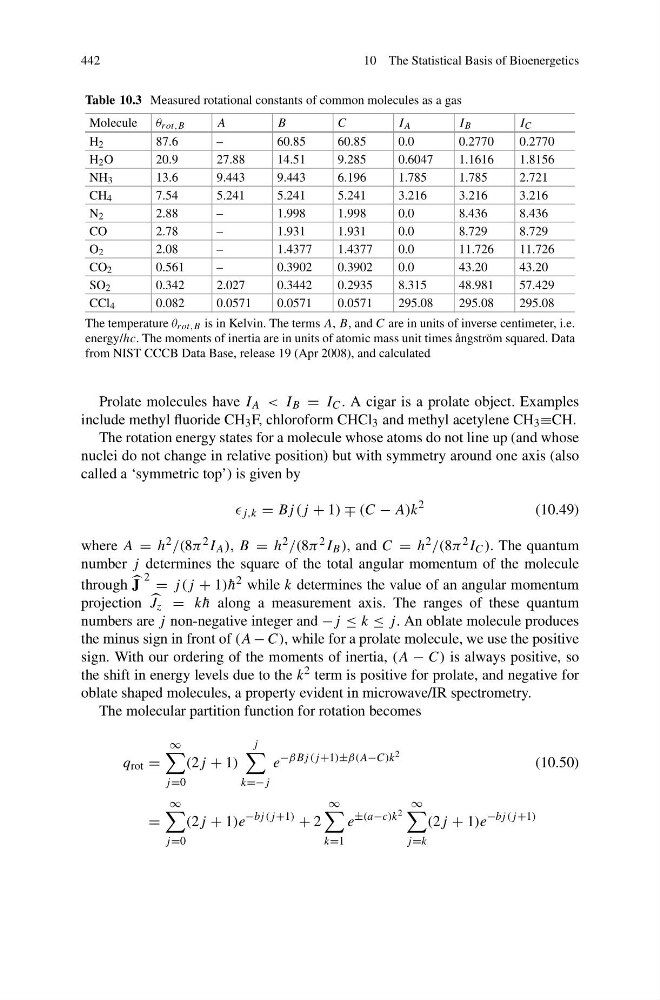
Table 10.3 Measured rotational constants of common molecules as a gas
Molecule θ rot,B
A
B
C
I A
I B
I C
H 2
87.6
–
60.85
60.85
0.0
0.2770
0.2770
H 2 O
20.9
27.88
14.51
9.285
0.6047
1.1616
1.8156
NH 3
13.6
9.443
9.443
6.196
1.785
1.785
2.721
CH 4
7.54
5.241
5.241
5.241
3.216
3.216
3.216
N 2
2.88
–
1.998
1.998
0.0
8.436
8.436
CO
2.78
–
1.931
1.931
0.0
8.729
8.729
O 2
2.08
–
1.4377
1.4377
0.0
11.726
11.726
CO 2
0.561
–
0.3902
0.3902
0.0
43.20
43.20
SO 2
0.342
2.027
0.3442
0.2935
8.315
48.981
57.429
CCl 4
0.082
0.0571
0.0571
0.0571
295.08
295.08
295.08
The temperature θ rot,B is in Kelvin. The terms A, B, and C are in units of inverse centimeter, i.e.
energy/hc. The moments of inertia are in units of atomic mass unit times ångström squared. Data
from NIST CCCB Data Base, release 19 (Apr 2008), and calculated
Prolate molecules have I A < I B = I C . A cigar is a prolate object. Examples
include methyl fluoride CH 3 F, chloroform CHCl 3 and methyl acetylene CH 3 ≡CH.
The rotation energy states for a molecule whose atoms do not line up (and whose
nuclei do not change in relative position) but with symmetry around one axis (also
called a ‘symmetric top’) is given by
j,k = Bj (j + 1) ∓ (C − A)k
2
(10.49)
where A = h 2 /(8π 2 I A ), B = h 2 /(8π 2 I B ), and C = h 2 /(8π 2 I C ). The quantum
number j determines the square of the total angular momentum of the molecule
through J
2 = j (j + 1) ¯
h 2 while k determines the value of an angular momentum
projection
J z = k ¯
h along a measurement axis. The ranges of these quantum
numbers are j non-negative integer and −j ≤ k ≤ j . An oblate molecule produces
the minus sign in front of (A − C), while for a prolate molecule, we use the positive
sign. With our ordering of the moments of inertia, (A − C) is always positive, so
the shift in energy levels due to the k 2 term is positive for prolate, and negative for
oblate shaped molecules, a property evident in microwave/IR spectrometry.
The molecular partition function for rotation becomes
q rot =
∞
j =0
(2j + 1)
j
k=−j
e
−βBj (j +1)±β(A−C)k 2
(10.50)
=
∞
j =0
(2j + 1)e
−bj (j +1)
+ 2
∞
k=1
e
±(a−c)k 2
∞
j =k
(2j + 1)e
−bj (j +1)
10 The Statistical Basis of Bioenergetics
Table 10.3 Measured rotational constants of common molecules as a gas
Molecule θ rot,B
A
B
C
I A
I B
I C
H 2
87.6
–
60.85
60.85
0.0
0.2770
0.2770
H 2 O
20.9
27.88
14.51
9.285
0.6047
1.1616
1.8156
NH 3
13.6
9.443
9.443
6.196
1.785
1.785
2.721
CH 4
7.54
5.241
5.241
5.241
3.216
3.216
3.216
N 2
2.88
–
1.998
1.998
0.0
8.436
8.436
CO
2.78
–
1.931
1.931
0.0
8.729
8.729
O 2
2.08
–
1.4377
1.4377
0.0
11.726
11.726
CO 2
0.561
–
0.3902
0.3902
0.0
43.20
43.20
SO 2
0.342
2.027
0.3442
0.2935
8.315
48.981
57.429
CCl 4
0.082
0.0571
0.0571
0.0571
295.08
295.08
295.08
The temperature θ rot,B is in Kelvin. The terms A, B, and C are in units of inverse centimeter, i.e.
energy/hc. The moments of inertia are in units of atomic mass unit times ångström squared. Data
from NIST CCCB Data Base, release 19 (Apr 2008), and calculated
Prolate molecules have I A < I B = I C . A cigar is a prolate object. Examples
include methyl fluoride CH 3 F, chloroform CHCl 3 and methyl acetylene CH 3 ≡CH.
The rotation energy states for a molecule whose atoms do not line up (and whose
nuclei do not change in relative position) but with symmetry around one axis (also
called a ‘symmetric top’) is given by
j,k = Bj (j + 1) ∓ (C − A)k
2
(10.49)
where A = h 2 /(8π 2 I A ), B = h 2 /(8π 2 I B ), and C = h 2 /(8π 2 I C ). The quantum
number j determines the square of the total angular momentum of the molecule
through J
2 = j (j + 1) ¯
h 2 while k determines the value of an angular momentum
projection
J z = k ¯
h along a measurement axis. The ranges of these quantum
numbers are j non-negative integer and −j ≤ k ≤ j . An oblate molecule produces
the minus sign in front of (A − C), while for a prolate molecule, we use the positive
sign. With our ordering of the moments of inertia, (A − C) is always positive, so
the shift in energy levels due to the k 2 term is positive for prolate, and negative for
oblate shaped molecules, a property evident in microwave/IR spectrometry.
The molecular partition function for rotation becomes
q rot =
∞
j =0
(2j + 1)
j
k=−j
e
−βBj (j +1)±β(A−C)k 2
(10.50)
=
∞
j =0
(2j + 1)e
−bj (j +1)
+ 2
∞
k=1
e
±(a−c)k 2
∞
j =k
(2j + 1)e
−bj (j +1)