

440
10 The Statistical Basis of Bioenergetics
Table 10.1 Molecular rotation quantum numbers
Rotor type
Conditions
Quantum #’s
Degeneracy a
Linear
I A ≈ 0, I B = I C
l, m
(2l + 1)
Symmetric oblate
I A = I B < I C
j, k
(2 − δ k,0 )(2k + 1)
Symmetric prolate
I A < I B = I C
j, k
(2 − δ k,0 )(2j + 1)
Spherical
I A = I B = I C
j, m, m
(2J + 1) 2
Asymmetric
I A < I B < I C
J τ
Varies with J
a In table, δ k,0 is one if k = 0 and zero otherwise. The index τ ranges from −J to J
Table 10.2 Measured geometric constants of common molecules as a gas
Molecule
Bond lengths (Å)
Angles (deg)
Hydrogen
H–H
0.741
(HH)
–
–
Water
H–O–H
0.958
(OH)
104.48
(HO)
Ammonia
NH 3
1.012
(NH)
106.67
(HNH)
Methane
CH 4
1.087
(CH)
109.47
(HCH)
Nitrogen
N≡N
1.098
(NN)
–
–
Carbon monoxide
C–O
1.128
(CO)
–
–
Oxygen
O–O
1.208
(OO)
–
–
Carbon dioxide
O=C=O
1.162
(CO)
180.00
(OCO)
Sulfur dioxide
O=S=O
1.432
(SO)
119.50
(OSO)
Carbon tetrachloride
CCl 4
1.767
(CCl)
109.47
(ClCCl)
Data from NIST CCCB Data Base, release 19 (Apr 2008)
H rot =
3
i=1
L 2
i
2I i
,
(10.46)
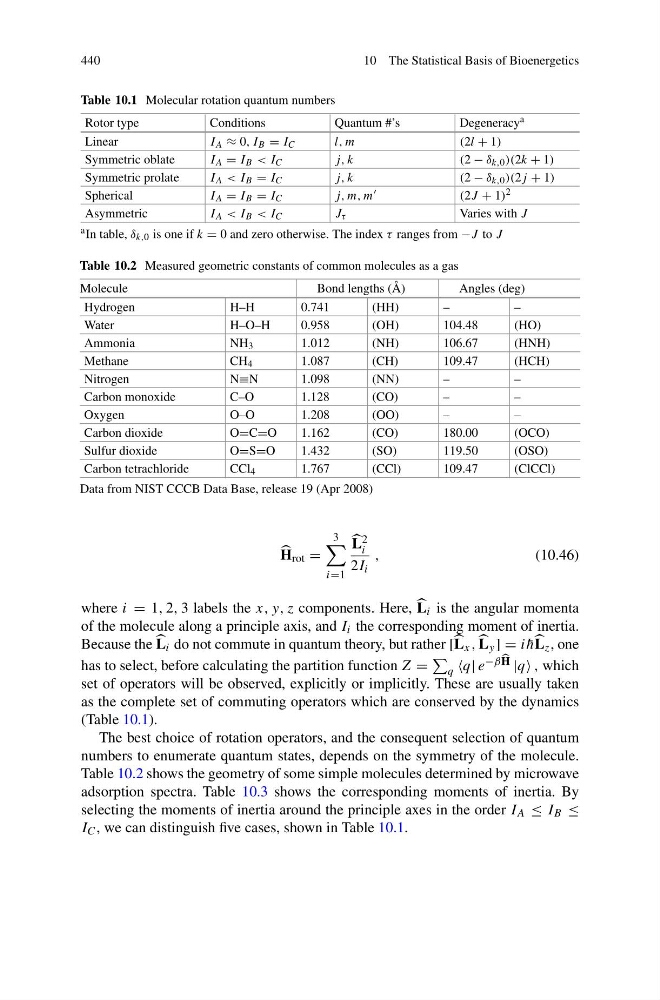
where i = 1, 2, 3 labels the x, y, z components. Here, L i is the angular momenta
of the molecule along a principle axis, and I i the corresponding moment of inertia.
Because the L i do not commute in quantum theory, but rather [ L x , L y ] = i ¯
h L z , one
has to select, before calculating the partition function Z =
q q| e −β
H |q , which
set of operators will be observed, explicitly or implicitly. These are usually taken
as the complete set of commuting operators which are conserved by the dynamics
(Table 10.1).
The best choice of rotation operators, and the consequent selection of quantum
numbers to enumerate quantum states, depends on the symmetry of the molecule.
Table 10.2 shows the geometry of some simple molecules determined by microwave
adsorption spectra. Table 10.3 shows the corresponding moments of inertia. By
selecting the moments of inertia around the principle axes in the order I A ≤ I B ≤
I C , we can distinguish five cases, shown in Table 10.1.
10 The Statistical Basis of Bioenergetics
Table 10.1 Molecular rotation quantum numbers
Rotor type
Conditions
Quantum #’s
Degeneracy a
Linear
I A ≈ 0, I B = I C
l, m
(2l + 1)
Symmetric oblate
I A = I B < I C
j, k
(2 − δ k,0 )(2k + 1)
Symmetric prolate
I A < I B = I C
j, k
(2 − δ k,0 )(2j + 1)
Spherical
I A = I B = I C
j, m, m
(2J + 1) 2
Asymmetric
I A < I B < I C
J τ
Varies with J
a In table, δ k,0 is one if k = 0 and zero otherwise. The index τ ranges from −J to J
Table 10.2 Measured geometric constants of common molecules as a gas
Molecule
Bond lengths (Å)
Angles (deg)
Hydrogen
H–H
0.741
(HH)
–
–
Water
H–O–H
0.958
(OH)
104.48
(HO)
Ammonia
NH 3
1.012
(NH)
106.67
(HNH)
Methane
CH 4
1.087
(CH)
109.47
(HCH)
Nitrogen
N≡N
1.098
(NN)
–
–
Carbon monoxide
C–O
1.128
(CO)
–
–
Oxygen
O–O
1.208
(OO)
–
–
Carbon dioxide
O=C=O
1.162
(CO)
180.00
(OCO)
Sulfur dioxide
O=S=O
1.432
(SO)
119.50
(OSO)
Carbon tetrachloride
CCl 4
1.767
(CCl)
109.47
(ClCCl)
Data from NIST CCCB Data Base, release 19 (Apr 2008)
H rot =
3
i=1
L 2
i
2I i
,
(10.46)
where i = 1, 2, 3 labels the x, y, z components. Here, L i is the angular momenta
of the molecule along a principle axis, and I i the corresponding moment of inertia.
Because the L i do not commute in quantum theory, but rather [ L x , L y ] = i ¯
h L z , one
has to select, before calculating the partition function Z =
q q| e −β
H |q , which
set of operators will be observed, explicitly or implicitly. These are usually taken
as the complete set of commuting operators which are conserved by the dynamics
(Table 10.1).
The best choice of rotation operators, and the consequent selection of quantum
numbers to enumerate quantum states, depends on the symmetry of the molecule.
Table 10.2 shows the geometry of some simple molecules determined by microwave
adsorption spectra. Table 10.3 shows the corresponding moments of inertia. By
selecting the moments of inertia around the principle axes in the order I A ≤ I B ≤
I C , we can distinguish five cases, shown in Table 10.1.