

Problems
419
9.11 Suppose a mammalian cell wall is blocked from transporting any ions except
sodium. As a result (after some time), an equilibrium voltage difference of 60 mV
is established. What is the ratio of the concentrations of sodium ions on one side
compared to the other side of the cell wall?
9.12 The adult human brain consumes about 20 W of power while resting. About a
fifth of that power is used by the cerebral cortex. Assume about 70% of the power
is devoted to maintaining the membrane potential. On average, how much ATP (in
molecules) is consumed by the cerebral cortex per minute for this purpose?
9.13 Explain how a biochemical reaction with the disassociation of a molecule into
two atoms can be spontaneous even if the energy released in the reaction is negative.
9.14 Overall, glycolysis is a conversion symbolized by:
Glucose + 2 ADP + 2 Pi + 2 NAD + → 2 Pyruvate + 2 ATP + 2 NADH + 2 H + + 2
H 2 O
This process is performed in cells through the reactions
1. Alpha-D-Glucose to alpha-D-Glucose-6-phosphate via Hexokinase
2. Alpha-D-Glucose to Beta-D-Frutose-6-phosphate via Phosphoglucoisomerase
3. Beta-D-Fructose-6-phosphate to Beta-D-Fructose-1,6-biphosphate via
Phospho-fructo-kinase
4. Beta-D-Fructose-1,6-biphosphate to Glyceraldehide-3-phosphate and Dihydroxyacetone phosphate
5. Dihydroxyacetone phosphate to Glyceraldehide-3-phosphate via Triose phosphate isomerase
6. Glyceraldehide-3-phosphate to 1,3-Biphosphoglycerate via glyceraldehyde-3phosphate dihydrogenase
7. 1,3-Biphosphoglycerate to 3-Phosphoglycerate via Phosphoglycerate kinase
8. 3-Phosphoglycerate to 2-Phosphoglycerate via phosphoglycerate mutase
9. 2-Phosphoglycerate to Phosphoenolpyruvate via Enolase
10. Phosphoenolpyruvate to Pyuvate via Pyruvate kinase.
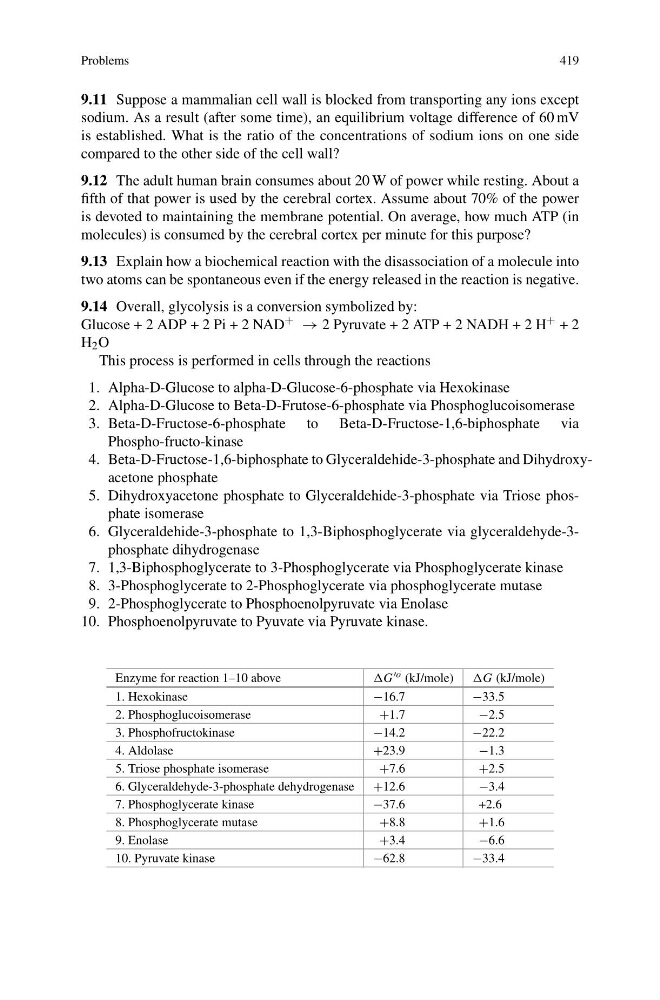
Enzyme for reaction 1–10 above
G o (kJ/mole) G (kJ/mole)
1. Hexokinase
−16.7
−33.5
2. Phosphoglucoisomerase
+1.7
−2.5
3. Phosphofructokinase
−14.2
−22.2
4. Aldolase
+23.9
−1.3
5. Triose phosphate isomerase
+7.6
+2.5
6. Glyceraldehyde-3-phosphate dehydrogenase +12.6
−3.4
7. Phosphoglycerate kinase
−37.6
+2.6
8. Phosphoglycerate mutase
+8.8
+1.6
9. Enolase
+3.4
−6.6
10. Pyruvate kinase
−62.8
−33.4
419
9.11 Suppose a mammalian cell wall is blocked from transporting any ions except
sodium. As a result (after some time), an equilibrium voltage difference of 60 mV
is established. What is the ratio of the concentrations of sodium ions on one side
compared to the other side of the cell wall?
9.12 The adult human brain consumes about 20 W of power while resting. About a
fifth of that power is used by the cerebral cortex. Assume about 70% of the power
is devoted to maintaining the membrane potential. On average, how much ATP (in
molecules) is consumed by the cerebral cortex per minute for this purpose?
9.13 Explain how a biochemical reaction with the disassociation of a molecule into
two atoms can be spontaneous even if the energy released in the reaction is negative.
9.14 Overall, glycolysis is a conversion symbolized by:
Glucose + 2 ADP + 2 Pi + 2 NAD + → 2 Pyruvate + 2 ATP + 2 NADH + 2 H + + 2
H 2 O
This process is performed in cells through the reactions
1. Alpha-D-Glucose to alpha-D-Glucose-6-phosphate via Hexokinase
2. Alpha-D-Glucose to Beta-D-Frutose-6-phosphate via Phosphoglucoisomerase
3. Beta-D-Fructose-6-phosphate to Beta-D-Fructose-1,6-biphosphate via
Phospho-fructo-kinase
4. Beta-D-Fructose-1,6-biphosphate to Glyceraldehide-3-phosphate and Dihydroxyacetone phosphate
5. Dihydroxyacetone phosphate to Glyceraldehide-3-phosphate via Triose phosphate isomerase
6. Glyceraldehide-3-phosphate to 1,3-Biphosphoglycerate via glyceraldehyde-3phosphate dihydrogenase
7. 1,3-Biphosphoglycerate to 3-Phosphoglycerate via Phosphoglycerate kinase
8. 3-Phosphoglycerate to 2-Phosphoglycerate via phosphoglycerate mutase
9. 2-Phosphoglycerate to Phosphoenolpyruvate via Enolase
10. Phosphoenolpyruvate to Pyuvate via Pyruvate kinase.
Enzyme for reaction 1–10 above
G o (kJ/mole) G (kJ/mole)
1. Hexokinase
−16.7
−33.5
2. Phosphoglucoisomerase
+1.7
−2.5
3. Phosphofructokinase
−14.2
−22.2
4. Aldolase
+23.9
−1.3
5. Triose phosphate isomerase
+7.6
+2.5
6. Glyceraldehyde-3-phosphate dehydrogenase +12.6
−3.4
7. Phosphoglycerate kinase
−37.6
+2.6
8. Phosphoglycerate mutase
+8.8
+1.6
9. Enolase
+3.4
−6.6
10. Pyruvate kinase
−62.8
−33.4