

9.23 Non-equilibrium Thermodynamics
413
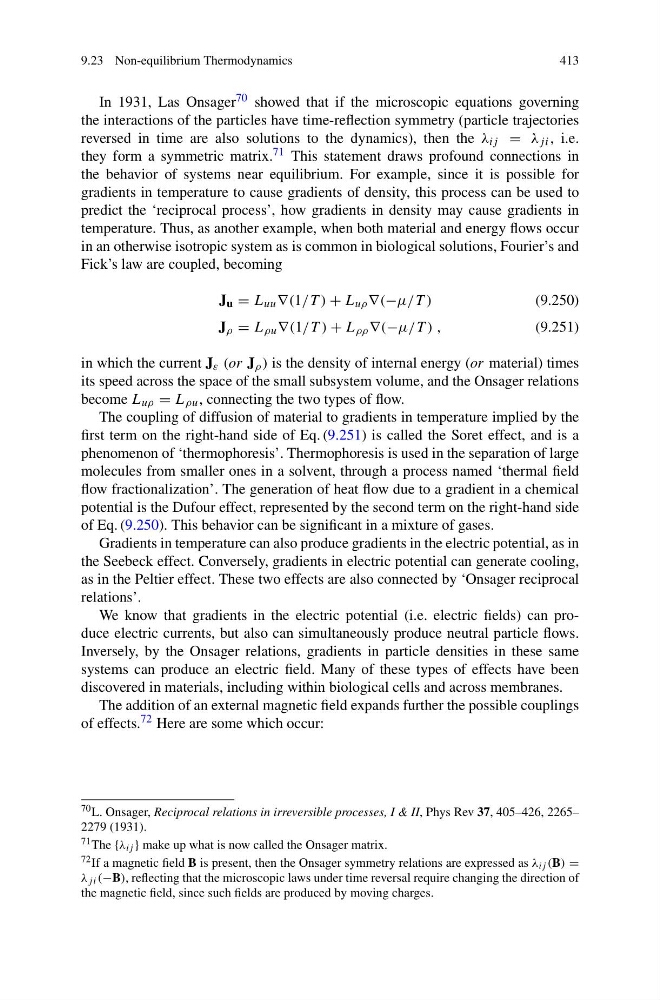
In 1931, Las Onsager 70 showed that if the microscopic equations governing
the interactions of the particles have time-reflection symmetry (particle trajectories
reversed in time are also solutions to the dynamics), then the λ ij = λ ji , i.e.
they form a symmetric matrix. 71 This statement draws profound connections in
the behavior of systems near equilibrium. For example, since it is possible for
gradients in temperature to cause gradients of density, this process can be used to
predict the ‘reciprocal process’, how gradients in density may cause gradients in
temperature. Thus, as another example, when both material and energy flows occur
in an otherwise isotropic system as is common in biological solutions, Fourier’s and
Fick’s law are coupled, becoming
J u = L uu ∇(1/T ) + L uρ ∇(−μ/T )
(9.250)
J ρ = L ρu ∇(1/T ) + L ρρ ∇(−μ/T ) ,
(9.251)
in which the current J ε (or J ρ ) is the density of internal energy (or material) times
its speed across the space of the small subsystem volume, and the Onsager relations
become L uρ = L ρu , connecting the two types of flow.
The coupling of diffusion of material to gradients in temperature implied by the
first term on the right-hand side of Eq. (9.251) is called the Soret effect, and is a
phenomenon of ‘thermophoresis’. Thermophoresis is used in the separation of large
molecules from smaller ones in a solvent, through a process named ‘thermal field
flow fractionalization’. The generation of heat flow due to a gradient in a chemical
potential is the Dufour effect, represented by the second term on the right-hand side
of Eq. (9.250). This behavior can be significant in a mixture of gases.
Gradients in temperature can also produce gradients in the electric potential, as in
the Seebeck effect. Conversely, gradients in electric potential can generate cooling,
as in the Peltier effect. These two effects are also connected by ‘Onsager reciprocal
relations’.
We know that gradients in the electric potential (i.e. electric fields) can produce electric currents, but also can simultaneously produce neutral particle flows.
Inversely, by the Onsager relations, gradients in particle densities in these same
systems can produce an electric field. Many of these types of effects have been
discovered in materials, including within biological cells and across membranes.
The addition of an external magnetic field expands further the possible couplings
of effects. 72 Here are some which occur:
70 L. Onsager, Reciprocal relations in irreversible processes, I & II, Phys Rev 37, 405–426, 2265–
2279 (1931).
71 The {λ ij } make up what is now called the Onsager matrix.
72 If a magnetic field B is present, then the Onsager symmetry relations are expressed as λ ij (B) =
λ ji (−B), reflecting that the microscopic laws under time reversal require changing the direction of
the magnetic field, since such fields are produced by moving charges.
413
In 1931, Las Onsager 70 showed that if the microscopic equations governing
the interactions of the particles have time-reflection symmetry (particle trajectories
reversed in time are also solutions to the dynamics), then the λ ij = λ ji , i.e.
they form a symmetric matrix. 71 This statement draws profound connections in
the behavior of systems near equilibrium. For example, since it is possible for
gradients in temperature to cause gradients of density, this process can be used to
predict the ‘reciprocal process’, how gradients in density may cause gradients in
temperature. Thus, as another example, when both material and energy flows occur
in an otherwise isotropic system as is common in biological solutions, Fourier’s and
Fick’s law are coupled, becoming
J u = L uu ∇(1/T ) + L uρ ∇(−μ/T )
(9.250)
J ρ = L ρu ∇(1/T ) + L ρρ ∇(−μ/T ) ,
(9.251)
in which the current J ε (or J ρ ) is the density of internal energy (or material) times
its speed across the space of the small subsystem volume, and the Onsager relations
become L uρ = L ρu , connecting the two types of flow.
The coupling of diffusion of material to gradients in temperature implied by the
first term on the right-hand side of Eq. (9.251) is called the Soret effect, and is a
phenomenon of ‘thermophoresis’. Thermophoresis is used in the separation of large
molecules from smaller ones in a solvent, through a process named ‘thermal field
flow fractionalization’. The generation of heat flow due to a gradient in a chemical
potential is the Dufour effect, represented by the second term on the right-hand side
of Eq. (9.250). This behavior can be significant in a mixture of gases.
Gradients in temperature can also produce gradients in the electric potential, as in
the Seebeck effect. Conversely, gradients in electric potential can generate cooling,
as in the Peltier effect. These two effects are also connected by ‘Onsager reciprocal
relations’.
We know that gradients in the electric potential (i.e. electric fields) can produce electric currents, but also can simultaneously produce neutral particle flows.
Inversely, by the Onsager relations, gradients in particle densities in these same
systems can produce an electric field. Many of these types of effects have been
discovered in materials, including within biological cells and across membranes.
The addition of an external magnetic field expands further the possible couplings
of effects. 72 Here are some which occur:
70 L. Onsager, Reciprocal relations in irreversible processes, I & II, Phys Rev 37, 405–426, 2265–
2279 (1931).
71 The {λ ij } make up what is now called the Onsager matrix.
72 If a magnetic field B is present, then the Onsager symmetry relations are expressed as λ ij (B) =
λ ji (−B), reflecting that the microscopic laws under time reversal require changing the direction of
the magnetic field, since such fields are produced by moving charges.