

9.21 Biochemical Reactions
397
The change δξ must decrease toward equilibrium, and reach zero at equilibrium.
We have
δG =
J
μ J ν J
δξ .
(9.209)
and the condition for equilibrium becomes
J
μ J ν J = 0 .
(9.210)
The simplest case of a reaction is A ↔ B. Then ν A = −1, ν B = 1, so that
μ
A
= μ
B .
Systems with molecules which can exist as two different structures or as two
different phases would be examples. When a mixture of two phases of a material
reach equilibrium, the chemical potentials of each phase must be equal. 62
As another example, the equilibrium condition across a cell membrane with a
difference in ion concentration, producing a membrane potential V I , is given by
G conc + G volt = 0
(9.211)
or
− RT ln
[C o ]
[C i ]
+ zFFV ion = 0
(9.212)
Here, z = number of charges on ion, and F = Faraday’s constant = |e| N A =
96,485 coul, the charge in one mole of singly-charged ions.
At the temperature of 37 ◦ C,
V ion = 2.3026
RT
zF
log 10
[C o ]
[C i ]
=
61.5 mV
z
log 10
[C o ]
[C i ]
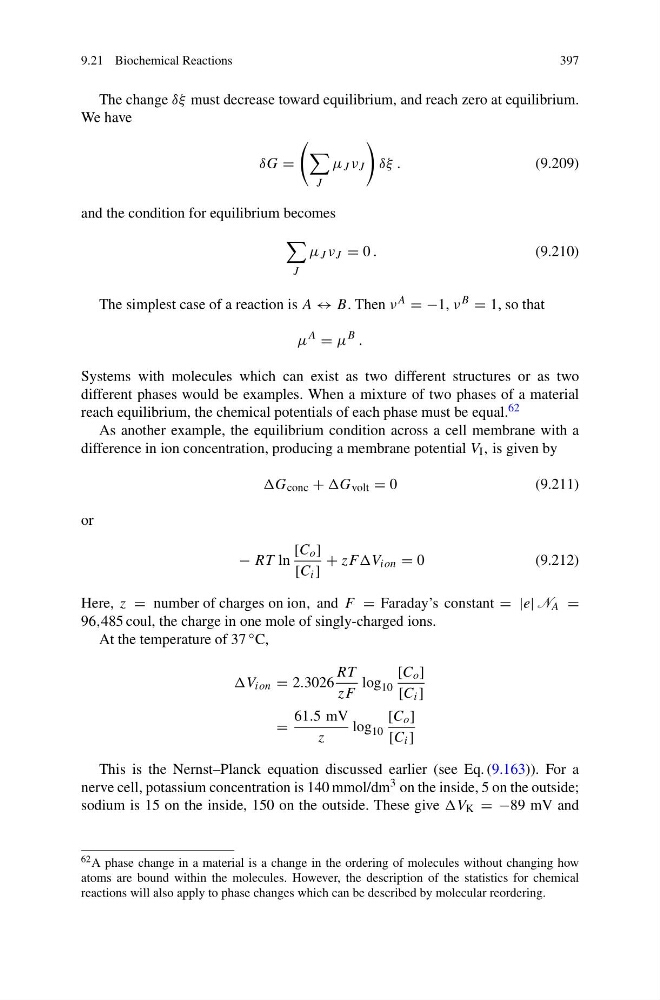
This is the Nernst–Planck equation discussed earlier (see Eq. (9.163)). For a
nerve cell, potassium concentration is 140 mmol/dm 3 on the inside, 5 on the outside;
sodium is 15 on the inside, 150 on the outside. These give V K = −89 mV and
62 A phase change in a material is a change in the ordering of molecules without changing how
atoms are bound within the molecules. However, the description of the statistics for chemical
reactions will also apply to phase changes which can be described by molecular reordering.
397
The change δξ must decrease toward equilibrium, and reach zero at equilibrium.
We have
δG =
J
μ J ν J
δξ .
(9.209)
and the condition for equilibrium becomes
J
μ J ν J = 0 .
(9.210)
The simplest case of a reaction is A ↔ B. Then ν A = −1, ν B = 1, so that
μ
A
= μ
B .
Systems with molecules which can exist as two different structures or as two
different phases would be examples. When a mixture of two phases of a material
reach equilibrium, the chemical potentials of each phase must be equal. 62
As another example, the equilibrium condition across a cell membrane with a
difference in ion concentration, producing a membrane potential V I , is given by
G conc + G volt = 0
(9.211)
or
− RT ln
[C o ]
[C i ]
+ zFFV ion = 0
(9.212)
Here, z = number of charges on ion, and F = Faraday’s constant = |e| N A =
96,485 coul, the charge in one mole of singly-charged ions.
At the temperature of 37 ◦ C,
V ion = 2.3026
RT
zF
log 10
[C o ]
[C i ]
=
61.5 mV
z
log 10
[C o ]
[C i ]
This is the Nernst–Planck equation discussed earlier (see Eq. (9.163)). For a
nerve cell, potassium concentration is 140 mmol/dm 3 on the inside, 5 on the outside;
sodium is 15 on the inside, 150 on the outside. These give V K = −89 mV and
62 A phase change in a material is a change in the ordering of molecules without changing how
atoms are bound within the molecules. However, the description of the statistics for chemical
reactions will also apply to phase changes which can be described by molecular reordering.