

394
9 Bioenergetics
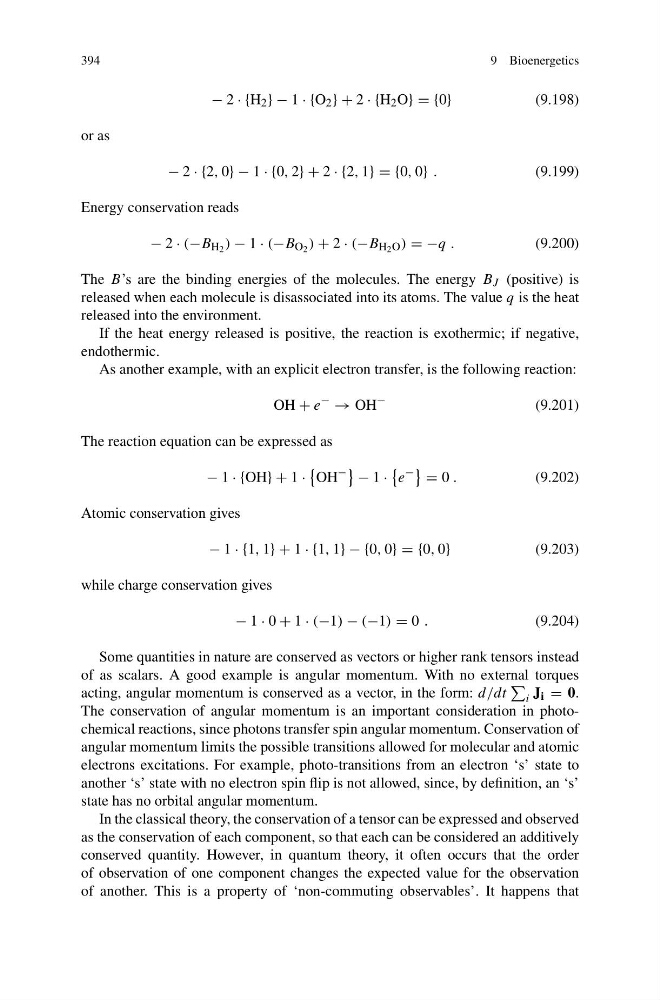
− 2 · {H 2 } − 1 · {O 2 } + 2 · {H 2 O} = {0}
(9.198)
or as
− 2 · {2, 0} − 1 · {0, 2} + 2 · {2, 1} = {0, 0} .
(9.199)
Energy conservation reads
− 2 · (−B H 2 ) − 1 · (−B O 2 ) + 2 · (−B H 2 O ) = −q .
(9.200)
The B’s are the binding energies of the molecules. The energy B J (positive) is
released when each molecule is disassociated into its atoms. The value q is the heat
released into the environment.
If the heat energy released is positive, the reaction is exothermic; if negative,
endothermic.
As another example, with an explicit electron transfer, is the following reaction:
OH + e
−
→ OH
−
(9.201)
The reaction equation can be expressed as
− 1 · {OH} + 1 ·
OH
−
− 1 ·
e
−
= 0 .
(9.202)
Atomic conservation gives
− 1 · {1, 1} + 1 · {1, 1} − {0, 0} = {0, 0}
(9.203)
while charge conservation gives
− 1 · 0 + 1 · (−1) − (−1) = 0 .
(9.204)
Some quantities in nature are conserved as vectors or higher rank tensors instead
of as scalars. A good example is angular momentum. With no external torques
acting, angular momentum is conserved as a vector, in the form: d/dt
i J i = 0.
The conservation of angular momentum is an important consideration in photochemical reactions, since photons transfer spin angular momentum. Conservation of
angular momentum limits the possible transitions allowed for molecular and atomic
electrons excitations. For example, photo-transitions from an electron ‘s’ state to
another ‘s’ state with no electron spin flip is not allowed, since, by definition, an ‘s’
state has no orbital angular momentum.
In the classical theory, the conservation of a tensor can be expressed and observed
as the conservation of each component, so that each can be considered an additively
conserved quantity. However, in quantum theory, it often occurs that the order
of observation of one component changes the expected value for the observation
of another. This is a property of ‘non-commuting observables’. It happens that
9 Bioenergetics
− 2 · {H 2 } − 1 · {O 2 } + 2 · {H 2 O} = {0}
(9.198)
or as
− 2 · {2, 0} − 1 · {0, 2} + 2 · {2, 1} = {0, 0} .
(9.199)
Energy conservation reads
− 2 · (−B H 2 ) − 1 · (−B O 2 ) + 2 · (−B H 2 O ) = −q .
(9.200)
The B’s are the binding energies of the molecules. The energy B J (positive) is
released when each molecule is disassociated into its atoms. The value q is the heat
released into the environment.
If the heat energy released is positive, the reaction is exothermic; if negative,
endothermic.
As another example, with an explicit electron transfer, is the following reaction:
OH + e
−
→ OH
−
(9.201)
The reaction equation can be expressed as
− 1 · {OH} + 1 ·
OH
−
− 1 ·
e
−
= 0 .
(9.202)
Atomic conservation gives
− 1 · {1, 1} + 1 · {1, 1} − {0, 0} = {0, 0}
(9.203)
while charge conservation gives
− 1 · 0 + 1 · (−1) − (−1) = 0 .
(9.204)
Some quantities in nature are conserved as vectors or higher rank tensors instead
of as scalars. A good example is angular momentum. With no external torques
acting, angular momentum is conserved as a vector, in the form: d/dt
i J i = 0.
The conservation of angular momentum is an important consideration in photochemical reactions, since photons transfer spin angular momentum. Conservation of
angular momentum limits the possible transitions allowed for molecular and atomic
electrons excitations. For example, photo-transitions from an electron ‘s’ state to
another ‘s’ state with no electron spin flip is not allowed, since, by definition, an ‘s’
state has no orbital angular momentum.
In the classical theory, the conservation of a tensor can be expressed and observed
as the conservation of each component, so that each can be considered an additively
conserved quantity. However, in quantum theory, it often occurs that the order
of observation of one component changes the expected value for the observation
of another. This is a property of ‘non-commuting observables’. It happens that