

9.21 Biochemical Reactions
391
activity. Reactions at constant temperature and pressure will proceed spontaneously
if the Gibbs free energy 60 can be lowered under the constraints on the system.
Equilibrium will occur when the Gibbs free energy reaches a minimum. We say
that if a reaction results in < 0, the reaction was exergonic (‘work producing’).
If G > 0, the reaction was endergonic (‘work absorbing’). Note that since the
enthalpy is H = E − T S, changes of the Gibbs free energy during a reaction at
constant temperature can be expressed as G = H − T TS, so a reaction will
proceed if H − T TS is less than zero. For a closed system at constant pressure,
the first term, H = E + ppV = Q, will be the negative of the heat released
by the reaction (‘exothermic’) and H will be positive if energy is absorbed by
the reactants (‘endothermic’). The second term, T TS, is the temperature times the
entropy increase. Both energy release and entropy increase will ‘drive’ a chemical
reaction forward.
We should not expect the entropy production to depend much on temperature,
as the production of order or disorder in a reaction among atoms and molecules
comes from how atoms become re-arranged, collected, or dispersed. 61 Also, we
should expect that the bulk of the enthalpy change comes from changes in binding
interactions, which have little temperature dependence.
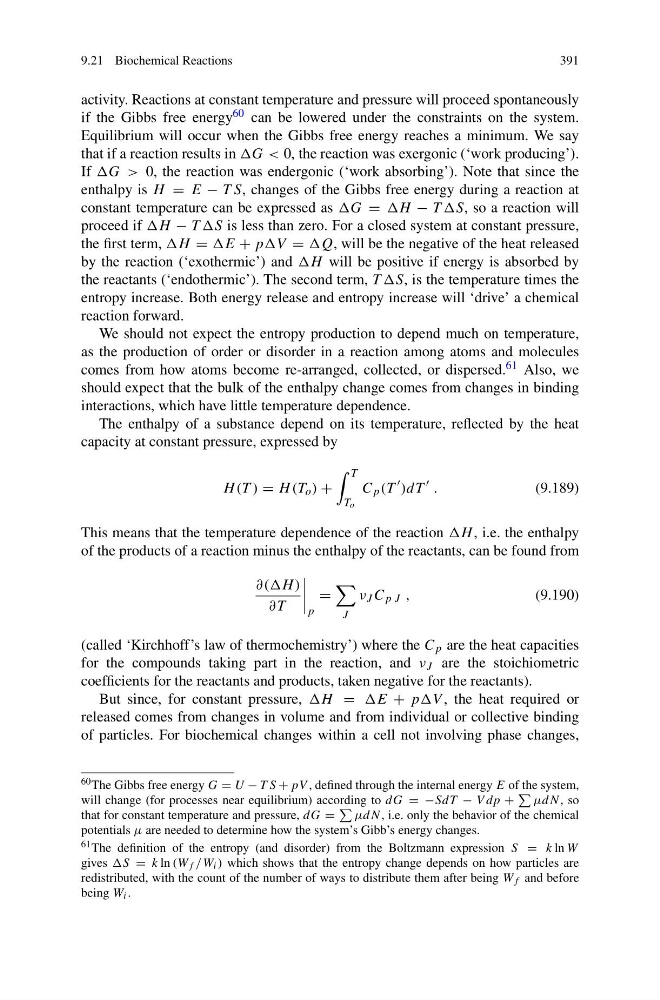
The enthalpy of a substance depend on its temperature, reflected by the heat
capacity at constant pressure, expressed by
H (T ) = H (T o ) +
T
T o
C p (T
)dT
.
(9.189)
This means that the temperature dependence of the reaction H , i.e. the enthalpy
of the products of a reaction minus the enthalpy of the reactants, can be found from
∂((H )
∂T
p
=
J
ν J C p J ,
(9.190)
(called ‘Kirchhoff’s law of thermochemistry’) where the C p are the heat capacities
for the compounds taking part in the reaction, and ν J are the stoichiometric
coefficients for the reactants and products, taken negative for the reactants).
But since, for constant pressure, H = E + ppV , the heat required or
released comes from changes in volume and from individual or collective binding
of particles. For biochemical changes within a cell not involving phase changes,
60 The Gibbs free energy G = U − T S + pV , defined through the internal energy E of the system,
will change (for processes near equilibrium) according to dG = −SdT − V dp +
μdN , so
that for constant temperature and pressure, dG =
μdN , i.e. only the behavior of the chemical
potentials μ are needed to determine how the system’s Gibb’s energy changes.
61 The definition of the entropy (and disorder) from the Boltzmann expression S = k ln W
gives S = k ln (W f /W i ) which shows that the entropy change depends on how particles are
redistributed, with the count of the number of ways to distribute them after being W f and before
being W i .
391
activity. Reactions at constant temperature and pressure will proceed spontaneously
if the Gibbs free energy 60 can be lowered under the constraints on the system.
Equilibrium will occur when the Gibbs free energy reaches a minimum. We say
that if a reaction results in < 0, the reaction was exergonic (‘work producing’).
If G > 0, the reaction was endergonic (‘work absorbing’). Note that since the
enthalpy is H = E − T S, changes of the Gibbs free energy during a reaction at
constant temperature can be expressed as G = H − T TS, so a reaction will
proceed if H − T TS is less than zero. For a closed system at constant pressure,
the first term, H = E + ppV = Q, will be the negative of the heat released
by the reaction (‘exothermic’) and H will be positive if energy is absorbed by
the reactants (‘endothermic’). The second term, T TS, is the temperature times the
entropy increase. Both energy release and entropy increase will ‘drive’ a chemical
reaction forward.
We should not expect the entropy production to depend much on temperature,
as the production of order or disorder in a reaction among atoms and molecules
comes from how atoms become re-arranged, collected, or dispersed. 61 Also, we
should expect that the bulk of the enthalpy change comes from changes in binding
interactions, which have little temperature dependence.
The enthalpy of a substance depend on its temperature, reflected by the heat
capacity at constant pressure, expressed by
H (T ) = H (T o ) +
T
T o
C p (T
)dT
.
(9.189)
This means that the temperature dependence of the reaction H , i.e. the enthalpy
of the products of a reaction minus the enthalpy of the reactants, can be found from
∂((H )
∂T
p
=
J
ν J C p J ,
(9.190)
(called ‘Kirchhoff’s law of thermochemistry’) where the C p are the heat capacities
for the compounds taking part in the reaction, and ν J are the stoichiometric
coefficients for the reactants and products, taken negative for the reactants).
But since, for constant pressure, H = E + ppV , the heat required or
released comes from changes in volume and from individual or collective binding
of particles. For biochemical changes within a cell not involving phase changes,
60 The Gibbs free energy G = U − T S + pV , defined through the internal energy E of the system,
will change (for processes near equilibrium) according to dG = −SdT − V dp +
μdN , so
that for constant temperature and pressure, dG =
μdN , i.e. only the behavior of the chemical
potentials μ are needed to determine how the system’s Gibb’s energy changes.
61 The definition of the entropy (and disorder) from the Boltzmann expression S = k ln W
gives S = k ln (W f /W i ) which shows that the entropy change depends on how particles are
redistributed, with the count of the number of ways to distribute them after being W f and before
being W i .