

374
9 Bioenergetics
Here, ρ s is the mass per mole of the given solute, and λ s is the energy required
per mole to release the solute as a gas from the solution (‘heat of dissolution’).
Just as for pure liquid vaporization, λ s is approximately constant over a range
of temperatures, such as from 0 to 20 ◦ C. As a consequence, Henry’s coefficient
for common atmospheric gases is predicted to rise in a range of temperatures
between the freezing and boiling point for water. Correspondingly, the solubility
of atmospheric gases will decrease with increasing temperature. As the ocean
temperature rises, it can hold less oxygen and carbon dioxide, adding stress to fish
and exacerbating the greenhouse effect.
As one application of Henry’s law, we will apply the law to estimate the amount
of nitrogen gas released from the blood when a diver ascends too quickly from the
deep. The resulting bubbles can clog the capillaries, starving tissue of oxygen. The
ascendant divers feel pain in their muscles as well as other symptoms. The syndrome
is called ‘the bends’, since some divers suffering from this ‘decompression sickness’
cannot straighten their joints.
We will focus on a small volume V b of blood in a capillary. Because water is
practically incompressible, V b will not vary with the pressure p on the blood. Let
n N 2 be the number of moles of nitrogen gas that has been dissolved into the blood
holding n w moles of water. From Henry’s law, the number of moles of nitrogen gas
dissolved will be n N 2 = x N 2 · n ≈ x N 2 · n w = p N 2 · n w /K N 2 , where K N 2 is Henry’s
constant for nitrogen dissolved in blood. The partial pressure of the nitrogen in the
air will be p N 2 = fp, where f is the mole fraction of nitrogen in the air. When
the diver is at a depth D, the breathing air is at a pressure p = p o + ρgD. After
ascending, the pressure in the breathing air is p o = 1 atm, and the blood will hold
less dissolved nitrogen. The amount that must have escaped is n esc
N 2
= n N 2 − n o
N 2
=
f (p o +ρ w gD)·n w /K N 2 −f o p o ρ w gD·n w /K N 2 . We will assume f remained nearly
constant during the descent, and that K N 2 for blood is about that for water, since
nitrogen gas does not react much with any of the substances in blood. If we apply
the ideal gas law for the nitrogen as a gas, and neglect bubble surface tension, then
the volume of nitrogen gas that came out of the blood into bubbles at atmospheric
pressure will be
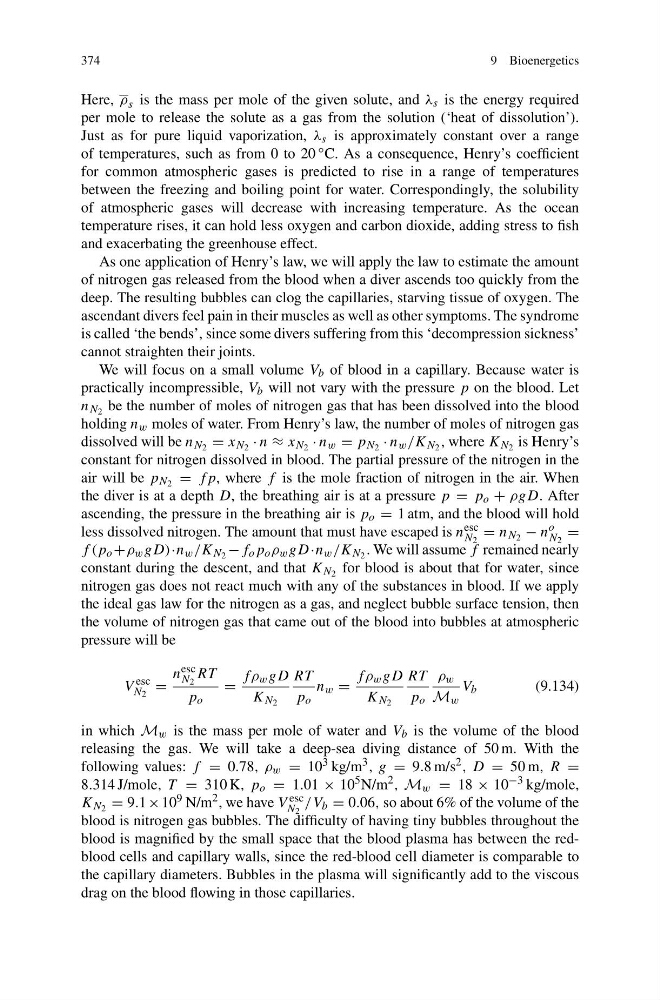
V
esc
N 2
=
n esc
N 2
RT
p o
=
fρ w gD
K N 2
RT
p o
n w =
fρ w gD
K N 2
RT
p o
ρ w
M w
V b
(9.134)
in which M w is the mass per mole of water and V b is the volume of the blood
releasing the gas. We will take a deep-sea diving distance of 50 m. With the
following values: f = 0.78, ρ w = 10 3 kg/m
3 , g = 9.8 m/s
2 , D = 50 m, R =
8.314 J/mole, T = 310 K, p o = 1.01 × 10 5 N/m
2 , M w = 18 × 10 −3 kg/mole,
K N 2 = 9.1 × 10 9 N/m
2 , we have V esc
N 2
/V b = 0.06, so about 6% of the volume of the
blood is nitrogen gas bubbles. The difficulty of having tiny bubbles throughout the
blood is magnified by the small space that the blood plasma has between the redblood cells and capillary walls, since the red-blood cell diameter is comparable to
the capillary diameters. Bubbles in the plasma will significantly add to the viscous
drag on the blood flowing in those capillaries.
9 Bioenergetics
Here, ρ s is the mass per mole of the given solute, and λ s is the energy required
per mole to release the solute as a gas from the solution (‘heat of dissolution’).
Just as for pure liquid vaporization, λ s is approximately constant over a range
of temperatures, such as from 0 to 20 ◦ C. As a consequence, Henry’s coefficient
for common atmospheric gases is predicted to rise in a range of temperatures
between the freezing and boiling point for water. Correspondingly, the solubility
of atmospheric gases will decrease with increasing temperature. As the ocean
temperature rises, it can hold less oxygen and carbon dioxide, adding stress to fish
and exacerbating the greenhouse effect.
As one application of Henry’s law, we will apply the law to estimate the amount
of nitrogen gas released from the blood when a diver ascends too quickly from the
deep. The resulting bubbles can clog the capillaries, starving tissue of oxygen. The
ascendant divers feel pain in their muscles as well as other symptoms. The syndrome
is called ‘the bends’, since some divers suffering from this ‘decompression sickness’
cannot straighten their joints.
We will focus on a small volume V b of blood in a capillary. Because water is
practically incompressible, V b will not vary with the pressure p on the blood. Let
n N 2 be the number of moles of nitrogen gas that has been dissolved into the blood
holding n w moles of water. From Henry’s law, the number of moles of nitrogen gas
dissolved will be n N 2 = x N 2 · n ≈ x N 2 · n w = p N 2 · n w /K N 2 , where K N 2 is Henry’s
constant for nitrogen dissolved in blood. The partial pressure of the nitrogen in the
air will be p N 2 = fp, where f is the mole fraction of nitrogen in the air. When
the diver is at a depth D, the breathing air is at a pressure p = p o + ρgD. After
ascending, the pressure in the breathing air is p o = 1 atm, and the blood will hold
less dissolved nitrogen. The amount that must have escaped is n esc
N 2
= n N 2 − n o
N 2
=
f (p o +ρ w gD)·n w /K N 2 −f o p o ρ w gD·n w /K N 2 . We will assume f remained nearly
constant during the descent, and that K N 2 for blood is about that for water, since
nitrogen gas does not react much with any of the substances in blood. If we apply
the ideal gas law for the nitrogen as a gas, and neglect bubble surface tension, then
the volume of nitrogen gas that came out of the blood into bubbles at atmospheric
pressure will be
V
esc
N 2
=
n esc
N 2
RT
p o
=
fρ w gD
K N 2
RT
p o
n w =
fρ w gD
K N 2
RT
p o
ρ w
M w
V b
(9.134)
in which M w is the mass per mole of water and V b is the volume of the blood
releasing the gas. We will take a deep-sea diving distance of 50 m. With the
following values: f = 0.78, ρ w = 10 3 kg/m
3 , g = 9.8 m/s
2 , D = 50 m, R =
8.314 J/mole, T = 310 K, p o = 1.01 × 10 5 N/m
2 , M w = 18 × 10 −3 kg/mole,
K N 2 = 9.1 × 10 9 N/m
2 , we have V esc
N 2
/V b = 0.06, so about 6% of the volume of the
blood is nitrogen gas bubbles. The difficulty of having tiny bubbles throughout the
blood is magnified by the small space that the blood plasma has between the redblood cells and capillary walls, since the red-blood cell diameter is comparable to
the capillary diameters. Bubbles in the plasma will significantly add to the viscous
drag on the blood flowing in those capillaries.