

9.16 Maxwell Relations
367
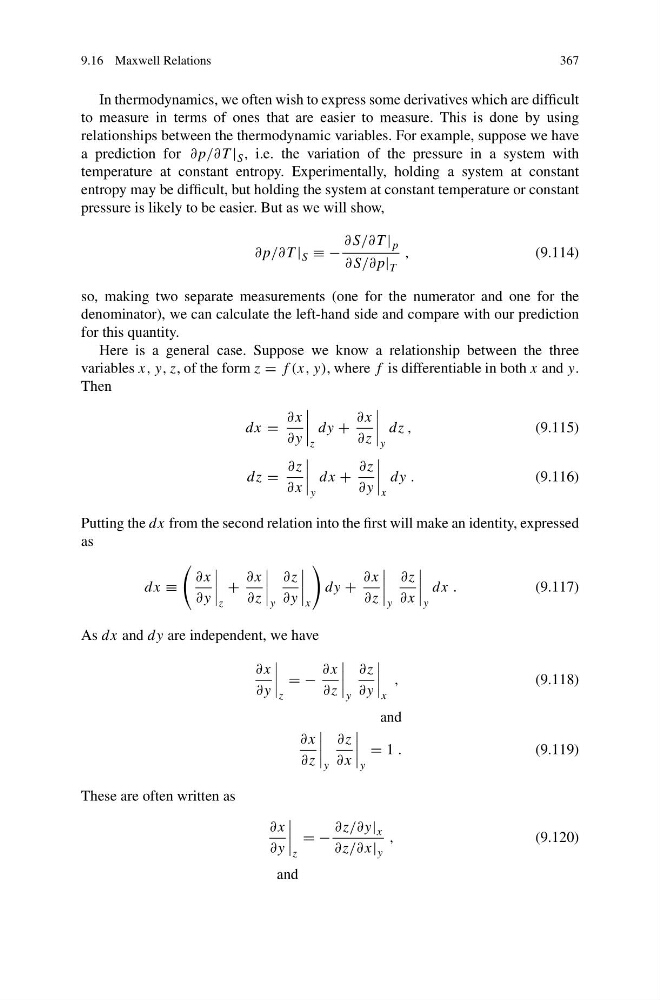
In thermodynamics, we often wish to express some derivatives which are difficult
to measure in terms of ones that are easier to measure. This is done by using
relationships between the thermodynamic variables. For example, suppose we have
a prediction for ∂p/∂T | S , i.e. the variation of the pressure in a system with
temperature at constant entropy. Experimentally, holding a system at constant
entropy may be difficult, but holding the system at constant temperature or constant
pressure is likely to be easier. But as we will show,
∂p/∂T | S ≡ −
∂S/∂T | p
∂S/∂p| T
,
(9.114)
so, making two separate measurements (one for the numerator and one for the
denominator), we can calculate the left-hand side and compare with our prediction
for this quantity.
Here is a general case. Suppose we know a relationship between the three
variables x, y, z, of the form z = f (x, y), where f is differentiable in both x and y.
Then
dx =
∂x
∂y
z
dy +
∂x
∂z
y
dz ,
(9.115)
dz =
∂z
∂x
y
dx +
∂z
∂y
x
dy .
(9.116)
Putting the dx from the second relation into the first will make an identity, expressed
as
dx ≡
∂x
∂y
z
+
∂x
∂z
y
∂z
∂y
x
dy +
∂x
∂z
y
∂z
∂x
y
dx .
(9.117)
As dx and dy are independent, we have
∂x
∂y
z
= −
∂x
∂z
y
∂z
∂y
x
,
(9.118)
and
∂x
∂z
y
∂z
∂x
y
= 1 .
(9.119)
These are often written as
∂x
∂y
z
= −
∂z/∂y| x
∂z/∂x| y
,
(9.120)
and
367
In thermodynamics, we often wish to express some derivatives which are difficult
to measure in terms of ones that are easier to measure. This is done by using
relationships between the thermodynamic variables. For example, suppose we have
a prediction for ∂p/∂T | S , i.e. the variation of the pressure in a system with
temperature at constant entropy. Experimentally, holding a system at constant
entropy may be difficult, but holding the system at constant temperature or constant
pressure is likely to be easier. But as we will show,
∂p/∂T | S ≡ −
∂S/∂T | p
∂S/∂p| T
,
(9.114)
so, making two separate measurements (one for the numerator and one for the
denominator), we can calculate the left-hand side and compare with our prediction
for this quantity.
Here is a general case. Suppose we know a relationship between the three
variables x, y, z, of the form z = f (x, y), where f is differentiable in both x and y.
Then
dx =
∂x
∂y
z
dy +
∂x
∂z
y
dz ,
(9.115)
dz =
∂z
∂x
y
dx +
∂z
∂y
x
dy .
(9.116)
Putting the dx from the second relation into the first will make an identity, expressed
as
dx ≡
∂x
∂y
z
+
∂x
∂z
y
∂z
∂y
x
dy +
∂x
∂z
y
∂z
∂x
y
dx .
(9.117)
As dx and dy are independent, we have
∂x
∂y
z
= −
∂x
∂z
y
∂z
∂y
x
,
(9.118)
and
∂x
∂z
y
∂z
∂x
y
= 1 .
(9.119)
These are often written as
∂x
∂y
z
= −
∂z/∂y| x
∂z/∂x| y
,
(9.120)
and