

2.2 Mixtures, Solutions, Colloids, Sols, and Gels
21
Fig. 2.2 Representative
scattered-light intensity
variation due to Brownian
motion of colloidal particles
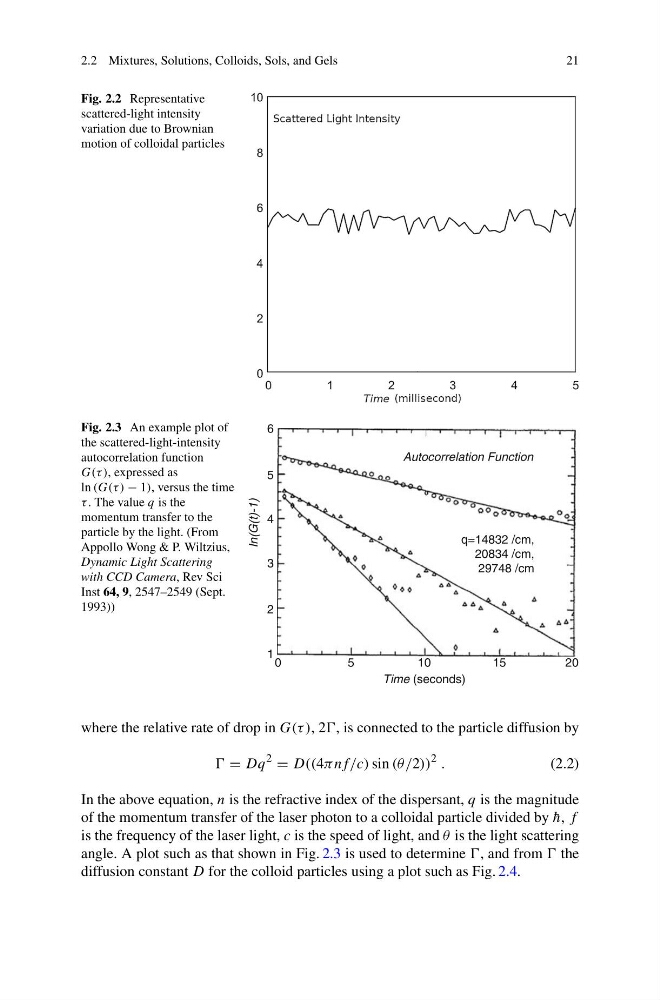
Fig. 2.3 An example plot of
the scattered-light-intensity
autocorrelation function
G(τ ), expressed as
ln (G(τ ) − 1), versus the time
τ . The value q is the
momentum transfer to the
particle by the light. (From
Appollo Wong & P. Wiltzius,
Dynamic Light Scattering
with CCD Camera, Rev Sci
Inst 64, 9, 2547–2549 (Sept.
1993))
6
5
4
3
2
1
0
5
1 0
q=14832 /cm,
20834 /cm,
29748 /cm
Time (seconds)
Autocorrelation Function
In(G(t)-1)
15
20
where the relative rate of drop in G(τ ), 2, is connected to the particle diffusion by
= Dq
2
= D((4πnf/c) sin (θ/2))
2 .
(2.2)
In the above equation, n is the refractive index of the dispersant, q is the magnitude
of the momentum transfer of the laser photon to a colloidal particle divided by ¯
h, f
is the frequency of the laser light, c is the speed of light, and θ is the light scattering
angle. A plot such as that shown in Fig. 2.3 is used to determine , and from the
diffusion constant D for the colloid particles using a plot such as Fig. 2.4.
21
Fig. 2.2 Representative
scattered-light intensity
variation due to Brownian
motion of colloidal particles
Fig. 2.3 An example plot of
the scattered-light-intensity
autocorrelation function
G(τ ), expressed as
ln (G(τ ) − 1), versus the time
τ . The value q is the
momentum transfer to the
particle by the light. (From
Appollo Wong & P. Wiltzius,
Dynamic Light Scattering
with CCD Camera, Rev Sci
Inst 64, 9, 2547–2549 (Sept.
1993))
6
5
4
3
2
1
0
5
1 0
q=14832 /cm,
20834 /cm,
29748 /cm
Time (seconds)
Autocorrelation Function
In(G(t)-1)
15
20
where the relative rate of drop in G(τ ), 2, is connected to the particle diffusion by
= Dq
2
= D((4πnf/c) sin (θ/2))
2 .
(2.2)
In the above equation, n is the refractive index of the dispersant, q is the magnitude
of the momentum transfer of the laser photon to a colloidal particle divided by ¯
h, f
is the frequency of the laser light, c is the speed of light, and θ is the light scattering
angle. A plot such as that shown in Fig. 2.3 is used to determine , and from the
diffusion constant D for the colloid particles using a plot such as Fig. 2.4.