

360
9 Bioenergetics
9.13.2 Helmholtz Free Energy
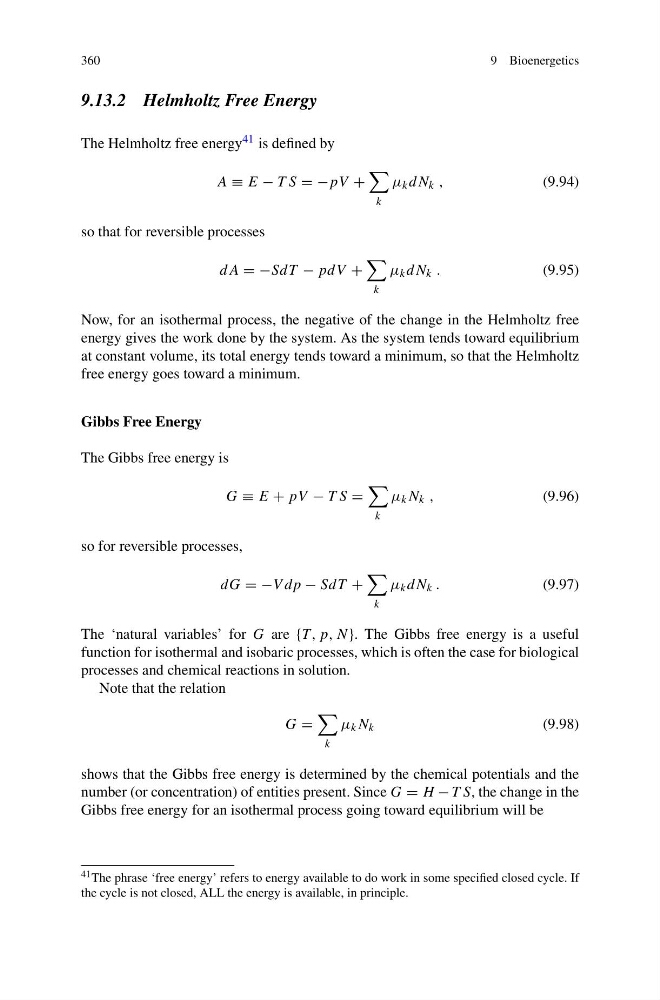
The Helmholtz free energy 41 is defined by
A ≡ E − T S = −pV +
k
μ k dN k ,
(9.94)
so that for reversible processes
dA = −SdT − pdV +
k
μ k dN k .
(9.95)
Now, for an isothermal process, the negative of the change in the Helmholtz free
energy gives the work done by the system. As the system tends toward equilibrium
at constant volume, its total energy tends toward a minimum, so that the Helmholtz
free energy goes toward a minimum.
Gibbs Free Energy
The Gibbs free energy is
G ≡ E + pV − T S =
k
μ k N k ,
(9.96)
so for reversible processes,
dG = −V dp − SdT +
k
μ k dN k .
(9.97)
The ‘natural variables’ for G are {T , p, N}. The Gibbs free energy is a useful
function for isothermal and isobaric processes, which is often the case for biological
processes and chemical reactions in solution.
Note that the relation
G =
k
μ k N k
(9.98)
shows that the Gibbs free energy is determined by the chemical potentials and the
number (or concentration) of entities present. Since G = H − T S, the change in the
Gibbs free energy for an isothermal process going toward equilibrium will be
41 The phrase ‘free energy’ refers to energy available to do work in some specified closed cycle. If
the cycle is not closed, ALL the energy is available, in principle.
9 Bioenergetics
9.13.2 Helmholtz Free Energy
The Helmholtz free energy 41 is defined by
A ≡ E − T S = −pV +
k
μ k dN k ,
(9.94)
so that for reversible processes
dA = −SdT − pdV +
k
μ k dN k .
(9.95)
Now, for an isothermal process, the negative of the change in the Helmholtz free
energy gives the work done by the system. As the system tends toward equilibrium
at constant volume, its total energy tends toward a minimum, so that the Helmholtz
free energy goes toward a minimum.
Gibbs Free Energy
The Gibbs free energy is
G ≡ E + pV − T S =
k
μ k N k ,
(9.96)
so for reversible processes,
dG = −V dp − SdT +
k
μ k dN k .
(9.97)
The ‘natural variables’ for G are {T , p, N}. The Gibbs free energy is a useful
function for isothermal and isobaric processes, which is often the case for biological
processes and chemical reactions in solution.
Note that the relation
G =
k
μ k N k
(9.98)
shows that the Gibbs free energy is determined by the chemical potentials and the
number (or concentration) of entities present. Since G = H − T S, the change in the
Gibbs free energy for an isothermal process going toward equilibrium will be
41 The phrase ‘free energy’ refers to energy available to do work in some specified closed cycle. If
the cycle is not closed, ALL the energy is available, in principle.