

9.11 The Thermodynamic Entropy of a System
355
C v =
∂E/∂S
∂ 2 E/∂S 2 .
(9.77)
Expressions equivalent to the fundamental equation of state E = E(S, V , N)
can be found by favoring a set of thermodynamic variables other than (S, V , N) in
which to express the measurable quantities. For example, S = S(E, V , N) serves
just as well.
9.11.1 Equations of State for an Ideal Gas
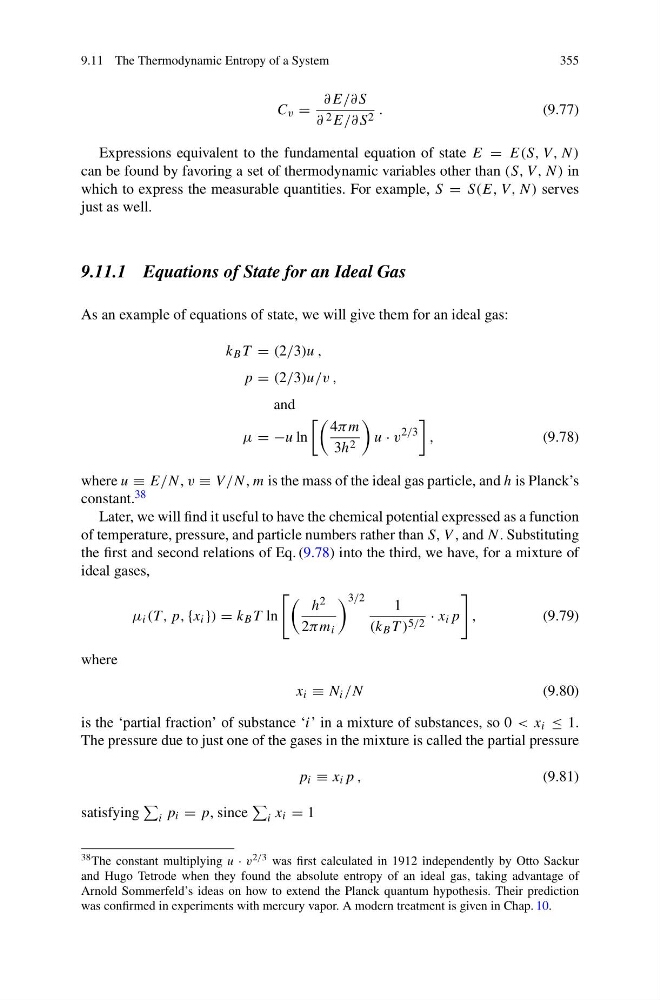
As an example of equations of state, we will give them for an ideal gas:
k B T = (2/3)u ,
p = (2/3)u/v ,
and
μ = −u ln
4πm
3h 2
u · v
2/3
,
(9.78)
where u ≡ E/N, v ≡ V /N, m is the mass of the ideal gas particle, and h is Planck’s
constant. 38
Later, we will find it useful to have the chemical potential expressed as a function
of temperature, pressure, and particle numbers rather than S, V , and N . Substituting
the first and second relations of Eq. (9.78) into the third, we have, for a mixture of
ideal gases,
μ i (T , p, {x i }) = k B T ln
h 2
2πm i
3/2
1
(k B T ) 5/2 · x i p
,
(9.79)
where
x i ≡ N i /N
(9.80)
is the ‘partial fraction’ of substance ‘i’ in a mixture of substances, so 0 < x i ≤ 1.
The pressure due to just one of the gases in the mixture is called the partial pressure
p i ≡ x i p ,
(9.81)
satisfying
i p i = p, since
i x i = 1
38 The constant multiplying u · v 2/3 was first calculated in 1912 independently by Otto Sackur
and Hugo Tetrode when they found the absolute entropy of an ideal gas, taking advantage of
Arnold Sommerfeld’s ideas on how to extend the Planck quantum hypothesis. Their prediction
was confirmed in experiments with mercury vapor. A modern treatment is given in Chap. 10.
355
C v =
∂E/∂S
∂ 2 E/∂S 2 .
(9.77)
Expressions equivalent to the fundamental equation of state E = E(S, V , N)
can be found by favoring a set of thermodynamic variables other than (S, V , N) in
which to express the measurable quantities. For example, S = S(E, V , N) serves
just as well.
9.11.1 Equations of State for an Ideal Gas
As an example of equations of state, we will give them for an ideal gas:
k B T = (2/3)u ,
p = (2/3)u/v ,
and
μ = −u ln
4πm
3h 2
u · v
2/3
,
(9.78)
where u ≡ E/N, v ≡ V /N, m is the mass of the ideal gas particle, and h is Planck’s
constant. 38
Later, we will find it useful to have the chemical potential expressed as a function
of temperature, pressure, and particle numbers rather than S, V , and N . Substituting
the first and second relations of Eq. (9.78) into the third, we have, for a mixture of
ideal gases,
μ i (T , p, {x i }) = k B T ln
h 2
2πm i
3/2
1
(k B T ) 5/2 · x i p
,
(9.79)
where
x i ≡ N i /N
(9.80)
is the ‘partial fraction’ of substance ‘i’ in a mixture of substances, so 0 < x i ≤ 1.
The pressure due to just one of the gases in the mixture is called the partial pressure
p i ≡ x i p ,
(9.81)
satisfying
i p i = p, since
i x i = 1
38 The constant multiplying u · v 2/3 was first calculated in 1912 independently by Otto Sackur
and Hugo Tetrode when they found the absolute entropy of an ideal gas, taking advantage of
Arnold Sommerfeld’s ideas on how to extend the Planck quantum hypothesis. Their prediction
was confirmed in experiments with mercury vapor. A modern treatment is given in Chap. 10.