

9.11 The Thermodynamic Entropy of a System
351
E
rev
= 1 −
T C
T H
=
T H − T C
T H
.
(9.63)
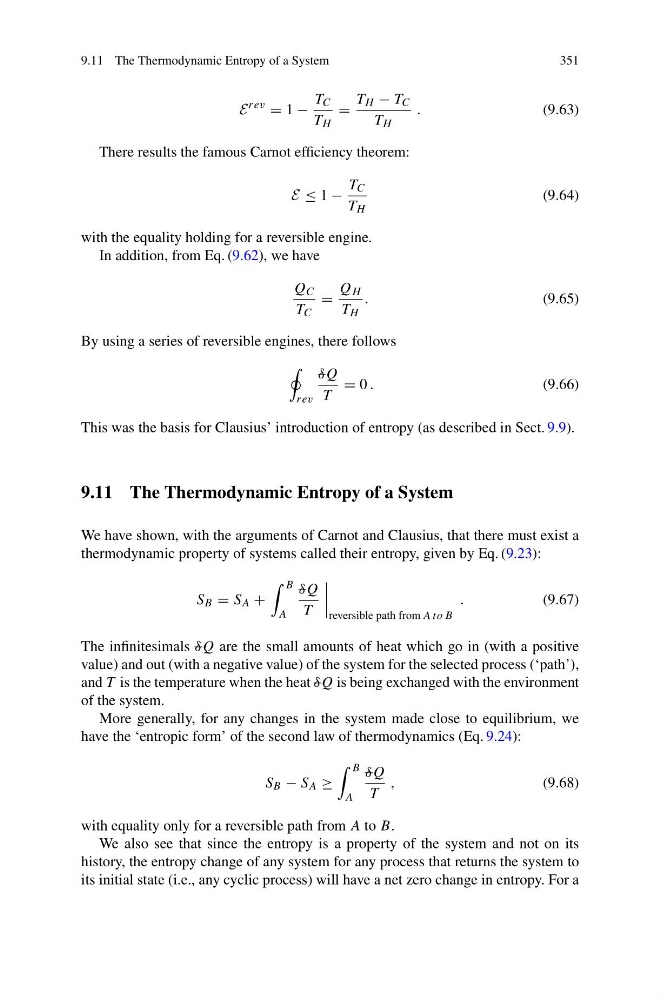
There results the famous Carnot efficiency theorem:
E ≤ 1 −
T C
T H
(9.64)
with the equality holding for a reversible engine.
In addition, from Eq. (9.62), we have
Q C
T C
=
Q H
T H
.
(9.65)
By using a series of reversible engines, there follows
rev
δQ
T
= 0 .
(9.66)
This was the basis for Clausius’ introduction of entropy (as described in Sect. 9.9).
9.11 The Thermodynamic Entropy of a System
We have shown, with the arguments of Carnot and Clausius, that there must exist a
thermodynamic property of systems called their entropy, given by Eq. (9.23):
S B = S A +
B
A
δQ
T
reversible path from A to B
.
(9.67)
The infinitesimals δQ are the small amounts of heat which go in (with a positive
value) and out (with a negative value) of the system for the selected process (‘path’),
and T is the temperature when the heat δQ is being exchanged with the environment
of the system.
More generally, for any changes in the system made close to equilibrium, we
have the ‘entropic form’ of the second law of thermodynamics (Eq. 9.24):
S B − S A ≥
B
A
δQ
T
,
(9.68)
with equality only for a reversible path from A to B.
We also see that since the entropy is a property of the system and not on its
history, the entropy change of any system for any process that returns the system to
its initial state (i.e., any cyclic process) will have a net zero change in entropy. For a
351
E
rev
= 1 −
T C
T H
=
T H − T C
T H
.
(9.63)
There results the famous Carnot efficiency theorem:
E ≤ 1 −
T C
T H
(9.64)
with the equality holding for a reversible engine.
In addition, from Eq. (9.62), we have
Q C
T C
=
Q H
T H
.
(9.65)
By using a series of reversible engines, there follows
rev
δQ
T
= 0 .
(9.66)
This was the basis for Clausius’ introduction of entropy (as described in Sect. 9.9).
9.11 The Thermodynamic Entropy of a System
We have shown, with the arguments of Carnot and Clausius, that there must exist a
thermodynamic property of systems called their entropy, given by Eq. (9.23):
S B = S A +
B
A
δQ
T
reversible path from A to B
.
(9.67)
The infinitesimals δQ are the small amounts of heat which go in (with a positive
value) and out (with a negative value) of the system for the selected process (‘path’),
and T is the temperature when the heat δQ is being exchanged with the environment
of the system.
More generally, for any changes in the system made close to equilibrium, we
have the ‘entropic form’ of the second law of thermodynamics (Eq. 9.24):
S B − S A ≥
B
A
δQ
T
,
(9.68)
with equality only for a reversible path from A to B.
We also see that since the entropy is a property of the system and not on its
history, the entropy change of any system for any process that returns the system to
its initial state (i.e., any cyclic process) will have a net zero change in entropy. For a