

346
9 Bioenergetics
Using the idea of a reversible heat engine, and with pure logical thought alone,
Carnot came to very far-reaching conclusions. These conclusions lead to the concept
of measurable order and disorder in all thermodynamic systems.
The efficiency of a heat engine is defined as
E =
W
Q H
.
(9.31)
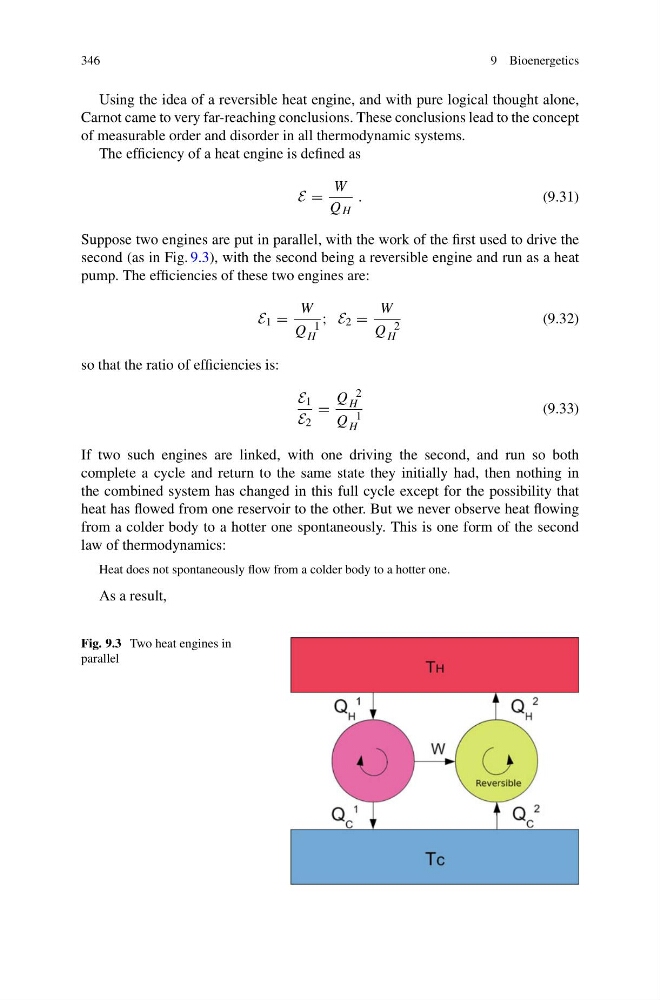
Suppose two engines are put in parallel, with the work of the first used to drive the
second (as in Fig. 9.3), with the second being a reversible engine and run as a heat
pump. The efficiencies of these two engines are:
E 1 =
W
Q 1
H
; E 2 =
W
Q 2
H
(9.32)
so that the ratio of efficiencies is:
E 1
E 2
=
Q 2
H
Q 1
H
(9.33)
If two such engines are linked, with one driving the second, and run so both
complete a cycle and return to the same state they initially had, then nothing in
the combined system has changed in this full cycle except for the possibility that
heat has flowed from one reservoir to the other. But we never observe heat flowing
from a colder body to a hotter one spontaneously. This is one form of the second
law of thermodynamics:
Heat does not spontaneously flow from a colder body to a hotter one.
As a result,
Fig. 9.3 Two heat engines in
parallel
9 Bioenergetics
Using the idea of a reversible heat engine, and with pure logical thought alone,
Carnot came to very far-reaching conclusions. These conclusions lead to the concept
of measurable order and disorder in all thermodynamic systems.
The efficiency of a heat engine is defined as
E =
W
Q H
.
(9.31)
Suppose two engines are put in parallel, with the work of the first used to drive the
second (as in Fig. 9.3), with the second being a reversible engine and run as a heat
pump. The efficiencies of these two engines are:
E 1 =
W
Q 1
H
; E 2 =
W
Q 2
H
(9.32)
so that the ratio of efficiencies is:
E 1
E 2
=
Q 2
H
Q 1
H
(9.33)
If two such engines are linked, with one driving the second, and run so both
complete a cycle and return to the same state they initially had, then nothing in
the combined system has changed in this full cycle except for the possibility that
heat has flowed from one reservoir to the other. But we never observe heat flowing
from a colder body to a hotter one spontaneously. This is one form of the second
law of thermodynamics:
Heat does not spontaneously flow from a colder body to a hotter one.
As a result,
Fig. 9.3 Two heat engines in
parallel