

344
9 Bioenergetics
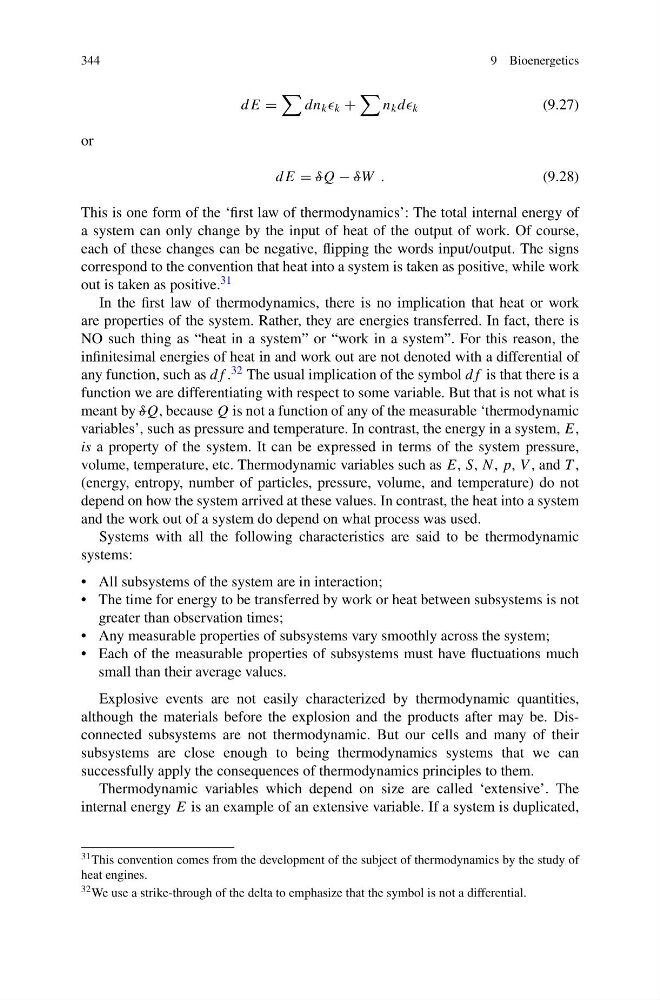
dE =
dn k k +
n k dd k
(9.27)
or
dE = δQ − δW .
(9.28)
This is one form of the ‘first law of thermodynamics’: The total internal energy of
a system can only change by the input of heat of the output of work. Of course,
each of these changes can be negative, flipping the words input/output. The signs
correspond to the convention that heat into a system is taken as positive, while work
out is taken as positive. 31
In the first law of thermodynamics, there is no implication that heat or work
are properties of the system. Rather, they are energies transferred. In fact, there is
NO such thing as “heat in a system” or “work in a system”. For this reason, the
infinitesimal energies of heat in and work out are not denoted with a differential of
any function, such as df . 32 The usual implication of the symbol df is that there is a
function we are differentiating with respect to some variable. But that is not what is
meant by δQ, because Q is not a function of any of the measurable ‘thermodynamic
variables’, such as pressure and temperature. In contrast, the energy in a system, E,
is a property of the system. It can be expressed in terms of the system pressure,
volume, temperature, etc. Thermodynamic variables such as E, S, N , p, V , and T ,
(energy, entropy, number of particles, pressure, volume, and temperature) do not
depend on how the system arrived at these values. In contrast, the heat into a system
and the work out of a system do depend on what process was used.
Systems with all the following characteristics are said to be thermodynamic
systems:
• All subsystems of the system are in interaction;
• The time for energy to be transferred by work or heat between subsystems is not
greater than observation times;
• Any measurable properties of subsystems vary smoothly across the system;
• Each of the measurable properties of subsystems must have fluctuations much
small than their average values.
Explosive events are not easily characterized by thermodynamic quantities,
although the materials before the explosion and the products after may be. Disconnected subsystems are not thermodynamic. But our cells and many of their
subsystems are close enough to being thermodynamics systems that we can
successfully apply the consequences of thermodynamics principles to them.
Thermodynamic variables which depend on size are called ‘extensive’. The
internal energy E is an example of an extensive variable. If a system is duplicated,
31 This convention comes from the development of the subject of thermodynamics by the study of
heat engines.
32 We use a strike-through of the delta to emphasize that the symbol is not a differential.
9 Bioenergetics
dE =
dn k k +
n k dd k
(9.27)
or
dE = δQ − δW .
(9.28)
This is one form of the ‘first law of thermodynamics’: The total internal energy of
a system can only change by the input of heat of the output of work. Of course,
each of these changes can be negative, flipping the words input/output. The signs
correspond to the convention that heat into a system is taken as positive, while work
out is taken as positive. 31
In the first law of thermodynamics, there is no implication that heat or work
are properties of the system. Rather, they are energies transferred. In fact, there is
NO such thing as “heat in a system” or “work in a system”. For this reason, the
infinitesimal energies of heat in and work out are not denoted with a differential of
any function, such as df . 32 The usual implication of the symbol df is that there is a
function we are differentiating with respect to some variable. But that is not what is
meant by δQ, because Q is not a function of any of the measurable ‘thermodynamic
variables’, such as pressure and temperature. In contrast, the energy in a system, E,
is a property of the system. It can be expressed in terms of the system pressure,
volume, temperature, etc. Thermodynamic variables such as E, S, N , p, V , and T ,
(energy, entropy, number of particles, pressure, volume, and temperature) do not
depend on how the system arrived at these values. In contrast, the heat into a system
and the work out of a system do depend on what process was used.
Systems with all the following characteristics are said to be thermodynamic
systems:
• All subsystems of the system are in interaction;
• The time for energy to be transferred by work or heat between subsystems is not
greater than observation times;
• Any measurable properties of subsystems vary smoothly across the system;
• Each of the measurable properties of subsystems must have fluctuations much
small than their average values.
Explosive events are not easily characterized by thermodynamic quantities,
although the materials before the explosion and the products after may be. Disconnected subsystems are not thermodynamic. But our cells and many of their
subsystems are close enough to being thermodynamics systems that we can
successfully apply the consequences of thermodynamics principles to them.
Thermodynamic variables which depend on size are called ‘extensive’. The
internal energy E is an example of an extensive variable. If a system is duplicated,
31 This convention comes from the development of the subject of thermodynamics by the study of
heat engines.
32 We use a strike-through of the delta to emphasize that the symbol is not a differential.