

342
9 Bioenergetics
S = S o +
rev
δQ
T
.
(9.23)
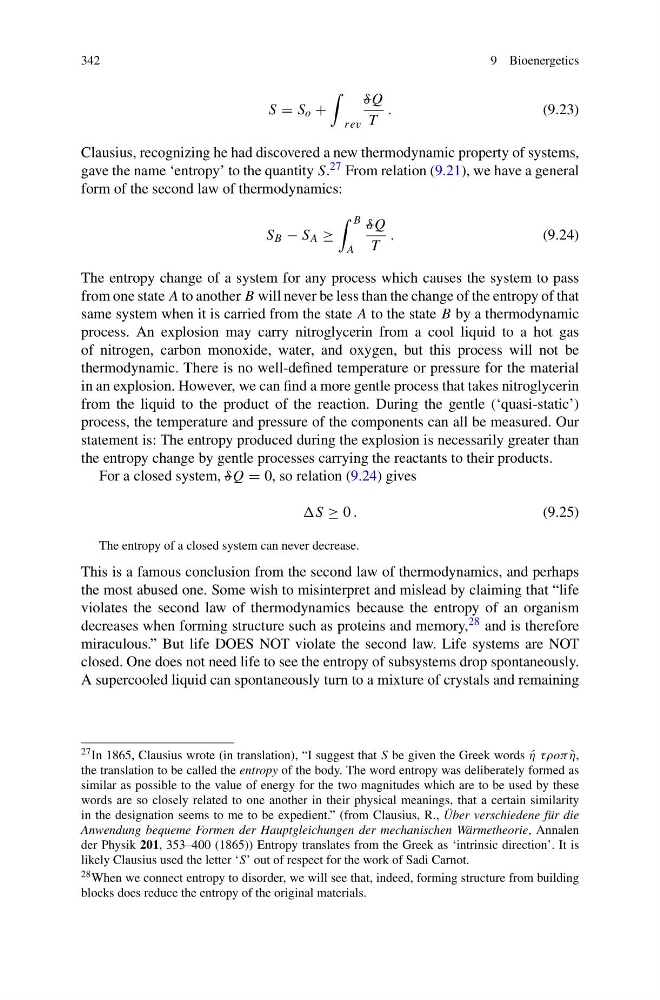
Clausius, recognizing he had discovered a new thermodynamic property of systems,
gave the name ‘entropy’ to the quantity S. 27 From relation (9.21), we have a general
form of the second law of thermodynamics:
S B − S A ≥
B
A
δQ
T
.
(9.24)
The entropy change of a system for any process which causes the system to pass
from one state A to another B will never be less than the change of the entropy of that
same system when it is carried from the state A to the state B by a thermodynamic
process. An explosion may carry nitroglycerin from a cool liquid to a hot gas
of nitrogen, carbon monoxide, water, and oxygen, but this process will not be
thermodynamic. There is no well-defined temperature or pressure for the material
in an explosion. However, we can find a more gentle process that takes nitroglycerin
from the liquid to the product of the reaction. During the gentle (‘quasi-static’)
process, the temperature and pressure of the components can all be measured. Our
statement is: The entropy produced during the explosion is necessarily greater than
the entropy change by gentle processes carrying the reactants to their products.
For a closed system, δQ = 0, so relation (9.24) gives
S ≥ 0 .
(9.25)
The entropy of a closed system can never decrease.
This is a famous conclusion from the second law of thermodynamics, and perhaps
the most abused one. Some wish to misinterpret and mislead by claiming that “life
violates the second law of thermodynamics because the entropy of an organism
decreases when forming structure such as proteins and memory, 28 and is therefore
miraculous.” But life DOES NOT violate the second law. Life systems are NOT
closed. One does not need life to see the entropy of subsystems drop spontaneously.
A supercooled liquid can spontaneously turn to a mixture of crystals and remaining
27 In 1865, Clausius wrote (in translation), “I suggest that S be given the Greek words ´
η τρoπ `
η,
the translation to be called the entropy of the body. The word entropy was deliberately formed as
similar as possible to the value of energy for the two magnitudes which are to be used by these
words are so closely related to one another in their physical meanings, that a certain similarity
in the designation seems to me to be expedient.” (from Clausius, R., Über verschiedene für die
Anwendung bequeme Formen der Hauptgleichungen der mechanischen Wärmetheorie, Annalen
der Physik 201, 353–400 (1865)) Entropy translates from the Greek as ‘intrinsic direction’. It is
likely Clausius used the letter ‘S’ out of respect for the work of Sadi Carnot.
28 When we connect entropy to disorder, we will see that, indeed, forming structure from building
blocks does reduce the entropy of the original materials.
9 Bioenergetics
S = S o +
rev
δQ
T
.
(9.23)
Clausius, recognizing he had discovered a new thermodynamic property of systems,
gave the name ‘entropy’ to the quantity S. 27 From relation (9.21), we have a general
form of the second law of thermodynamics:
S B − S A ≥
B
A
δQ
T
.
(9.24)
The entropy change of a system for any process which causes the system to pass
from one state A to another B will never be less than the change of the entropy of that
same system when it is carried from the state A to the state B by a thermodynamic
process. An explosion may carry nitroglycerin from a cool liquid to a hot gas
of nitrogen, carbon monoxide, water, and oxygen, but this process will not be
thermodynamic. There is no well-defined temperature or pressure for the material
in an explosion. However, we can find a more gentle process that takes nitroglycerin
from the liquid to the product of the reaction. During the gentle (‘quasi-static’)
process, the temperature and pressure of the components can all be measured. Our
statement is: The entropy produced during the explosion is necessarily greater than
the entropy change by gentle processes carrying the reactants to their products.
For a closed system, δQ = 0, so relation (9.24) gives
S ≥ 0 .
(9.25)
The entropy of a closed system can never decrease.
This is a famous conclusion from the second law of thermodynamics, and perhaps
the most abused one. Some wish to misinterpret and mislead by claiming that “life
violates the second law of thermodynamics because the entropy of an organism
decreases when forming structure such as proteins and memory, 28 and is therefore
miraculous.” But life DOES NOT violate the second law. Life systems are NOT
closed. One does not need life to see the entropy of subsystems drop spontaneously.
A supercooled liquid can spontaneously turn to a mixture of crystals and remaining
27 In 1865, Clausius wrote (in translation), “I suggest that S be given the Greek words ´
η τρoπ `
η,
the translation to be called the entropy of the body. The word entropy was deliberately formed as
similar as possible to the value of energy for the two magnitudes which are to be used by these
words are so closely related to one another in their physical meanings, that a certain similarity
in the designation seems to me to be expedient.” (from Clausius, R., Über verschiedene für die
Anwendung bequeme Formen der Hauptgleichungen der mechanischen Wärmetheorie, Annalen
der Physik 201, 353–400 (1865)) Entropy translates from the Greek as ‘intrinsic direction’. It is
likely Clausius used the letter ‘S’ out of respect for the work of Sadi Carnot.
28 When we connect entropy to disorder, we will see that, indeed, forming structure from building
blocks does reduce the entropy of the original materials.