

18
2 The Kinds of Ordinary Materials
Table 2.1 Colloid phase possibilities
Dispersed particles
Gas
Liquid
Solid
Medium Gas
[Vapor]
Droplet aerosol
Particulate aerosol
e.g. Moist air
e.g. Fog, mist
e.g. Smoke
Liquid
Fluid foam
Emulsion
Liquid sol
e.g. Whipped
cream
e.g. Milk, blood,
pharmaceutical creams
e.g. Paint, ink,
sol-cytoplasm
Solid
Rigid foam
Rigid gel
Rigid sol
e.g. Aerogels,
styrofoam
e.g. Gelatin,
gelcytoplasm
e.g. Bone, ruby glass
Vapor here is not strictly a colloid, but rather a gas-gas solution
A froth is a fluid foam stabilized by solid particles
trations occurs through collisions of those particles with the background molecules,
a process first properly described by Einstein in 1905. 11 We will return to a more
detailed description of the diffusion of substances such as perfume in air or oxygen
from a blood cell in Sect. 9.20.
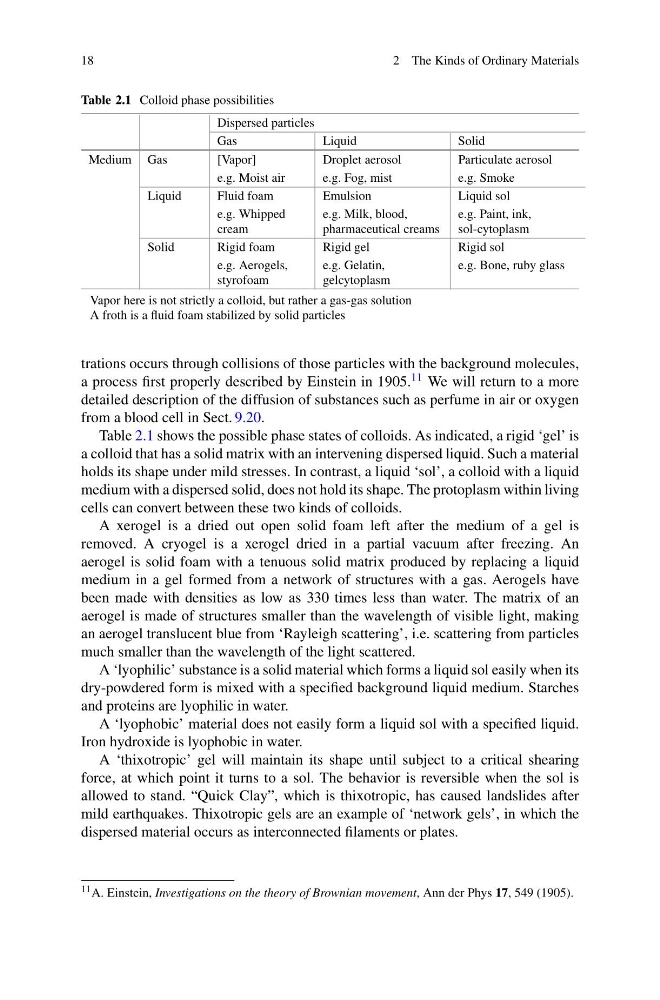
Table 2.1 shows the possible phase states of colloids. As indicated, a rigid ‘gel’ is
a colloid that has a solid matrix with an intervening dispersed liquid. Such a material
holds its shape under mild stresses. In contrast, a liquid ‘sol’, a colloid with a liquid
medium with a dispersed solid, does not hold its shape. The protoplasm within living
cells can convert between these two kinds of colloids.
A xerogel is a dried out open solid foam left after the medium of a gel is
removed. A cryogel is a xerogel dried in a partial vacuum after freezing. An
aerogel is solid foam with a tenuous solid matrix produced by replacing a liquid
medium in a gel formed from a network of structures with a gas. Aerogels have
been made with densities as low as 330 times less than water. The matrix of an
aerogel is made of structures smaller than the wavelength of visible light, making
an aerogel translucent blue from ‘Rayleigh scattering’, i.e. scattering from particles
much smaller than the wavelength of the light scattered.
A ‘lyophilic’ substance is a solid material which forms a liquid sol easily when its
dry-powdered form is mixed with a specified background liquid medium. Starches
and proteins are lyophilic in water.
A ‘lyophobic’ material does not easily form a liquid sol with a specified liquid.
Iron hydroxide is lyophobic in water.
A ‘thixotropic’ gel will maintain its shape until subject to a critical shearing
force, at which point it turns to a sol. The behavior is reversible when the sol is
allowed to stand. “Quick Clay”, which is thixotropic, has caused landslides after
mild earthquakes. Thixotropic gels are an example of ‘network gels’, in which the
dispersed material occurs as interconnected filaments or plates.
11 A. Einstein, Investigations on the theory of Brownian movement, Ann der Phys 17, 549 (1905).
2 The Kinds of Ordinary Materials
Table 2.1 Colloid phase possibilities
Dispersed particles
Gas
Liquid
Solid
Medium Gas
[Vapor]
Droplet aerosol
Particulate aerosol
e.g. Moist air
e.g. Fog, mist
e.g. Smoke
Liquid
Fluid foam
Emulsion
Liquid sol
e.g. Whipped
cream
e.g. Milk, blood,
pharmaceutical creams
e.g. Paint, ink,
sol-cytoplasm
Solid
Rigid foam
Rigid gel
Rigid sol
e.g. Aerogels,
styrofoam
e.g. Gelatin,
gelcytoplasm
e.g. Bone, ruby glass
Vapor here is not strictly a colloid, but rather a gas-gas solution
A froth is a fluid foam stabilized by solid particles
trations occurs through collisions of those particles with the background molecules,
a process first properly described by Einstein in 1905. 11 We will return to a more
detailed description of the diffusion of substances such as perfume in air or oxygen
from a blood cell in Sect. 9.20.
Table 2.1 shows the possible phase states of colloids. As indicated, a rigid ‘gel’ is
a colloid that has a solid matrix with an intervening dispersed liquid. Such a material
holds its shape under mild stresses. In contrast, a liquid ‘sol’, a colloid with a liquid
medium with a dispersed solid, does not hold its shape. The protoplasm within living
cells can convert between these two kinds of colloids.
A xerogel is a dried out open solid foam left after the medium of a gel is
removed. A cryogel is a xerogel dried in a partial vacuum after freezing. An
aerogel is solid foam with a tenuous solid matrix produced by replacing a liquid
medium in a gel formed from a network of structures with a gas. Aerogels have
been made with densities as low as 330 times less than water. The matrix of an
aerogel is made of structures smaller than the wavelength of visible light, making
an aerogel translucent blue from ‘Rayleigh scattering’, i.e. scattering from particles
much smaller than the wavelength of the light scattered.
A ‘lyophilic’ substance is a solid material which forms a liquid sol easily when its
dry-powdered form is mixed with a specified background liquid medium. Starches
and proteins are lyophilic in water.
A ‘lyophobic’ material does not easily form a liquid sol with a specified liquid.
Iron hydroxide is lyophobic in water.
A ‘thixotropic’ gel will maintain its shape until subject to a critical shearing
force, at which point it turns to a sol. The behavior is reversible when the sol is
allowed to stand. “Quick Clay”, which is thixotropic, has caused landslides after
mild earthquakes. Thixotropic gels are an example of ‘network gels’, in which the
dispersed material occurs as interconnected filaments or plates.
11 A. Einstein, Investigations on the theory of Brownian movement, Ann der Phys 17, 549 (1905).