

9.5 Heat Transfer Mechanisms
335
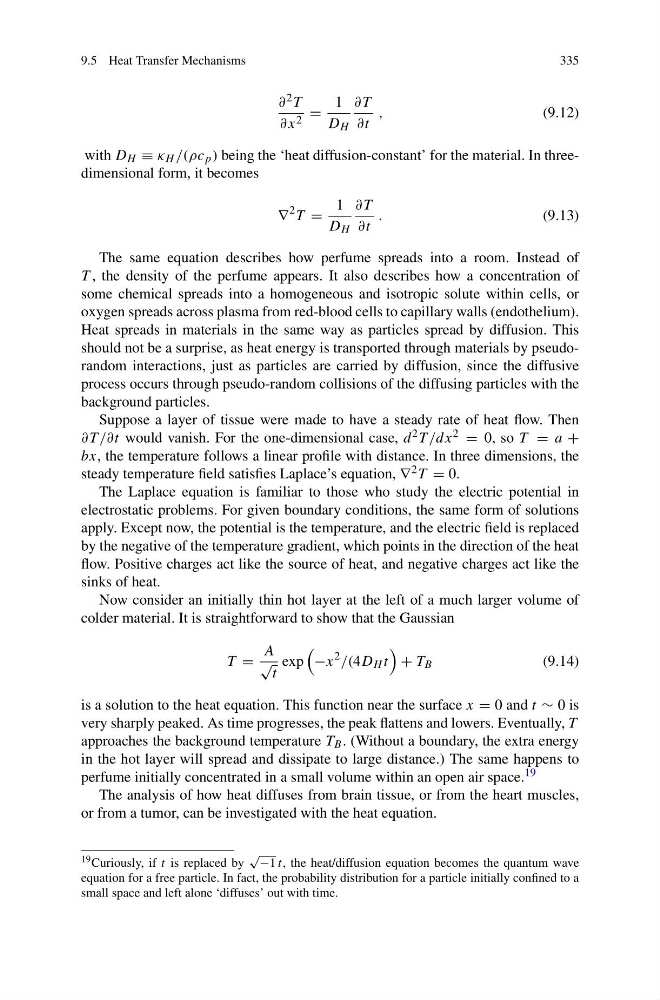
∂ 2 T
∂x 2 =
1
D H
∂T
∂t
,
(9.12)
with D H ≡ κ H /(ρc p ) being the ‘heat diffusion-constant’ for the material. In threedimensional form, it becomes
∇
2 T =
1
D H
∂T
∂t
.
(9.13)
The same equation describes how perfume spreads into a room. Instead of
T , the density of the perfume appears. It also describes how a concentration of
some chemical spreads into a homogeneous and isotropic solute within cells, or
oxygen spreads across plasma from red-blood cells to capillary walls (endothelium).
Heat spreads in materials in the same way as particles spread by diffusion. This
should not be a surprise, as heat energy is transported through materials by pseudorandom interactions, just as particles are carried by diffusion, since the diffusive
process occurs through pseudo-random collisions of the diffusing particles with the
background particles.
Suppose a layer of tissue were made to have a steady rate of heat flow. Then
∂T /∂t would vanish. For the one-dimensional case, d 2 T /dx 2 = 0, so T = a +
bx, the temperature follows a linear profile with distance. In three dimensions, the
steady temperature field satisfies Laplace’s equation, ∇ 2 T = 0.
The Laplace equation is familiar to those who study the electric potential in
electrostatic problems. For given boundary conditions, the same form of solutions
apply. Except now, the potential is the temperature, and the electric field is replaced
by the negative of the temperature gradient, which points in the direction of the heat
flow. Positive charges act like the source of heat, and negative charges act like the
sinks of heat.
Now consider an initially thin hot layer at the left of a much larger volume of
colder material. It is straightforward to show that the Gaussian
T =
A
√
t
exp
−x
2 /(4D H t
+ T B
(9.14)
is a solution to the heat equation. This function near the surface x = 0 and t ∼ 0 is
very sharply peaked. As time progresses, the peak flattens and lowers. Eventually, T
approaches the background temperature T B . (Without a boundary, the extra energy
in the hot layer will spread and dissipate to large distance.) The same happens to
perfume initially concentrated in a small volume within an open air space. 19
The analysis of how heat diffuses from brain tissue, or from the heart muscles,
or from a tumor, can be investigated with the heat equation.
19 Curiously, if t is replaced by
√ −1 t, the heat/diffusion equation becomes the quantum wave
equation for a free particle. In fact, the probability distribution for a particle initially confined to a
small space and left alone ‘diffuses’ out with time.
335
∂ 2 T
∂x 2 =
1
D H
∂T
∂t
,
(9.12)
with D H ≡ κ H /(ρc p ) being the ‘heat diffusion-constant’ for the material. In threedimensional form, it becomes
∇
2 T =
1
D H
∂T
∂t
.
(9.13)
The same equation describes how perfume spreads into a room. Instead of
T , the density of the perfume appears. It also describes how a concentration of
some chemical spreads into a homogeneous and isotropic solute within cells, or
oxygen spreads across plasma from red-blood cells to capillary walls (endothelium).
Heat spreads in materials in the same way as particles spread by diffusion. This
should not be a surprise, as heat energy is transported through materials by pseudorandom interactions, just as particles are carried by diffusion, since the diffusive
process occurs through pseudo-random collisions of the diffusing particles with the
background particles.
Suppose a layer of tissue were made to have a steady rate of heat flow. Then
∂T /∂t would vanish. For the one-dimensional case, d 2 T /dx 2 = 0, so T = a +
bx, the temperature follows a linear profile with distance. In three dimensions, the
steady temperature field satisfies Laplace’s equation, ∇ 2 T = 0.
The Laplace equation is familiar to those who study the electric potential in
electrostatic problems. For given boundary conditions, the same form of solutions
apply. Except now, the potential is the temperature, and the electric field is replaced
by the negative of the temperature gradient, which points in the direction of the heat
flow. Positive charges act like the source of heat, and negative charges act like the
sinks of heat.
Now consider an initially thin hot layer at the left of a much larger volume of
colder material. It is straightforward to show that the Gaussian
T =
A
√
t
exp
−x
2 /(4D H t
+ T B
(9.14)
is a solution to the heat equation. This function near the surface x = 0 and t ∼ 0 is
very sharply peaked. As time progresses, the peak flattens and lowers. Eventually, T
approaches the background temperature T B . (Without a boundary, the extra energy
in the hot layer will spread and dissipate to large distance.) The same happens to
perfume initially concentrated in a small volume within an open air space. 19
The analysis of how heat diffuses from brain tissue, or from the heart muscles,
or from a tumor, can be investigated with the heat equation.
19 Curiously, if t is replaced by
√ −1 t, the heat/diffusion equation becomes the quantum wave
equation for a free particle. In fact, the probability distribution for a particle initially confined to a
small space and left alone ‘diffuses’ out with time.