

330
9 Bioenergetics
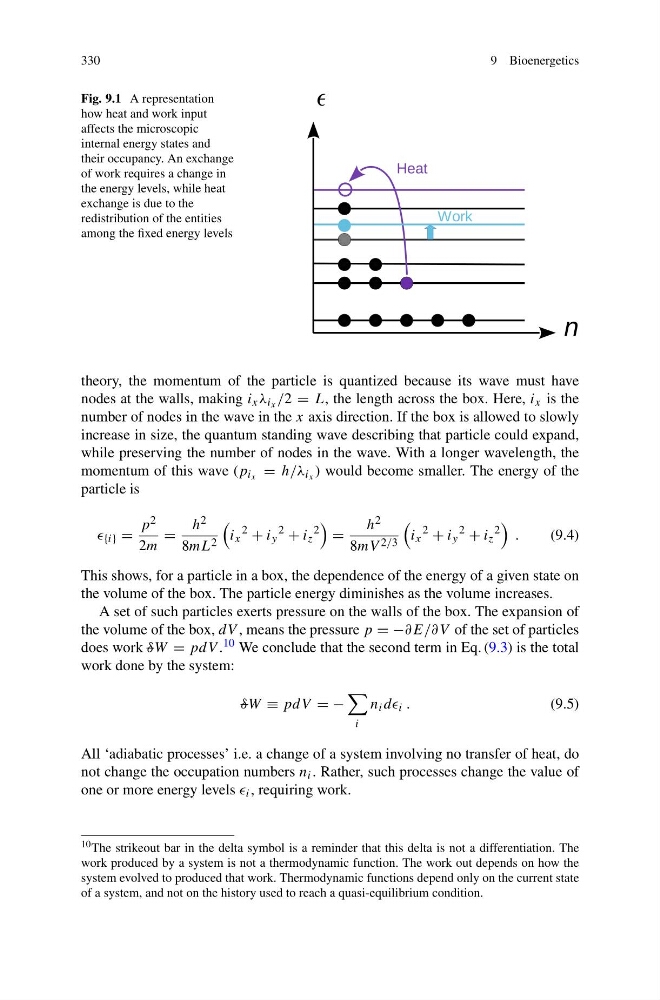
Fig. 9.1 A representation
how heat and work input
affects the microscopic
internal energy states and
their occupancy. An exchange
of work requires a change in
the energy levels, while heat
exchange is due to the
redistribution of the entities
among the fixed energy levels
theory, the momentum of the particle is quantized because its wave must have
nodes at the walls, making i x λ i x /2 = L, the length across the box. Here, i x is the
number of nodes in the wave in the x axis direction. If the box is allowed to slowly
increase in size, the quantum standing wave describing that particle could expand,
while preserving the number of nodes in the wave. With a longer wavelength, the
momentum of this wave (p i x = h/λ i x ) would become smaller. The energy of the
particle is
{i} =
p 2
2m
=
h 2
8mL 2
i x
2
+ i y
2
+ i z
2
=
h 2
8mV 2/3
i x
2
+ i y
2
+ i z
2
.
(9.4)
This shows, for a particle in a box, the dependence of the energy of a given state on
the volume of the box. The particle energy diminishes as the volume increases.
A set of such particles exerts pressure on the walls of the box. The expansion of
the volume of the box, dV , means the pressure p = −∂E/∂V of the set of particles
does work δW = pdV . 10 We conclude that the second term in Eq. (9.3) is the total
work done by the system:
δW ≡ pdV = −
i
n i dd i .
(9.5)
All ‘adiabatic processes’ i.e. a change of a system involving no transfer of heat, do
not change the occupation numbers n i . Rather, such processes change the value of
one or more energy levels i , requiring work.
10 The strikeout bar in the delta symbol is a reminder that this delta is not a differentiation. The
work produced by a system is not a thermodynamic function. The work out depends on how the
system evolved to produced that work. Thermodynamic functions depend only on the current state
of a system, and not on the history used to reach a quasi-equilibrium condition.
9 Bioenergetics
Fig. 9.1 A representation
how heat and work input
affects the microscopic
internal energy states and
their occupancy. An exchange
of work requires a change in
the energy levels, while heat
exchange is due to the
redistribution of the entities
among the fixed energy levels
theory, the momentum of the particle is quantized because its wave must have
nodes at the walls, making i x λ i x /2 = L, the length across the box. Here, i x is the
number of nodes in the wave in the x axis direction. If the box is allowed to slowly
increase in size, the quantum standing wave describing that particle could expand,
while preserving the number of nodes in the wave. With a longer wavelength, the
momentum of this wave (p i x = h/λ i x ) would become smaller. The energy of the
particle is
{i} =
p 2
2m
=
h 2
8mL 2
i x
2
+ i y
2
+ i z
2
=
h 2
8mV 2/3
i x
2
+ i y
2
+ i z
2
.
(9.4)
This shows, for a particle in a box, the dependence of the energy of a given state on
the volume of the box. The particle energy diminishes as the volume increases.
A set of such particles exerts pressure on the walls of the box. The expansion of
the volume of the box, dV , means the pressure p = −∂E/∂V of the set of particles
does work δW = pdV . 10 We conclude that the second term in Eq. (9.3) is the total
work done by the system:
δW ≡ pdV = −
i
n i dd i .
(9.5)
All ‘adiabatic processes’ i.e. a change of a system involving no transfer of heat, do
not change the occupation numbers n i . Rather, such processes change the value of
one or more energy levels i , requiring work.
10 The strikeout bar in the delta symbol is a reminder that this delta is not a differentiation. The
work produced by a system is not a thermodynamic function. The work out depends on how the
system evolved to produced that work. Thermodynamic functions depend only on the current state
of a system, and not on the history used to reach a quasi-equilibrium condition.