

326
9 Bioenergetics
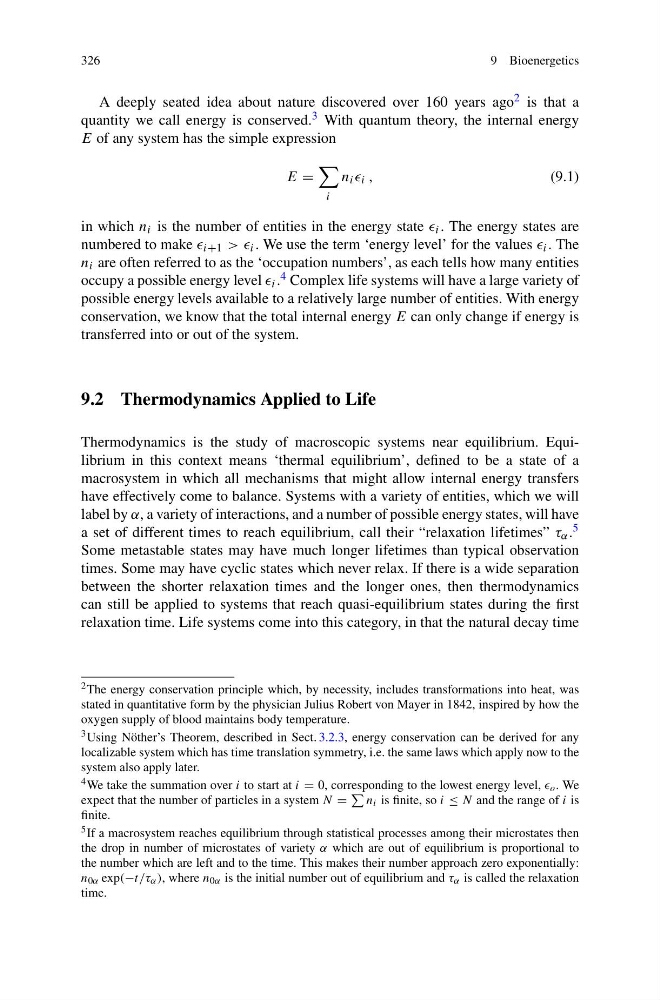
A deeply seated idea about nature discovered over 160 years ago 2 is that a
quantity we call energy is conserved. 3 With quantum theory, the internal energy
E of any system has the simple expression
E =
i
n i i ,
(9.1)
in which n i is the number of entities in the energy state i . The energy states are
numbered to make i+1 > > i . We use the term ‘energy level’ for the values i . The
n i are often referred to as the ‘occupation numbers’, as each tells how many entities
occupy a possible energy level i . 4 Complex life systems will have a large variety of
possible energy levels available to a relatively large number of entities. With energy
conservation, we know that the total internal energy E can only change if energy is
transferred into or out of the system.
9.2 Thermodynamics Applied to Life
Thermodynamics is the study of macroscopic systems near equilibrium. Equilibrium in this context means ‘thermal equilibrium’, defined to be a state of a
macrosystem in which all mechanisms that might allow internal energy transfers
have effectively come to balance. Systems with a variety of entities, which we will
label by α, a variety of interactions, and a number of possible energy states, will have
a set of different times to reach equilibrium, call their “relaxation lifetimes” τ α . 5
Some metastable states may have much longer lifetimes than typical observation
times. Some may have cyclic states which never relax. If there is a wide separation
between the shorter relaxation times and the longer ones, then thermodynamics
can still be applied to systems that reach quasi-equilibrium states during the first
relaxation time. Life systems come into this category, in that the natural decay time
2 The energy conservation principle which, by necessity, includes transformations into heat, was
stated in quantitative form by the physician Julius Robert von Mayer in 1842, inspired by how the
oxygen supply of blood maintains body temperature.
3 Using Nöther’s Theorem, described in Sect. 3.2.3, energy conservation can be derived for any
localizable system which has time translation symmetry, i.e. the same laws which apply now to the
system also apply later.
4 We take the summation over i to start at i = 0, corresponding to the lowest energy level, o . We
expect that the number of particles in a system N =
n i is finite, so i ≤ N and the range of i is
finite.
5 If a macrosystem reaches equilibrium through statistical processes among their microstates then
the drop in number of microstates of variety α which are out of equilibrium is proportional to
the number which are left and to the time. This makes their number approach zero exponentially:
n 0α exp(−t/τ α ), where n 0α is the initial number out of equilibrium and τ α is called the relaxation
time.
9 Bioenergetics
A deeply seated idea about nature discovered over 160 years ago 2 is that a
quantity we call energy is conserved. 3 With quantum theory, the internal energy
E of any system has the simple expression
E =
i
n i i ,
(9.1)
in which n i is the number of entities in the energy state i . The energy states are
numbered to make i+1 > > i . We use the term ‘energy level’ for the values i . The
n i are often referred to as the ‘occupation numbers’, as each tells how many entities
occupy a possible energy level i . 4 Complex life systems will have a large variety of
possible energy levels available to a relatively large number of entities. With energy
conservation, we know that the total internal energy E can only change if energy is
transferred into or out of the system.
9.2 Thermodynamics Applied to Life
Thermodynamics is the study of macroscopic systems near equilibrium. Equilibrium in this context means ‘thermal equilibrium’, defined to be a state of a
macrosystem in which all mechanisms that might allow internal energy transfers
have effectively come to balance. Systems with a variety of entities, which we will
label by α, a variety of interactions, and a number of possible energy states, will have
a set of different times to reach equilibrium, call their “relaxation lifetimes” τ α . 5
Some metastable states may have much longer lifetimes than typical observation
times. Some may have cyclic states which never relax. If there is a wide separation
between the shorter relaxation times and the longer ones, then thermodynamics
can still be applied to systems that reach quasi-equilibrium states during the first
relaxation time. Life systems come into this category, in that the natural decay time
2 The energy conservation principle which, by necessity, includes transformations into heat, was
stated in quantitative form by the physician Julius Robert von Mayer in 1842, inspired by how the
oxygen supply of blood maintains body temperature.
3 Using Nöther’s Theorem, described in Sect. 3.2.3, energy conservation can be derived for any
localizable system which has time translation symmetry, i.e. the same laws which apply now to the
system also apply later.
4 We take the summation over i to start at i = 0, corresponding to the lowest energy level, o . We
expect that the number of particles in a system N =
n i is finite, so i ≤ N and the range of i is
finite.
5 If a macrosystem reaches equilibrium through statistical processes among their microstates then
the drop in number of microstates of variety α which are out of equilibrium is proportional to
the number which are left and to the time. This makes their number approach zero exponentially:
n 0α exp(−t/τ α ), where n 0α is the initial number out of equilibrium and τ α is called the relaxation
time.