

8.10 Radiative Bactericide
307
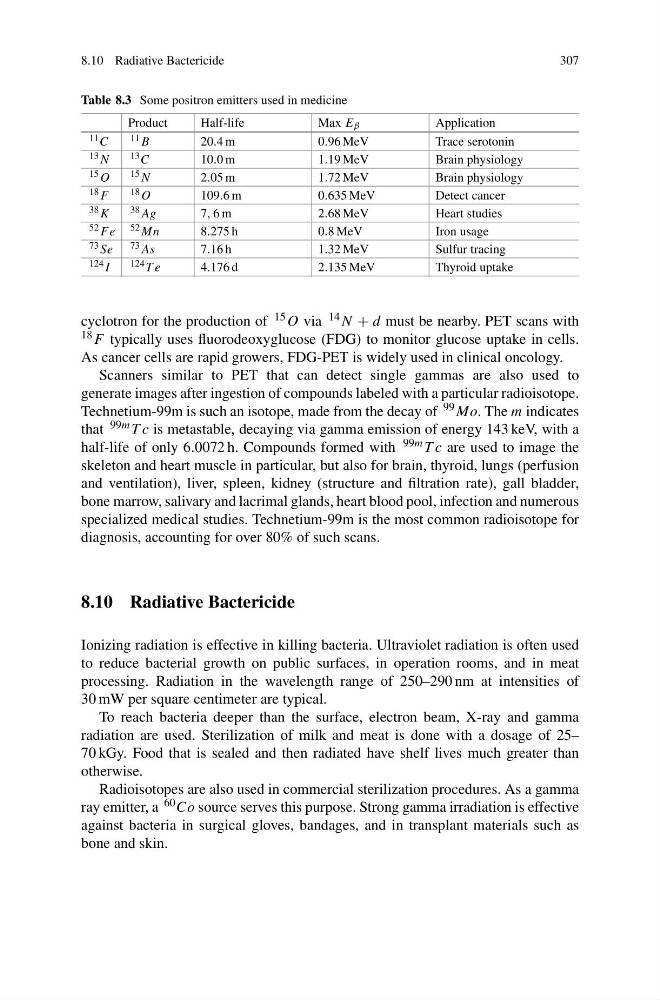
Table 8.3 Some positron emitters used in medicine
Product
Half-life
Max E β
Application
11 C
11 B
20.4 m
0.96 MeV
Trace serotonin
13 N
13 C
10.0 m
1.19 MeV
Brain physiology
15 O
15 N
2.05 m
1.72 MeV
Brain physiology
18 F
18 O
109.6 m
0.635 MeV
Detect cancer
38 K
38 Ag
7, 6 m
2.68 MeV
Heart studies
52 F e 52 Mn
8.275 h
0.8 MeV
Iron usage
73 Se 73 As
7.16 h
1.32 MeV
Sulfur tracing
124 I
124 T e
4.176 d
2.135 MeV
Thyroid uptake
cyclotron for the production of 15 O via 14 N + d must be nearby. PET scans with
18 F typically uses fluorodeoxyglucose (FDG) to monitor glucose uptake in cells.
As cancer cells are rapid growers, FDG-PET is widely used in clinical oncology.
Scanners similar to PET that can detect single gammas are also used to
generate images after ingestion of compounds labeled with a particular radioisotope.
Technetium-99m is such an isotope, made from the decay of 99 Mo. The m indicates
that 99m T c is metastable, decaying via gamma emission of energy 143 keV, with a
half-life of only 6.0072 h. Compounds formed with 99m T c are used to image the
skeleton and heart muscle in particular, but also for brain, thyroid, lungs (perfusion
and ventilation), liver, spleen, kidney (structure and filtration rate), gall bladder,
bone marrow, salivary and lacrimal glands, heart blood pool, infection and numerous
specialized medical studies. Technetium-99m is the most common radioisotope for
diagnosis, accounting for over 80% of such scans.
8.10 Radiative Bactericide
Ionizing radiation is effective in killing bacteria. Ultraviolet radiation is often used
to reduce bacterial growth on public surfaces, in operation rooms, and in meat
processing. Radiation in the wavelength range of 250–290 nm at intensities of
30 mW per square centimeter are typical.
To reach bacteria deeper than the surface, electron beam, X-ray and gamma
radiation are used. Sterilization of milk and meat is done with a dosage of 25–
70 kGy. Food that is sealed and then radiated have shelf lives much greater than
otherwise.
Radioisotopes are also used in commercial sterilization procedures. As a gamma
ray emitter, a 60 Co source serves this purpose. Strong gamma irradiation is effective
against bacteria in surgical gloves, bandages, and in transplant materials such as
bone and skin.
307
Table 8.3 Some positron emitters used in medicine
Product
Half-life
Max E β
Application
11 C
11 B
20.4 m
0.96 MeV
Trace serotonin
13 N
13 C
10.0 m
1.19 MeV
Brain physiology
15 O
15 N
2.05 m
1.72 MeV
Brain physiology
18 F
18 O
109.6 m
0.635 MeV
Detect cancer
38 K
38 Ag
7, 6 m
2.68 MeV
Heart studies
52 F e 52 Mn
8.275 h
0.8 MeV
Iron usage
73 Se 73 As
7.16 h
1.32 MeV
Sulfur tracing
124 I
124 T e
4.176 d
2.135 MeV
Thyroid uptake
cyclotron for the production of 15 O via 14 N + d must be nearby. PET scans with
18 F typically uses fluorodeoxyglucose (FDG) to monitor glucose uptake in cells.
As cancer cells are rapid growers, FDG-PET is widely used in clinical oncology.
Scanners similar to PET that can detect single gammas are also used to
generate images after ingestion of compounds labeled with a particular radioisotope.
Technetium-99m is such an isotope, made from the decay of 99 Mo. The m indicates
that 99m T c is metastable, decaying via gamma emission of energy 143 keV, with a
half-life of only 6.0072 h. Compounds formed with 99m T c are used to image the
skeleton and heart muscle in particular, but also for brain, thyroid, lungs (perfusion
and ventilation), liver, spleen, kidney (structure and filtration rate), gall bladder,
bone marrow, salivary and lacrimal glands, heart blood pool, infection and numerous
specialized medical studies. Technetium-99m is the most common radioisotope for
diagnosis, accounting for over 80% of such scans.
8.10 Radiative Bactericide
Ionizing radiation is effective in killing bacteria. Ultraviolet radiation is often used
to reduce bacterial growth on public surfaces, in operation rooms, and in meat
processing. Radiation in the wavelength range of 250–290 nm at intensities of
30 mW per square centimeter are typical.
To reach bacteria deeper than the surface, electron beam, X-ray and gamma
radiation are used. Sterilization of milk and meat is done with a dosage of 25–
70 kGy. Food that is sealed and then radiated have shelf lives much greater than
otherwise.
Radioisotopes are also used in commercial sterilization procedures. As a gamma
ray emitter, a 60 Co source serves this purpose. Strong gamma irradiation is effective
against bacteria in surgical gloves, bandages, and in transplant materials such as
bone and skin.