

8.4 Ultraviolet Radiation
287
8.4 Ultraviolet Radiation
Ultraviolet (UV) radiation consists of electromagnetic waves above the visiblelight frequencies of the normal human perception but below X-rays. Some animals
can see UV, including some birds, bees, butterflies, and even arctic reindeer. ‘Soft
ultraviolet’ wavelengths are usually taken from the end of the violet colors, 400
nanometers, to about 200 nanometers. A frequency in the region 1.5 × 10 15 Hz
to 3 × 10 16 Hz corresponds to ‘hard ultraviolet’ radiation, ranging in wavelength
from 200 nanometers to about 10 nanometers, where X-ray wavelengths begin.
The UV spectrum is also divided into UV-A: 400–315 nm; UV-B: 315–280 nm;
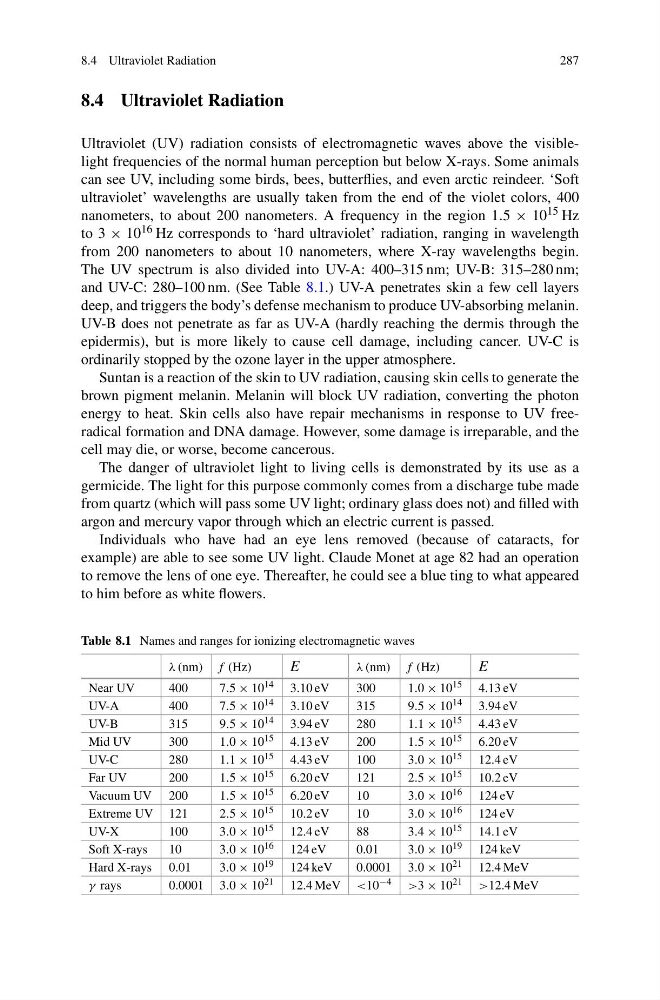
and UV-C: 280–100 nm. (See Table 8.1.) UV-A penetrates skin a few cell layers
deep, and triggers the body’s defense mechanism to produce UV-absorbing melanin.
UV-B does not penetrate as far as UV-A (hardly reaching the dermis through the
epidermis), but is more likely to cause cell damage, including cancer. UV-C is
ordinarily stopped by the ozone layer in the upper atmosphere.
Suntan is a reaction of the skin to UV radiation, causing skin cells to generate the
brown pigment melanin. Melanin will block UV radiation, converting the photon
energy to heat. Skin cells also have repair mechanisms in response to UV freeradical formation and DNA damage. However, some damage is irreparable, and the
cell may die, or worse, become cancerous.
The danger of ultraviolet light to living cells is demonstrated by its use as a
germicide. The light for this purpose commonly comes from a discharge tube made
from quartz (which will pass some UV light; ordinary glass does not) and filled with
argon and mercury vapor through which an electric current is passed.
Individuals who have had an eye lens removed (because of cataracts, for
example) are able to see some UV light. Claude Monet at age 82 had an operation
to remove the lens of one eye. Thereafter, he could see a blue ting to what appeared
to him before as white flowers.
Table 8.1 Names and ranges for ionizing electromagnetic waves
λ (nm) f (Hz)
E
λ (nm) f (Hz)
E
Near UV
400
7.5 × 10 14 3.10 eV
300
1.0 × 10 15 4.13 eV
UV-A
400
7.5 × 10 14 3.10 eV
315
9.5 × 10 14 3.94 eV
UV-B
315
9.5 × 10 14 3.94 eV
280
1.1 × 10 15 4.43 eV
Mid UV
300
1.0 × 10 15 4.13 eV
200
1.5 × 10 15 6.20 eV
UV-C
280
1.1 × 10 15 4.43 eV
100
3.0 × 10 15 12.4 eV
Far UV
200
1.5 × 10 15 6.20 eV
121
2.5 × 10 15 10.2 eV
Vacuum UV 200
1.5 × 10 15 6.20 eV
10
3.0 × 10 16 124 eV
Extreme UV 121
2.5 × 10 15 10.2 eV
10
3.0 × 10 16 124 eV
UV-X
100
3.0 × 10 15 12.4 eV
88
3.4 × 10 15 14.1 eV
Soft X-rays
10
3.0 × 10 16 124 eV
0.01
3.0 × 10 19 124 keV
Hard X-rays 0.01
3.0 × 10 19 124 keV
0.0001 3.0 × 10 21 12.4 MeV
γ rays
0.0001 3.0 × 10 21 12.4 MeV <10 −4 >3 × 10 21 >12.4 MeV
287
8.4 Ultraviolet Radiation
Ultraviolet (UV) radiation consists of electromagnetic waves above the visiblelight frequencies of the normal human perception but below X-rays. Some animals
can see UV, including some birds, bees, butterflies, and even arctic reindeer. ‘Soft
ultraviolet’ wavelengths are usually taken from the end of the violet colors, 400
nanometers, to about 200 nanometers. A frequency in the region 1.5 × 10 15 Hz
to 3 × 10 16 Hz corresponds to ‘hard ultraviolet’ radiation, ranging in wavelength
from 200 nanometers to about 10 nanometers, where X-ray wavelengths begin.
The UV spectrum is also divided into UV-A: 400–315 nm; UV-B: 315–280 nm;
and UV-C: 280–100 nm. (See Table 8.1.) UV-A penetrates skin a few cell layers
deep, and triggers the body’s defense mechanism to produce UV-absorbing melanin.
UV-B does not penetrate as far as UV-A (hardly reaching the dermis through the
epidermis), but is more likely to cause cell damage, including cancer. UV-C is
ordinarily stopped by the ozone layer in the upper atmosphere.
Suntan is a reaction of the skin to UV radiation, causing skin cells to generate the
brown pigment melanin. Melanin will block UV radiation, converting the photon
energy to heat. Skin cells also have repair mechanisms in response to UV freeradical formation and DNA damage. However, some damage is irreparable, and the
cell may die, or worse, become cancerous.
The danger of ultraviolet light to living cells is demonstrated by its use as a
germicide. The light for this purpose commonly comes from a discharge tube made
from quartz (which will pass some UV light; ordinary glass does not) and filled with
argon and mercury vapor through which an electric current is passed.
Individuals who have had an eye lens removed (because of cataracts, for
example) are able to see some UV light. Claude Monet at age 82 had an operation
to remove the lens of one eye. Thereafter, he could see a blue ting to what appeared
to him before as white flowers.
Table 8.1 Names and ranges for ionizing electromagnetic waves
λ (nm) f (Hz)
E
λ (nm) f (Hz)
E
Near UV
400
7.5 × 10 14 3.10 eV
300
1.0 × 10 15 4.13 eV
UV-A
400
7.5 × 10 14 3.10 eV
315
9.5 × 10 14 3.94 eV
UV-B
315
9.5 × 10 14 3.94 eV
280
1.1 × 10 15 4.43 eV
Mid UV
300
1.0 × 10 15 4.13 eV
200
1.5 × 10 15 6.20 eV
UV-C
280
1.1 × 10 15 4.43 eV
100
3.0 × 10 15 12.4 eV
Far UV
200
1.5 × 10 15 6.20 eV
121
2.5 × 10 15 10.2 eV
Vacuum UV 200
1.5 × 10 15 6.20 eV
10
3.0 × 10 16 124 eV
Extreme UV 121
2.5 × 10 15 10.2 eV
10
3.0 × 10 16 124 eV
UV-X
100
3.0 × 10 15 12.4 eV
88
3.4 × 10 15 14.1 eV
Soft X-rays
10
3.0 × 10 16 124 eV
0.01
3.0 × 10 19 124 keV
Hard X-rays 0.01
3.0 × 10 19 124 keV
0.0001 3.0 × 10 21 12.4 MeV
γ rays
0.0001 3.0 × 10 21 12.4 MeV <10 −4 >3 × 10 21 >12.4 MeV