

8.2 Characterizing Ionizing Radiation
285
b r e m s s t r a h lu n g
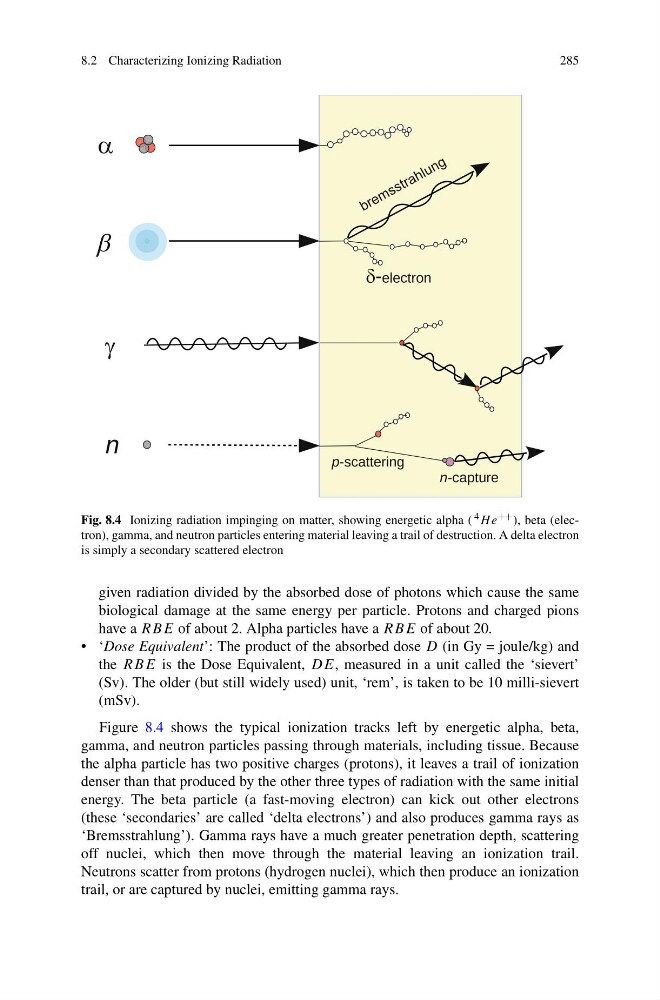
Fig. 8.4 Ionizing radiation impinging on matter, showing energetic alpha ( 4 H e ++ ), beta (electron), gamma, and neutron particles entering material leaving a trail of destruction. A delta electron
is simply a secondary scattered electron
given radiation divided by the absorbed dose of photons which cause the same
biological damage at the same energy per particle. Protons and charged pions
have a RBE of about 2. Alpha particles have a RBE of about 20.
• ‘Dose Equivalent’: The product of the absorbed dose D (in Gy = joule/kg) and
the RBE is the Dose Equivalent, DE, measured in a unit called the ‘sievert’
(Sv). The older (but still widely used) unit, ‘rem’, is taken to be 10 milli-sievert
(mSv).
Figure 8.4 shows the typical ionization tracks left by energetic alpha, beta,
gamma, and neutron particles passing through materials, including tissue. Because
the alpha particle has two positive charges (protons), it leaves a trail of ionization
denser than that produced by the other three types of radiation with the same initial
energy. The beta particle (a fast-moving electron) can kick out other electrons
(these ‘secondaries’ are called ‘delta electrons’) and also produces gamma rays as
‘Bremsstrahlung’). Gamma rays have a much greater penetration depth, scattering
off nuclei, which then move through the material leaving an ionization trail.
Neutrons scatter from protons (hydrogen nuclei), which then produce an ionization
trail, or are captured by nuclei, emitting gamma rays.
285
b r e m s s t r a h lu n g
Fig. 8.4 Ionizing radiation impinging on matter, showing energetic alpha ( 4 H e ++ ), beta (electron), gamma, and neutron particles entering material leaving a trail of destruction. A delta electron
is simply a secondary scattered electron
given radiation divided by the absorbed dose of photons which cause the same
biological damage at the same energy per particle. Protons and charged pions
have a RBE of about 2. Alpha particles have a RBE of about 20.
• ‘Dose Equivalent’: The product of the absorbed dose D (in Gy = joule/kg) and
the RBE is the Dose Equivalent, DE, measured in a unit called the ‘sievert’
(Sv). The older (but still widely used) unit, ‘rem’, is taken to be 10 milli-sievert
(mSv).
Figure 8.4 shows the typical ionization tracks left by energetic alpha, beta,
gamma, and neutron particles passing through materials, including tissue. Because
the alpha particle has two positive charges (protons), it leaves a trail of ionization
denser than that produced by the other three types of radiation with the same initial
energy. The beta particle (a fast-moving electron) can kick out other electrons
(these ‘secondaries’ are called ‘delta electrons’) and also produces gamma rays as
‘Bremsstrahlung’). Gamma rays have a much greater penetration depth, scattering
off nuclei, which then move through the material leaving an ionization trail.
Neutrons scatter from protons (hydrogen nuclei), which then produce an ionization
trail, or are captured by nuclei, emitting gamma rays.