

Problems
277
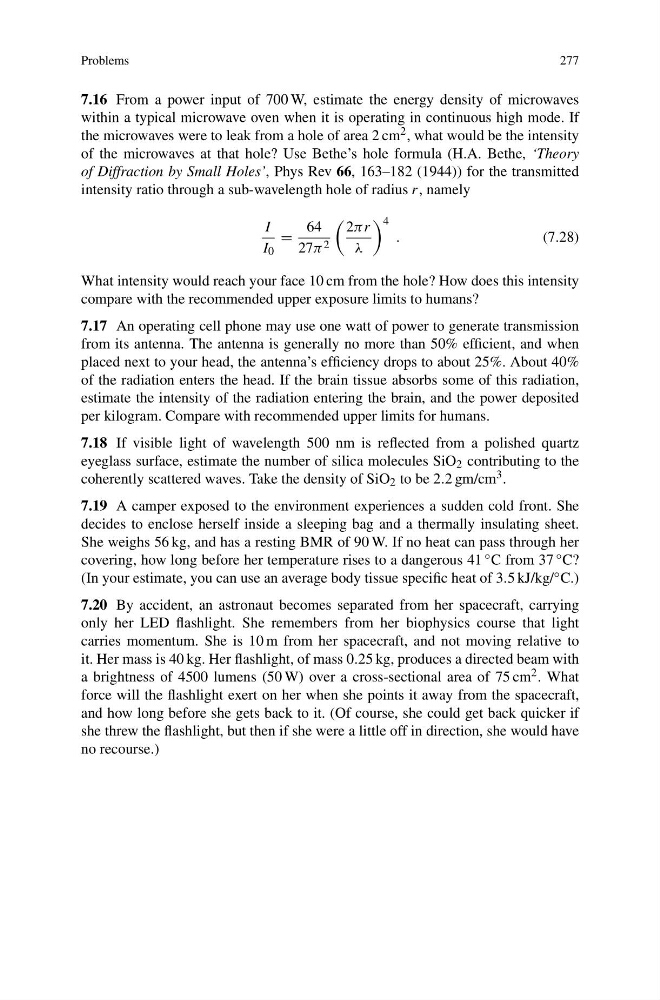
7.16 From a power input of 700 W, estimate the energy density of microwaves
within a typical microwave oven when it is operating in continuous high mode. If
the microwaves were to leak from a hole of area 2 cm 2 , what would be the intensity
of the microwaves at that hole? Use Bethe’s hole formula (H.A. Bethe, ‘Theory
of Diffraction by Small Holes’, Phys Rev 66, 163–182 (1944)) for the transmitted
intensity ratio through a sub-wavelength hole of radius r, namely
I
I 0
=
64
27π 2
2πr
λ
4
.
(7.28)
What intensity would reach your face 10 cm from the hole? How does this intensity
compare with the recommended upper exposure limits to humans?
7.17 An operating cell phone may use one watt of power to generate transmission
from its antenna. The antenna is generally no more than 50% efficient, and when
placed next to your head, the antenna’s efficiency drops to about 25%. About 40%
of the radiation enters the head. If the brain tissue absorbs some of this radiation,
estimate the intensity of the radiation entering the brain, and the power deposited
per kilogram. Compare with recommended upper limits for humans.
7.18 If visible light of wavelength 500 nm is reflected from a polished quartz
eyeglass surface, estimate the number of silica molecules SiO 2 contributing to the
coherently scattered waves. Take the density of SiO 2 to be 2.2 gm/cm 3 .
7.19 A camper exposed to the environment experiences a sudden cold front. She
decides to enclose herself inside a sleeping bag and a thermally insulating sheet.
She weighs 56 kg, and has a resting BMR of 90 W. If no heat can pass through her
covering, how long before her temperature rises to a dangerous 41 ◦ C from 37 ◦ C?
(In your estimate, you can use an average body tissue specific heat of 3.5 kJ/kg/ ◦ C.)
7.20 By accident, an astronaut becomes separated from her spacecraft, carrying
only her LED flashlight. She remembers from her biophysics course that light
carries momentum. She is 10 m from her spacecraft, and not moving relative to
it. Her mass is 40 kg. Her flashlight, of mass 0.25 kg, produces a directed beam with
a brightness of 4500 lumens (50 W) over a cross-sectional area of 75 cm 2 . What
force will the flashlight exert on her when she points it away from the spacecraft,
and how long before she gets back to it. (Of course, she could get back quicker if
she threw the flashlight, but then if she were a little off in direction, she would have
no recourse.)
277
7.16 From a power input of 700 W, estimate the energy density of microwaves
within a typical microwave oven when it is operating in continuous high mode. If
the microwaves were to leak from a hole of area 2 cm 2 , what would be the intensity
of the microwaves at that hole? Use Bethe’s hole formula (H.A. Bethe, ‘Theory
of Diffraction by Small Holes’, Phys Rev 66, 163–182 (1944)) for the transmitted
intensity ratio through a sub-wavelength hole of radius r, namely
I
I 0
=
64
27π 2
2πr
λ
4
.
(7.28)
What intensity would reach your face 10 cm from the hole? How does this intensity
compare with the recommended upper exposure limits to humans?
7.17 An operating cell phone may use one watt of power to generate transmission
from its antenna. The antenna is generally no more than 50% efficient, and when
placed next to your head, the antenna’s efficiency drops to about 25%. About 40%
of the radiation enters the head. If the brain tissue absorbs some of this radiation,
estimate the intensity of the radiation entering the brain, and the power deposited
per kilogram. Compare with recommended upper limits for humans.
7.18 If visible light of wavelength 500 nm is reflected from a polished quartz
eyeglass surface, estimate the number of silica molecules SiO 2 contributing to the
coherently scattered waves. Take the density of SiO 2 to be 2.2 gm/cm 3 .
7.19 A camper exposed to the environment experiences a sudden cold front. She
decides to enclose herself inside a sleeping bag and a thermally insulating sheet.
She weighs 56 kg, and has a resting BMR of 90 W. If no heat can pass through her
covering, how long before her temperature rises to a dangerous 41 ◦ C from 37 ◦ C?
(In your estimate, you can use an average body tissue specific heat of 3.5 kJ/kg/ ◦ C.)
7.20 By accident, an astronaut becomes separated from her spacecraft, carrying
only her LED flashlight. She remembers from her biophysics course that light
carries momentum. She is 10 m from her spacecraft, and not moving relative to
it. Her mass is 40 kg. Her flashlight, of mass 0.25 kg, produces a directed beam with
a brightness of 4500 lumens (50 W) over a cross-sectional area of 75 cm 2 . What
force will the flashlight exert on her when she points it away from the spacecraft,
and how long before she gets back to it. (Of course, she could get back quicker if
she threw the flashlight, but then if she were a little off in direction, she would have
no recourse.)