

7.29 Optical Instruments
263
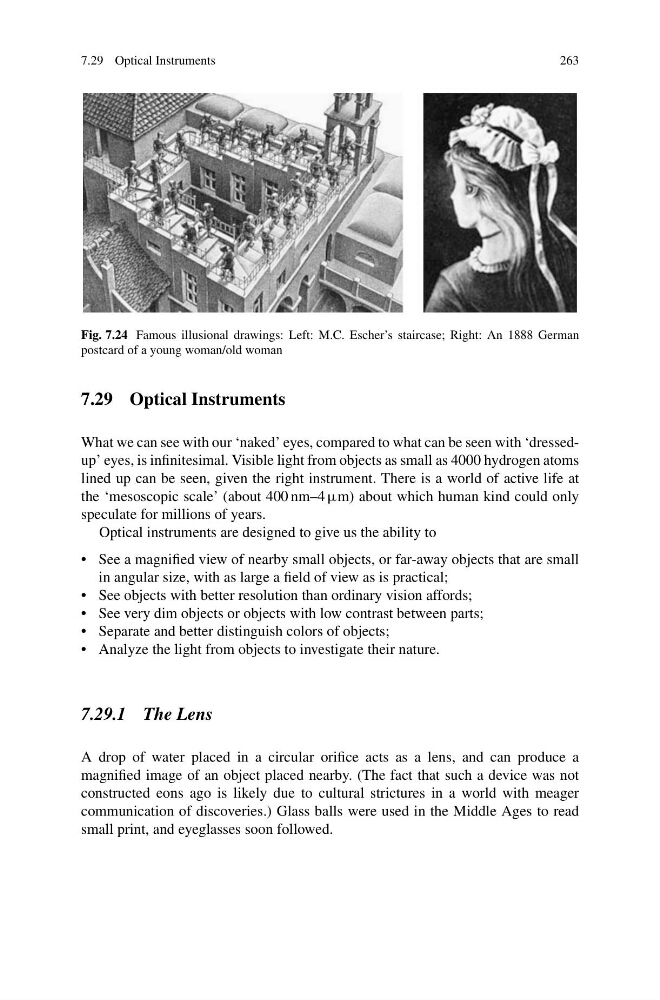
Fig. 7.24 Famous illusional drawings: Left: M.C. Escher’s staircase; Right: An 1888 German
postcard of a young woman/old woman
7.29 Optical Instruments
What we can see with our ‘naked’ eyes, compared to what can be seen with ‘dressedup’ eyes, is infinitesimal. Visible light from objects as small as 4000 hydrogen atoms
lined up can be seen, given the right instrument. There is a world of active life at
the ‘mesoscopic scale’ (about 400 nm–4 μm) about which human kind could only
speculate for millions of years.
Optical instruments are designed to give us the ability to
• See a magnified view of nearby small objects, or far-away objects that are small
in angular size, with as large a field of view as is practical;
• See objects with better resolution than ordinary vision affords;
• See very dim objects or objects with low contrast between parts;
• Separate and better distinguish colors of objects;
• Analyze the light from objects to investigate their nature.
7.29.1 The Lens
A drop of water placed in a circular orifice acts as a lens, and can produce a
magnified image of an object placed nearby. (The fact that such a device was not
constructed eons ago is likely due to cultural strictures in a world with meager
communication of discoveries.) Glass balls were used in the Middle Ages to read
small print, and eyeglasses soon followed.
263
Fig. 7.24 Famous illusional drawings: Left: M.C. Escher’s staircase; Right: An 1888 German
postcard of a young woman/old woman
7.29 Optical Instruments
What we can see with our ‘naked’ eyes, compared to what can be seen with ‘dressedup’ eyes, is infinitesimal. Visible light from objects as small as 4000 hydrogen atoms
lined up can be seen, given the right instrument. There is a world of active life at
the ‘mesoscopic scale’ (about 400 nm–4 μm) about which human kind could only
speculate for millions of years.
Optical instruments are designed to give us the ability to
• See a magnified view of nearby small objects, or far-away objects that are small
in angular size, with as large a field of view as is practical;
• See objects with better resolution than ordinary vision affords;
• See very dim objects or objects with low contrast between parts;
• Separate and better distinguish colors of objects;
• Analyze the light from objects to investigate their nature.
7.29.1 The Lens
A drop of water placed in a circular orifice acts as a lens, and can produce a
magnified image of an object placed nearby. (The fact that such a device was not
constructed eons ago is likely due to cultural strictures in a world with meager
communication of discoveries.) Glass balls were used in the Middle Ages to read
small print, and eyeglasses soon followed.