

254
7 Light in Biology and Medicine
7.25 Optical Holography
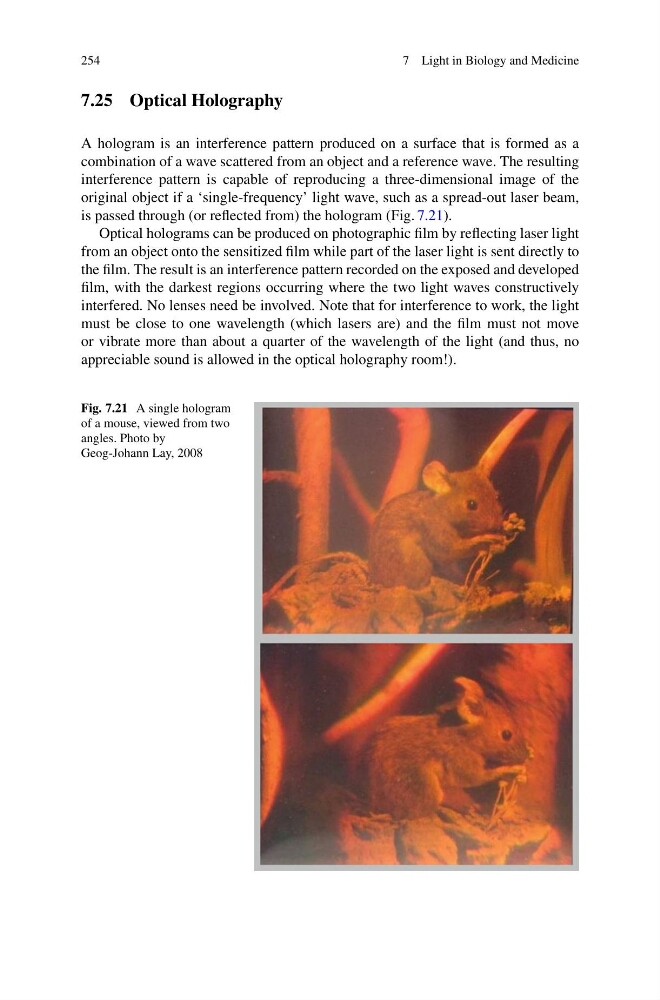
A hologram is an interference pattern produced on a surface that is formed as a
combination of a wave scattered from an object and a reference wave. The resulting
interference pattern is capable of reproducing a three-dimensional image of the
original object if a ‘single-frequency’ light wave, such as a spread-out laser beam,
is passed through (or reflected from) the hologram (Fig. 7.21).
Optical holograms can be produced on photographic film by reflecting laser light
from an object onto the sensitized film while part of the laser light is sent directly to
the film. The result is an interference pattern recorded on the exposed and developed
film, with the darkest regions occurring where the two light waves constructively
interfered. No lenses need be involved. Note that for interference to work, the light
must be close to one wavelength (which lasers are) and the film must not move
or vibrate more than about a quarter of the wavelength of the light (and thus, no
appreciable sound is allowed in the optical holography room!).
Fig. 7.21 A single hologram
of a mouse, viewed from two
angles. Photo by
Geog-Johann Lay, 2008
7 Light in Biology and Medicine
7.25 Optical Holography
A hologram is an interference pattern produced on a surface that is formed as a
combination of a wave scattered from an object and a reference wave. The resulting
interference pattern is capable of reproducing a three-dimensional image of the
original object if a ‘single-frequency’ light wave, such as a spread-out laser beam,
is passed through (or reflected from) the hologram (Fig. 7.21).
Optical holograms can be produced on photographic film by reflecting laser light
from an object onto the sensitized film while part of the laser light is sent directly to
the film. The result is an interference pattern recorded on the exposed and developed
film, with the darkest regions occurring where the two light waves constructively
interfered. No lenses need be involved. Note that for interference to work, the light
must be close to one wavelength (which lasers are) and the film must not move
or vibrate more than about a quarter of the wavelength of the light (and thus, no
appreciable sound is allowed in the optical holography room!).
Fig. 7.21 A single hologram
of a mouse, viewed from two
angles. Photo by
Geog-Johann Lay, 2008