

252
7 Light in Biology and Medicine
F = (δ · ∇)E +
1
c
dδ
dt
× B + (μ · ∇)B ,
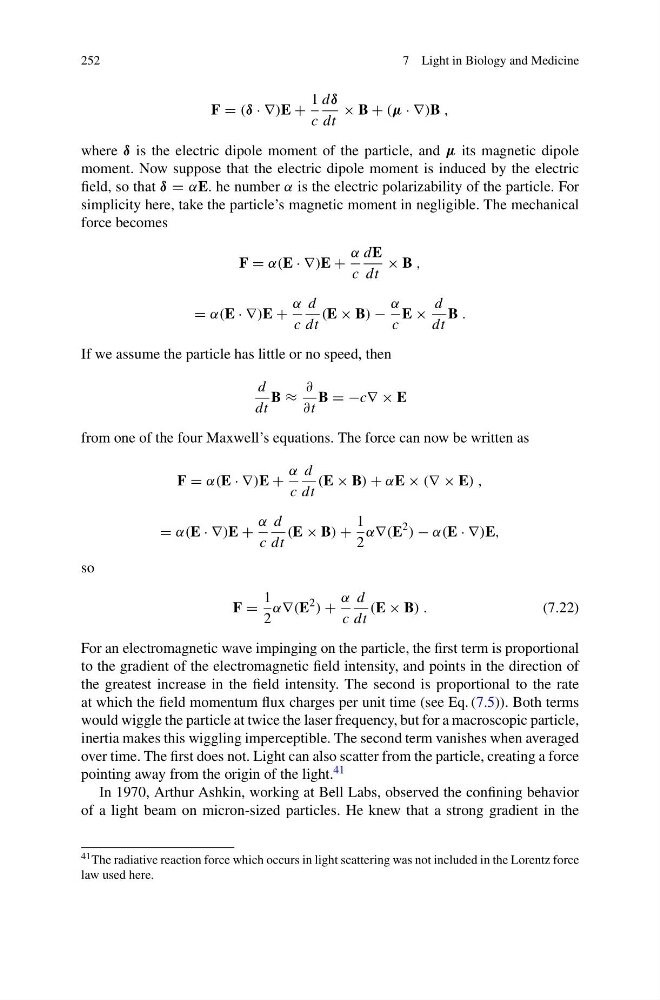
where δ is the electric dipole moment of the particle, and μ its magnetic dipole
moment. Now suppose that the electric dipole moment is induced by the electric
field, so that δ = αE. he number α is the electric polarizability of the particle. For
simplicity here, take the particle’s magnetic moment in negligible. The mechanical
force becomes
F = α(E · ∇)E +
α
c
dE
dt
× B ,
= α(E · ∇)E +
α
c
d
dt
(E × B) −
α
c
E ×
d
dt
B .
If we assume the particle has little or no speed, then
d
dt
B ≈
∂
∂t
B = −c∇ × E
from one of the four Maxwell’s equations. The force can now be written as
F = α(E · ∇)E +
α
c
d
dt
(E × B) + αE × (∇ × E) ,
= α(E · ∇)E +
α
c
d
dt
(E × B) +
1
2
α∇(E
2 ) − α(E · ∇)E,
so
F =
1
2
α∇(E
2 ) +
α
c
d
dt
(E × B) .
(7.22)
For an electromagnetic wave impinging on the particle, the first term is proportional
to the gradient of the electromagnetic field intensity, and points in the direction of
the greatest increase in the field intensity. The second is proportional to the rate
at which the field momentum flux charges per unit time (see Eq. (7.5)). Both terms
would wiggle the particle at twice the laser frequency, but for a macroscopic particle,
inertia makes this wiggling imperceptible. The second term vanishes when averaged
over time. The first does not. Light can also scatter from the particle, creating a force
pointing away from the origin of the light. 41
In 1970, Arthur Ashkin, working at Bell Labs, observed the confining behavior
of a light beam on micron-sized particles. He knew that a strong gradient in the
41 The radiative reaction force which occurs in light scattering was not included in the Lorentz force
law used here.
7 Light in Biology and Medicine
F = (δ · ∇)E +
1
c
dδ
dt
× B + (μ · ∇)B ,
where δ is the electric dipole moment of the particle, and μ its magnetic dipole
moment. Now suppose that the electric dipole moment is induced by the electric
field, so that δ = αE. he number α is the electric polarizability of the particle. For
simplicity here, take the particle’s magnetic moment in negligible. The mechanical
force becomes
F = α(E · ∇)E +
α
c
dE
dt
× B ,
= α(E · ∇)E +
α
c
d
dt
(E × B) −
α
c
E ×
d
dt
B .
If we assume the particle has little or no speed, then
d
dt
B ≈
∂
∂t
B = −c∇ × E
from one of the four Maxwell’s equations. The force can now be written as
F = α(E · ∇)E +
α
c
d
dt
(E × B) + αE × (∇ × E) ,
= α(E · ∇)E +
α
c
d
dt
(E × B) +
1
2
α∇(E
2 ) − α(E · ∇)E,
so
F =
1
2
α∇(E
2 ) +
α
c
d
dt
(E × B) .
(7.22)
For an electromagnetic wave impinging on the particle, the first term is proportional
to the gradient of the electromagnetic field intensity, and points in the direction of
the greatest increase in the field intensity. The second is proportional to the rate
at which the field momentum flux charges per unit time (see Eq. (7.5)). Both terms
would wiggle the particle at twice the laser frequency, but for a macroscopic particle,
inertia makes this wiggling imperceptible. The second term vanishes when averaged
over time. The first does not. Light can also scatter from the particle, creating a force
pointing away from the origin of the light. 41
In 1970, Arthur Ashkin, working at Bell Labs, observed the confining behavior
of a light beam on micron-sized particles. He knew that a strong gradient in the
41 The radiative reaction force which occurs in light scattering was not included in the Lorentz force
law used here.