

246
7 Light in Biology and Medicine
back to the ground state, and the material will be phosphorescent, with decay
time in the milliseconds to hundreds of seconds.
Excited electron states in atoms or molecular will be long-lived if electromagnetic effects cannot easily force the electron to make a transition. Such
states are said to be ‘metastable’. For example, suppose both the excited state
and the ground state are quantum s-waves. Then light is not easily generated
by a transition from this excited state to the ground state because photons
must transfer a unit of angular momentum, and the two states have no angular
momentum to give. The transition probability may still be finite, however,
because such quantum states can have a small admixture of p or d-waves
through interaction with neighboring electrons.
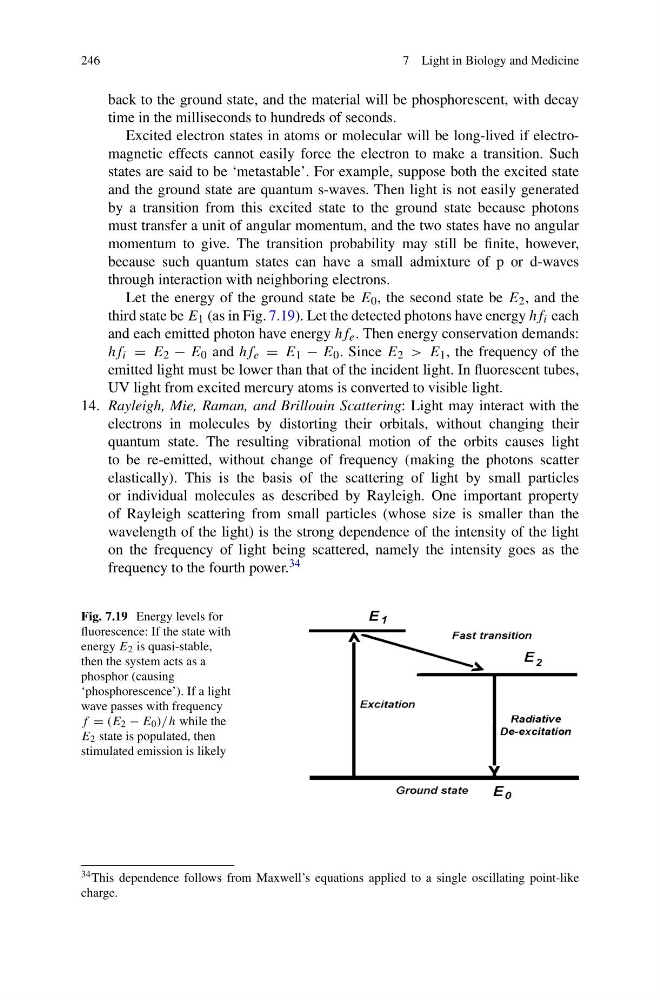
Let the energy of the ground state be E 0 , the second state be E 2 , and the
third state be E 1 (as in Fig. 7.19). Let the detected photons have energy hf i each
and each emitted photon have energy hf e . Then energy conservation demands:
hf i = E 2 − E 0 and hf e = E 1 − E 0 . Since E 2 > E 1 , the frequency of the
emitted light must be lower than that of the incident light. In fluorescent tubes,
UV light from excited mercury atoms is converted to visible light.
14. Rayleigh, Mie, Raman, and Brillouin Scattering: Light may interact with the
electrons in molecules by distorting their orbitals, without changing their
quantum state. The resulting vibrational motion of the orbits causes light
to be re-emitted, without change of frequency (making the photons scatter
elastically). This is the basis of the scattering of light by small particles
or individual molecules as described by Rayleigh. One important property
of Rayleigh scattering from small particles (whose size is smaller than the
wavelength of the light) is the strong dependence of the intensity of the light
on the frequency of light being scattered, namely the intensity goes as the
frequency to the fourth power. 34
Fig. 7.19 Energy levels for
fluorescence: If the state with
energy E 2 is quasi-stable,
then the system acts as a
phosphor (causing
‘phosphorescence’). If a light
wave passes with frequency
f = (E 2 − E 0 )/ h while the
E 2 state is populated, then
stimulated emission is likely
34 This dependence follows from Maxwell’s equations applied to a single oscillating point-like
charge.
7 Light in Biology and Medicine
back to the ground state, and the material will be phosphorescent, with decay
time in the milliseconds to hundreds of seconds.
Excited electron states in atoms or molecular will be long-lived if electromagnetic effects cannot easily force the electron to make a transition. Such
states are said to be ‘metastable’. For example, suppose both the excited state
and the ground state are quantum s-waves. Then light is not easily generated
by a transition from this excited state to the ground state because photons
must transfer a unit of angular momentum, and the two states have no angular
momentum to give. The transition probability may still be finite, however,
because such quantum states can have a small admixture of p or d-waves
through interaction with neighboring electrons.
Let the energy of the ground state be E 0 , the second state be E 2 , and the
third state be E 1 (as in Fig. 7.19). Let the detected photons have energy hf i each
and each emitted photon have energy hf e . Then energy conservation demands:
hf i = E 2 − E 0 and hf e = E 1 − E 0 . Since E 2 > E 1 , the frequency of the
emitted light must be lower than that of the incident light. In fluorescent tubes,
UV light from excited mercury atoms is converted to visible light.
14. Rayleigh, Mie, Raman, and Brillouin Scattering: Light may interact with the
electrons in molecules by distorting their orbitals, without changing their
quantum state. The resulting vibrational motion of the orbits causes light
to be re-emitted, without change of frequency (making the photons scatter
elastically). This is the basis of the scattering of light by small particles
or individual molecules as described by Rayleigh. One important property
of Rayleigh scattering from small particles (whose size is smaller than the
wavelength of the light) is the strong dependence of the intensity of the light
on the frequency of light being scattered, namely the intensity goes as the
frequency to the fourth power. 34
Fig. 7.19 Energy levels for
fluorescence: If the state with
energy E 2 is quasi-stable,
then the system acts as a
phosphor (causing
‘phosphorescence’). If a light
wave passes with frequency
f = (E 2 − E 0 )/ h while the
E 2 state is populated, then
stimulated emission is likely
34 This dependence follows from Maxwell’s equations applied to a single oscillating point-like
charge.