

7.22 Light Absorption by Biological Matter
241
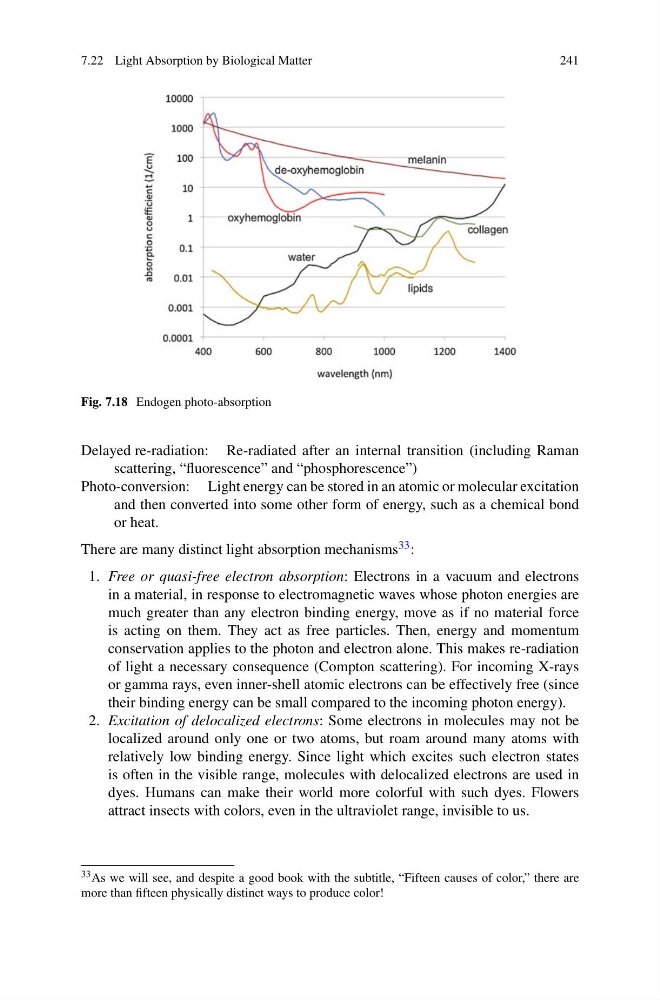
Fig. 7.18 Endogen photo-absorption
Delayed re-radiation: Re-radiated after an internal transition (including Raman
scattering, “fluorescence” and “phosphorescence”)
Photo-conversion: Light energy can be stored in an atomic or molecular excitation
and then converted into some other form of energy, such as a chemical bond
or heat.
There are many distinct light absorption mechanisms 33 :
1. Free or quasi-free electron absorption: Electrons in a vacuum and electrons
in a material, in response to electromagnetic waves whose photon energies are
much greater than any electron binding energy, move as if no material force
is acting on them. They act as free particles. Then, energy and momentum
conservation applies to the photon and electron alone. This makes re-radiation
of light a necessary consequence (Compton scattering). For incoming X-rays
or gamma rays, even inner-shell atomic electrons can be effectively free (since
their binding energy can be small compared to the incoming photon energy).
2. Excitation of delocalized electrons: Some electrons in molecules may not be
localized around only one or two atoms, but roam around many atoms with
relatively low binding energy. Since light which excites such electron states
is often in the visible range, molecules with delocalized electrons are used in
dyes. Humans can make their world more colorful with such dyes. Flowers
attract insects with colors, even in the ultraviolet range, invisible to us.
33 As we will see, and despite a good book with the subtitle, “Fifteen causes of color,” there are
more than fifteen physically distinct ways to produce color!
241
Fig. 7.18 Endogen photo-absorption
Delayed re-radiation: Re-radiated after an internal transition (including Raman
scattering, “fluorescence” and “phosphorescence”)
Photo-conversion: Light energy can be stored in an atomic or molecular excitation
and then converted into some other form of energy, such as a chemical bond
or heat.
There are many distinct light absorption mechanisms 33 :
1. Free or quasi-free electron absorption: Electrons in a vacuum and electrons
in a material, in response to electromagnetic waves whose photon energies are
much greater than any electron binding energy, move as if no material force
is acting on them. They act as free particles. Then, energy and momentum
conservation applies to the photon and electron alone. This makes re-radiation
of light a necessary consequence (Compton scattering). For incoming X-rays
or gamma rays, even inner-shell atomic electrons can be effectively free (since
their binding energy can be small compared to the incoming photon energy).
2. Excitation of delocalized electrons: Some electrons in molecules may not be
localized around only one or two atoms, but roam around many atoms with
relatively low binding energy. Since light which excites such electron states
is often in the visible range, molecules with delocalized electrons are used in
dyes. Humans can make their world more colorful with such dyes. Flowers
attract insects with colors, even in the ultraviolet range, invisible to us.
33 As we will see, and despite a good book with the subtitle, “Fifteen causes of color,” there are
more than fifteen physically distinct ways to produce color!