

220
7 Light in Biology and Medicine
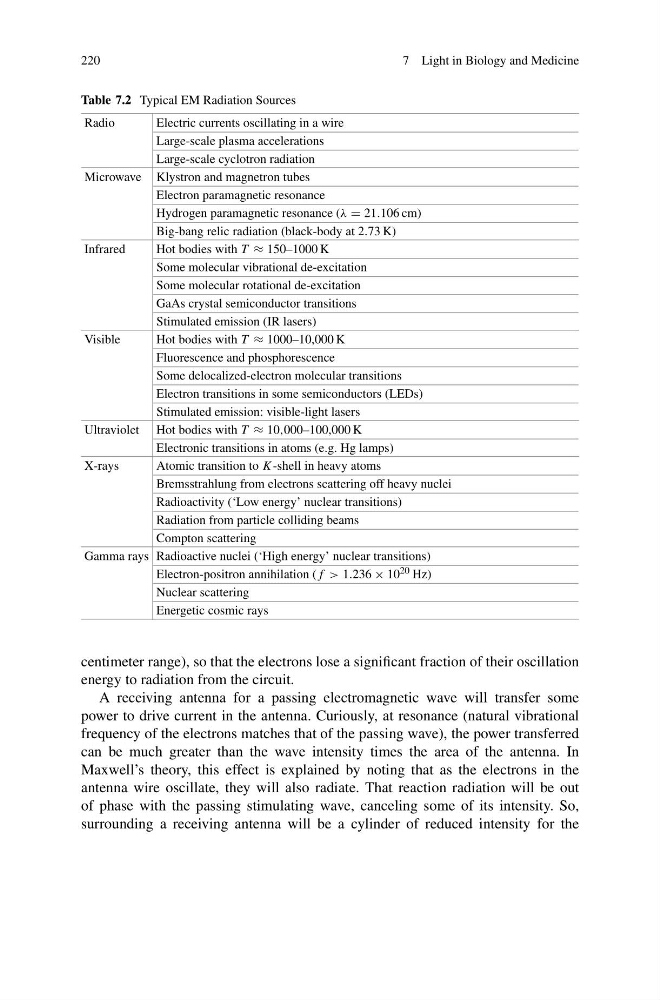
Table 7.2 Typical EM Radiation Sources
Radio
Electric currents oscillating in a wire
Large-scale plasma accelerations
Large-scale cyclotron radiation
Microwave Klystron and magnetron tubes
Electron paramagnetic resonance
Hydrogen paramagnetic resonance (λ = 21.106 cm)
Big-bang relic radiation (black-body at 2.73 K)
Infrared
Hot bodies with T ≈ 150–1000 K
Some molecular vibrational de-excitation
Some molecular rotational de-excitation
GaAs crystal semiconductor transitions
Stimulated emission (IR lasers)
Visible
Hot bodies with T ≈ 1000–10,000 K
Fluorescence and phosphorescence
Some delocalized-electron molecular transitions
Electron transitions in some semiconductors (LEDs)
Stimulated emission: visible-light lasers
Ultraviolet Hot bodies with T ≈ 10,000–100,000 K
Electronic transitions in atoms (e.g. Hg lamps)
X-rays
Atomic transition to K-shell in heavy atoms
Bremsstrahlung from electrons scattering off heavy nuclei
Radioactivity (‘Low energy’ nuclear transitions)
Radiation from particle colliding beams
Compton scattering
Gamma rays Radioactive nuclei (‘High energy’ nuclear transitions)
Electron-positron annihilation (f > 1.236 × 10 20 Hz)
Nuclear scattering
Energetic cosmic rays
centimeter range), so that the electrons lose a significant fraction of their oscillation
energy to radiation from the circuit.
A receiving antenna for a passing electromagnetic wave will transfer some
power to drive current in the antenna. Curiously, at resonance (natural vibrational
frequency of the electrons matches that of the passing wave), the power transferred
can be much greater than the wave intensity times the area of the antenna. In
Maxwell’s theory, this effect is explained by noting that as the electrons in the
antenna wire oscillate, they will also radiate. That reaction radiation will be out
of phase with the passing stimulating wave, canceling some of its intensity. So,
surrounding a receiving antenna will be a cylinder of reduced intensity for the
7 Light in Biology and Medicine
Table 7.2 Typical EM Radiation Sources
Radio
Electric currents oscillating in a wire
Large-scale plasma accelerations
Large-scale cyclotron radiation
Microwave Klystron and magnetron tubes
Electron paramagnetic resonance
Hydrogen paramagnetic resonance (λ = 21.106 cm)
Big-bang relic radiation (black-body at 2.73 K)
Infrared
Hot bodies with T ≈ 150–1000 K
Some molecular vibrational de-excitation
Some molecular rotational de-excitation
GaAs crystal semiconductor transitions
Stimulated emission (IR lasers)
Visible
Hot bodies with T ≈ 1000–10,000 K
Fluorescence and phosphorescence
Some delocalized-electron molecular transitions
Electron transitions in some semiconductors (LEDs)
Stimulated emission: visible-light lasers
Ultraviolet Hot bodies with T ≈ 10,000–100,000 K
Electronic transitions in atoms (e.g. Hg lamps)
X-rays
Atomic transition to K-shell in heavy atoms
Bremsstrahlung from electrons scattering off heavy nuclei
Radioactivity (‘Low energy’ nuclear transitions)
Radiation from particle colliding beams
Compton scattering
Gamma rays Radioactive nuclei (‘High energy’ nuclear transitions)
Electron-positron annihilation (f > 1.236 × 10 20 Hz)
Nuclear scattering
Energetic cosmic rays
centimeter range), so that the electrons lose a significant fraction of their oscillation
energy to radiation from the circuit.
A receiving antenna for a passing electromagnetic wave will transfer some
power to drive current in the antenna. Curiously, at resonance (natural vibrational
frequency of the electrons matches that of the passing wave), the power transferred
can be much greater than the wave intensity times the area of the antenna. In
Maxwell’s theory, this effect is explained by noting that as the electrons in the
antenna wire oscillate, they will also radiate. That reaction radiation will be out
of phase with the passing stimulating wave, canceling some of its intensity. So,
surrounding a receiving antenna will be a cylinder of reduced intensity for the