

212
7 Light in Biology and Medicine
Gamma rays
X rays
UV
I nfrared
Visible
Radio Waves
140
130
120
110
100
90
80
60
50
40
30
20
10
0
10 –11 10 –10 10 –9 10 –8 10 –7 10 –6 10 –5
Wavelength (centimeters)
Altitude (kilometers)
10 –4 10 –3 10 –2 10 –1 10 0 10 1 10 2 10 3 10 4
70
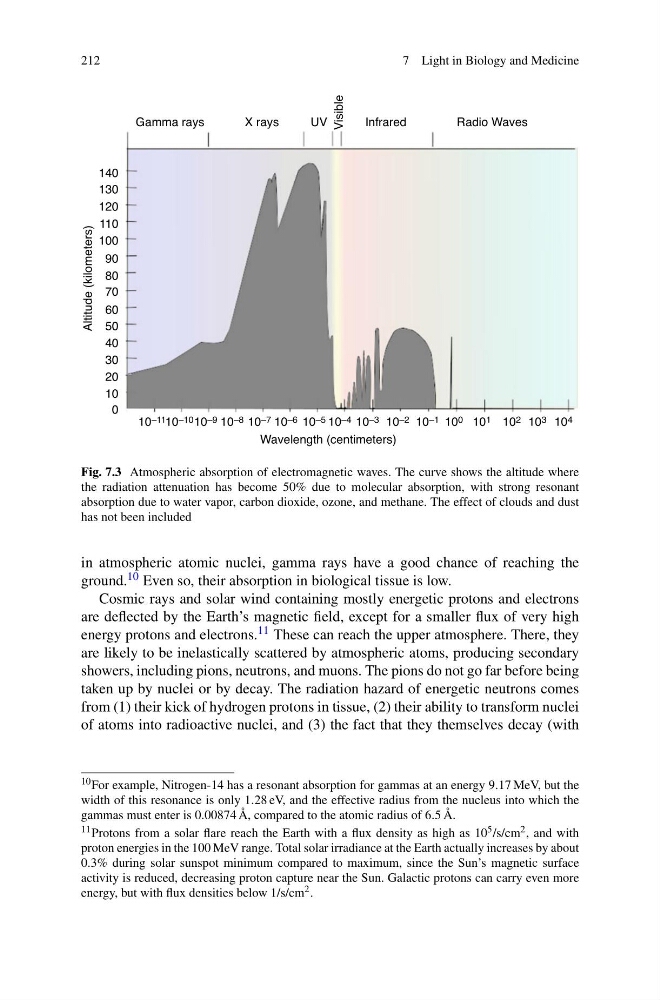
Fig. 7.3 Atmospheric absorption of electromagnetic waves. The curve shows the altitude where
the radiation attenuation has become 50% due to molecular absorption, with strong resonant
absorption due to water vapor, carbon dioxide, ozone, and methane. The effect of clouds and dust
has not been included
in atmospheric atomic nuclei, gamma rays have a good chance of reaching the
ground. 10 Even so, their absorption in biological tissue is low.
Cosmic rays and solar wind containing mostly energetic protons and electrons
are deflected by the Earth’s magnetic field, except for a smaller flux of very high
energy protons and electrons. 11 These can reach the upper atmosphere. There, they
are likely to be inelastically scattered by atmospheric atoms, producing secondary
showers, including pions, neutrons, and muons. The pions do not go far before being
taken up by nuclei or by decay. The radiation hazard of energetic neutrons comes
from (1) their kick of hydrogen protons in tissue, (2) their ability to transform nuclei
of atoms into radioactive nuclei, and (3) the fact that they themselves decay (with
10 For example, Nitrogen-14 has a resonant absorption for gammas at an energy 9.17 MeV, but the
width of this resonance is only 1.28 eV, and the effective radius from the nucleus into which the
gammas must enter is 0.00874 Å, compared to the atomic radius of 6.5 Å.
11 Protons from a solar flare reach the Earth with a flux density as high as 10 5 /s/cm 2 , and with
proton energies in the 100 MeV range. Total solar irradiance at the Earth actually increases by about
0.3% during solar sunspot minimum compared to maximum, since the Sun’s magnetic surface
activity is reduced, decreasing proton capture near the Sun. Galactic protons can carry even more
energy, but with flux densities below 1/s/cm 2 .
7 Light in Biology and Medicine
Gamma rays
X rays
UV
I nfrared
Visible
Radio Waves
140
130
120
110
100
90
80
60
50
40
30
20
10
0
10 –11 10 –10 10 –9 10 –8 10 –7 10 –6 10 –5
Wavelength (centimeters)
Altitude (kilometers)
10 –4 10 –3 10 –2 10 –1 10 0 10 1 10 2 10 3 10 4
70
Fig. 7.3 Atmospheric absorption of electromagnetic waves. The curve shows the altitude where
the radiation attenuation has become 50% due to molecular absorption, with strong resonant
absorption due to water vapor, carbon dioxide, ozone, and methane. The effect of clouds and dust
has not been included
in atmospheric atomic nuclei, gamma rays have a good chance of reaching the
ground. 10 Even so, their absorption in biological tissue is low.
Cosmic rays and solar wind containing mostly energetic protons and electrons
are deflected by the Earth’s magnetic field, except for a smaller flux of very high
energy protons and electrons. 11 These can reach the upper atmosphere. There, they
are likely to be inelastically scattered by atmospheric atoms, producing secondary
showers, including pions, neutrons, and muons. The pions do not go far before being
taken up by nuclei or by decay. The radiation hazard of energetic neutrons comes
from (1) their kick of hydrogen protons in tissue, (2) their ability to transform nuclei
of atoms into radioactive nuclei, and (3) the fact that they themselves decay (with
10 For example, Nitrogen-14 has a resonant absorption for gammas at an energy 9.17 MeV, but the
width of this resonance is only 1.28 eV, and the effective radius from the nucleus into which the
gammas must enter is 0.00874 Å, compared to the atomic radius of 6.5 Å.
11 Protons from a solar flare reach the Earth with a flux density as high as 10 5 /s/cm 2 , and with
proton energies in the 100 MeV range. Total solar irradiance at the Earth actually increases by about
0.3% during solar sunspot minimum compared to maximum, since the Sun’s magnetic surface
activity is reduced, decreasing proton capture near the Sun. Galactic protons can carry even more
energy, but with flux densities below 1/s/cm 2 .