

7.1 Electromagnetic Waves
209
THE ELECTRO MAGNETIC SPECTRUM
Wavelength
Frequency
(Hz)
Microwave Infrared Visible
Ultraviolet
X-Ray Gamma Ray
Radio
10 3
10 –2
10 –5
10 –6
10 –8
10 –10
10 –12
10 4
10 8
10 12
10 16
10 15
10 18
10 20
(metres)
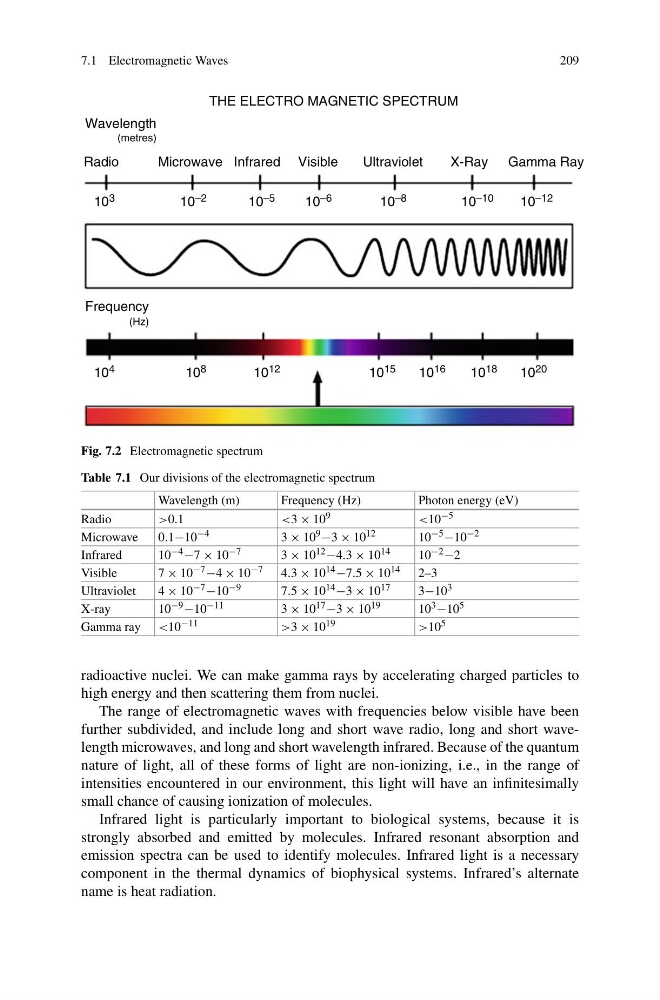
Fig. 7.2 Electromagnetic spectrum
Table 7.1 Our divisions of the electromagnetic spectrum
Wavelength (m)
Frequency (Hz)
Photon energy (eV)
Radio
>0.1
<3 × 10 9
<10 −5
Microwave
0.1−10 −4
3 × 10 9 −3 × 10 12
10 −5 −10 −2
Infrared
10 −4 −7 × 10 −7
3 × 10 12 −4.3 × 10 14
10 −2 −2
Visible
7 × 10 −7 −4 × 10 −7 4.3 × 10 14 −7.5 × 10 14 2–3
Ultraviolet
4 × 10 −7 −10 −9
7.5 × 10 14 −3 × 10 17
3−10 3
X-ray
10 −9 −10 −11
3 × 10 17 −3 × 10 19
10 3 −10 5
Gamma ray <10 −11
>3 × 10 19
>10 5
radioactive nuclei. We can make gamma rays by accelerating charged particles to
high energy and then scattering them from nuclei.
The range of electromagnetic waves with frequencies below visible have been
further subdivided, and include long and short wave radio, long and short wavelength microwaves, and long and short wavelength infrared. Because of the quantum
nature of light, all of these forms of light are non-ionizing, i.e., in the range of
intensities encountered in our environment, this light will have an infinitesimally
small chance of causing ionization of molecules.
Infrared light is particularly important to biological systems, because it is
strongly absorbed and emitted by molecules. Infrared resonant absorption and
emission spectra can be used to identify molecules. Infrared light is a necessary
component in the thermal dynamics of biophysical systems. Infrared’s alternate
name is heat radiation.
209
THE ELECTRO MAGNETIC SPECTRUM
Wavelength
Frequency
(Hz)
Microwave Infrared Visible
Ultraviolet
X-Ray Gamma Ray
Radio
10 3
10 –2
10 –5
10 –6
10 –8
10 –10
10 –12
10 4
10 8
10 12
10 16
10 15
10 18
10 20
(metres)
Fig. 7.2 Electromagnetic spectrum
Table 7.1 Our divisions of the electromagnetic spectrum
Wavelength (m)
Frequency (Hz)
Photon energy (eV)
Radio
>0.1
<3 × 10 9
<10 −5
Microwave
0.1−10 −4
3 × 10 9 −3 × 10 12
10 −5 −10 −2
Infrared
10 −4 −7 × 10 −7
3 × 10 12 −4.3 × 10 14
10 −2 −2
Visible
7 × 10 −7 −4 × 10 −7 4.3 × 10 14 −7.5 × 10 14 2–3
Ultraviolet
4 × 10 −7 −10 −9
7.5 × 10 14 −3 × 10 17
3−10 3
X-ray
10 −9 −10 −11
3 × 10 17 −3 × 10 19
10 3 −10 5
Gamma ray <10 −11
>3 × 10 19
>10 5
radioactive nuclei. We can make gamma rays by accelerating charged particles to
high energy and then scattering them from nuclei.
The range of electromagnetic waves with frequencies below visible have been
further subdivided, and include long and short wave radio, long and short wavelength microwaves, and long and short wavelength infrared. Because of the quantum
nature of light, all of these forms of light are non-ionizing, i.e., in the range of
intensities encountered in our environment, this light will have an infinitesimally
small chance of causing ionization of molecules.
Infrared light is particularly important to biological systems, because it is
strongly absorbed and emitted by molecules. Infrared resonant absorption and
emission spectra can be used to identify molecules. Infrared light is a necessary
component in the thermal dynamics of biophysical systems. Infrared’s alternate
name is heat radiation.