

7.1 Electromagnetic Waves
207
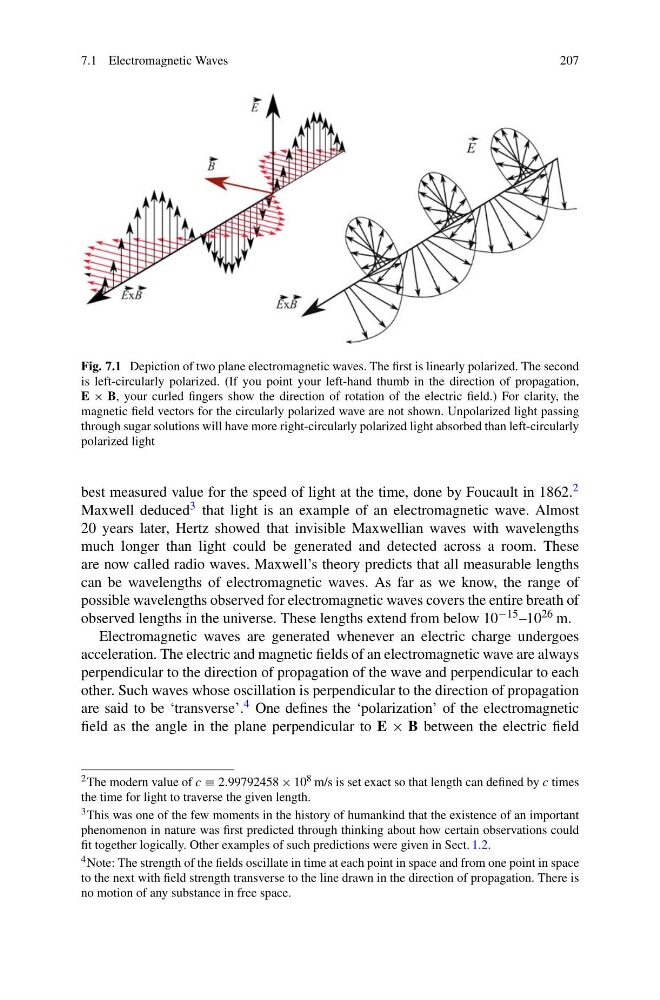
Fig. 7.1 Depiction of two plane electromagnetic waves. The first is linearly polarized. The second
is left-circularly polarized. (If you point your left-hand thumb in the direction of propagation,
E × B, your curled fingers show the direction of rotation of the electric field.) For clarity, the
magnetic field vectors for the circularly polarized wave are not shown. Unpolarized light passing
through sugar solutions will have more right-circularly polarized light absorbed than left-circularly
polarized light
best measured value for the speed of light at the time, done by Foucault in 1862. 2
Maxwell deduced 3 that light is an example of an electromagnetic wave. Almost
20 years later, Hertz showed that invisible Maxwellian waves with wavelengths
much longer than light could be generated and detected across a room. These
are now called radio waves. Maxwell’s theory predicts that all measurable lengths
can be wavelengths of electromagnetic waves. As far as we know, the range of
possible wavelengths observed for electromagnetic waves covers the entire breath of
observed lengths in the universe. These lengths extend from below 10 −15 –10 26 m.
Electromagnetic waves are generated whenever an electric charge undergoes
acceleration. The electric and magnetic fields of an electromagnetic wave are always
perpendicular to the direction of propagation of the wave and perpendicular to each
other. Such waves whose oscillation is perpendicular to the direction of propagation
are said to be ‘transverse’. 4 One defines the ‘polarization’ of the electromagnetic
field as the angle in the plane perpendicular to E × B between the electric field
2 The modern value of c ≡ 2.99792458 × 10 8 m/s is set exact so that length can defined by c times
the time for light to traverse the given length.
3 This was one of the few moments in the history of humankind that the existence of an important
phenomenon in nature was first predicted through thinking about how certain observations could
fit together logically. Other examples of such predictions were given in Sect. 1.2.
4 Note: The strength of the fields oscillate in time at each point in space and from one point in space
to the next with field strength transverse to the line drawn in the direction of propagation. There is
no motion of any substance in free space.
207
Fig. 7.1 Depiction of two plane electromagnetic waves. The first is linearly polarized. The second
is left-circularly polarized. (If you point your left-hand thumb in the direction of propagation,
E × B, your curled fingers show the direction of rotation of the electric field.) For clarity, the
magnetic field vectors for the circularly polarized wave are not shown. Unpolarized light passing
through sugar solutions will have more right-circularly polarized light absorbed than left-circularly
polarized light
best measured value for the speed of light at the time, done by Foucault in 1862. 2
Maxwell deduced 3 that light is an example of an electromagnetic wave. Almost
20 years later, Hertz showed that invisible Maxwellian waves with wavelengths
much longer than light could be generated and detected across a room. These
are now called radio waves. Maxwell’s theory predicts that all measurable lengths
can be wavelengths of electromagnetic waves. As far as we know, the range of
possible wavelengths observed for electromagnetic waves covers the entire breath of
observed lengths in the universe. These lengths extend from below 10 −15 –10 26 m.
Electromagnetic waves are generated whenever an electric charge undergoes
acceleration. The electric and magnetic fields of an electromagnetic wave are always
perpendicular to the direction of propagation of the wave and perpendicular to each
other. Such waves whose oscillation is perpendicular to the direction of propagation
are said to be ‘transverse’. 4 One defines the ‘polarization’ of the electromagnetic
field as the angle in the plane perpendicular to E × B between the electric field
2 The modern value of c ≡ 2.99792458 × 10 8 m/s is set exact so that length can defined by c times
the time for light to traverse the given length.
3 This was one of the few moments in the history of humankind that the existence of an important
phenomenon in nature was first predicted through thinking about how certain observations could
fit together logically. Other examples of such predictions were given in Sect. 1.2.
4 Note: The strength of the fields oscillate in time at each point in space and from one point in space
to the next with field strength transverse to the line drawn in the direction of propagation. There is
no motion of any substance in free space.