

Problems
203
• Ferromagnetic materials, such as implants or accidental inclusions, could be
rotated and, in a spatial gradient magnetic field, could be dragged through tissue.
• Ferrous and non-ferrous metals in the body can be heated by eddy currents
when the magnetic field changes in time and from radio waves for field gradient
induction.
• Rapid changes in the strength of the magnetic field can induce electric fields
capable of disrupting nerve action. Near the limits of rates, patients can feel
tingles, vertigo, metallic tastes, cardiac stress, and even pain from this effect.
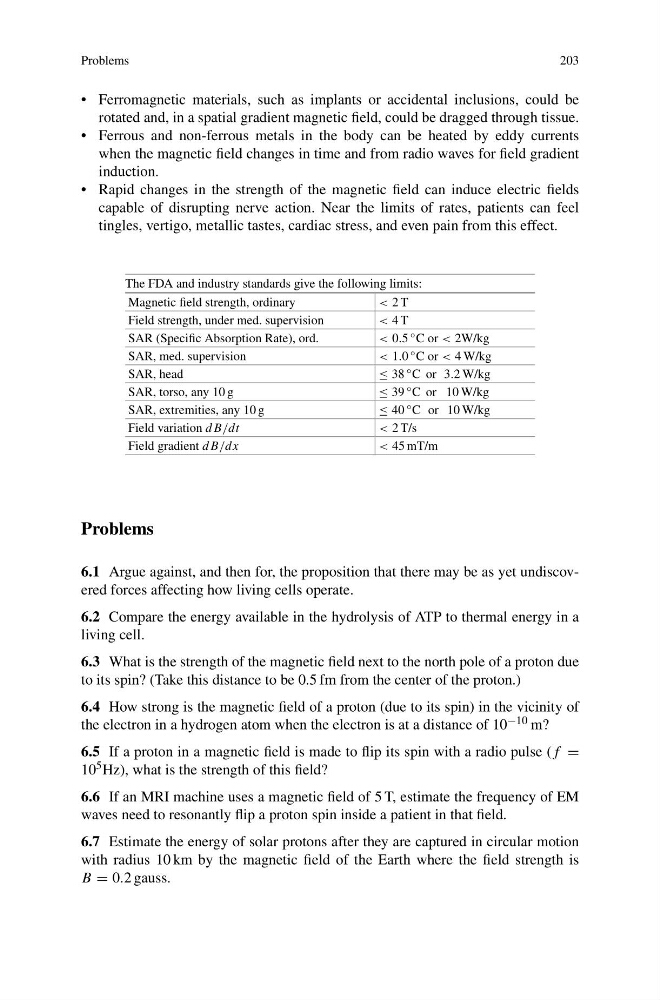
The FDA and industry standards give the following limits:
Magnetic field strength, ordinary
< 2 T
Field strength, under med. supervision
< 4 T
SAR (Specific Absorption Rate), ord.
< 0.5 ◦ C or < 2W/kg
SAR, med. supervision
< 1.0 ◦ C or < 4 W/kg
SAR, head
≤ 38 ◦ C or 3.2 W/kg
SAR, torso, any 10 g
≤ 39 ◦ C or 10 W/kg
SAR, extremities, any 10 g
≤ 40 ◦ C or 10W/kg
Field variation dB/dt
< 2 T/s
Field gradient dB/dx
< 45 mT/m
Problems
6.1 Argue against, and then for, the proposition that there may be as yet undiscovered forces affecting how living cells operate.
6.2 Compare the energy available in the hydrolysis of ATP to thermal energy in a
living cell.
6.3 What is the strength of the magnetic field next to the north pole of a proton due
to its spin? (Take this distance to be 0.5 fm from the center of the proton.)
6.4 How strong is the magnetic field of a proton (due to its spin) in the vicinity of
the electron in a hydrogen atom when the electron is at a distance of 10 −10 m?
6.5 If a proton in a magnetic field is made to flip its spin with a radio pulse (f =
10 5 Hz), what is the strength of this field?
6.6 If an MRI machine uses a magnetic field of 5 T, estimate the frequency of EM
waves need to resonantly flip a proton spin inside a patient in that field.
6.7 Estimate the energy of solar protons after they are captured in circular motion
with radius 10 km by the magnetic field of the Earth where the field strength is
B = 0.2 gauss.
203
• Ferromagnetic materials, such as implants or accidental inclusions, could be
rotated and, in a spatial gradient magnetic field, could be dragged through tissue.
• Ferrous and non-ferrous metals in the body can be heated by eddy currents
when the magnetic field changes in time and from radio waves for field gradient
induction.
• Rapid changes in the strength of the magnetic field can induce electric fields
capable of disrupting nerve action. Near the limits of rates, patients can feel
tingles, vertigo, metallic tastes, cardiac stress, and even pain from this effect.
The FDA and industry standards give the following limits:
Magnetic field strength, ordinary
< 2 T
Field strength, under med. supervision
< 4 T
SAR (Specific Absorption Rate), ord.
< 0.5 ◦ C or < 2W/kg
SAR, med. supervision
< 1.0 ◦ C or < 4 W/kg
SAR, head
≤ 38 ◦ C or 3.2 W/kg
SAR, torso, any 10 g
≤ 39 ◦ C or 10 W/kg
SAR, extremities, any 10 g
≤ 40 ◦ C or 10W/kg
Field variation dB/dt
< 2 T/s
Field gradient dB/dx
< 45 mT/m
Problems
6.1 Argue against, and then for, the proposition that there may be as yet undiscovered forces affecting how living cells operate.
6.2 Compare the energy available in the hydrolysis of ATP to thermal energy in a
living cell.
6.3 What is the strength of the magnetic field next to the north pole of a proton due
to its spin? (Take this distance to be 0.5 fm from the center of the proton.)
6.4 How strong is the magnetic field of a proton (due to its spin) in the vicinity of
the electron in a hydrogen atom when the electron is at a distance of 10 −10 m?
6.5 If a proton in a magnetic field is made to flip its spin with a radio pulse (f =
10 5 Hz), what is the strength of this field?
6.6 If an MRI machine uses a magnetic field of 5 T, estimate the frequency of EM
waves need to resonantly flip a proton spin inside a patient in that field.
6.7 Estimate the energy of solar protons after they are captured in circular motion
with radius 10 km by the magnetic field of the Earth where the field strength is
B = 0.2 gauss.